
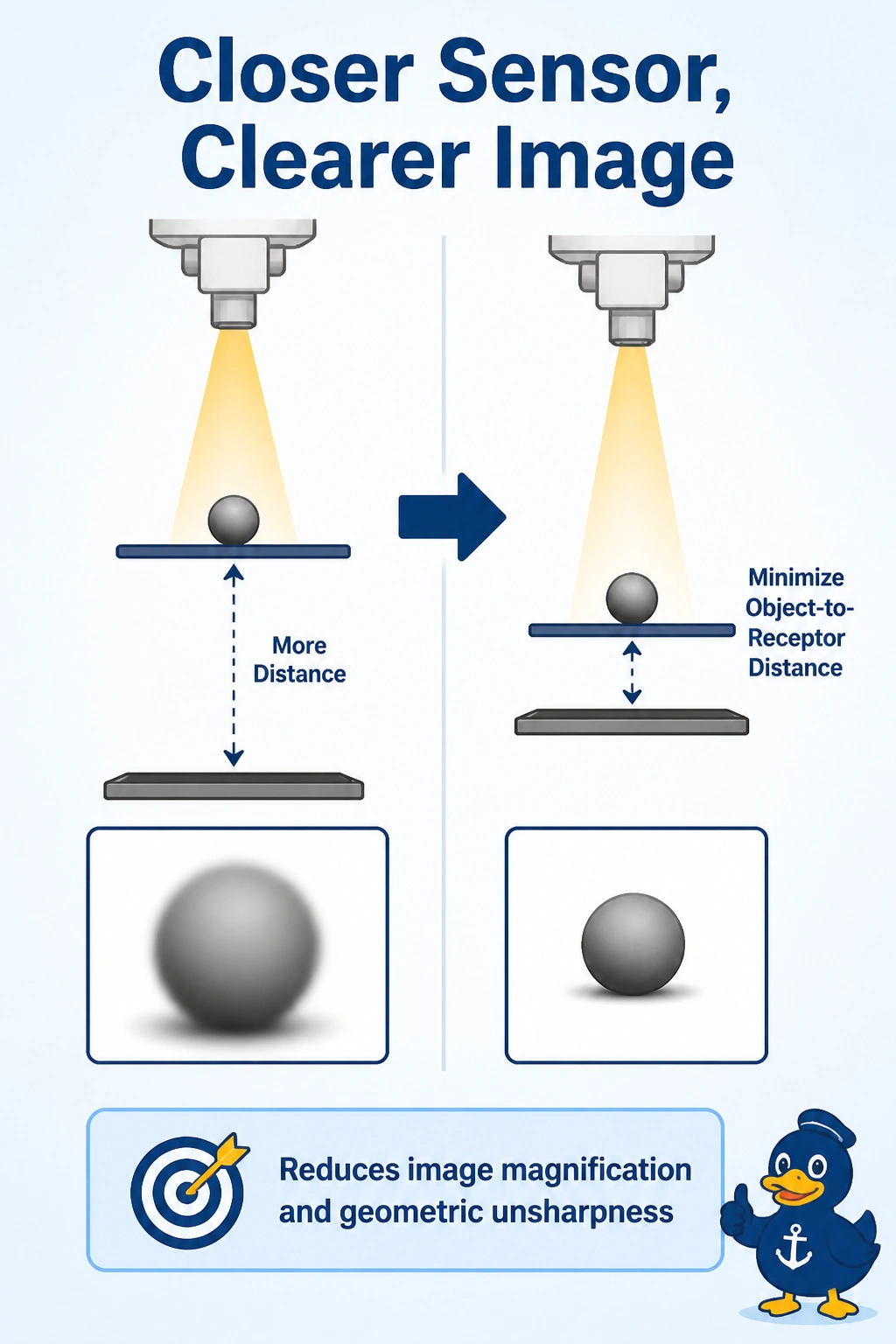
While setting up a digital periapical radiograph of a mandibular premolar, a dental assistant positions the sensor as close to the lingual surface of the tooth as the patient's anatomy allows. What is the primary geometric benefit of minimizing this object-to-receptor distance?
Select an answer to reveal the explanation.
Short Explanation
Think about casting a shadow on a wall—the closer your hand is to the wall, the crisper and truer to size the shadow looks. The trap is confusing receptor closeness with beam penetration, which is controlled by kilovoltage instead.
Full Explanation
Positioning the digital sensor as close as possible to the tooth minimizes the object-to-receptor distance, so It reduces image magnification and geometric unsharpness, producing sharper anatomical borders and more accurate root proportions. It increases X-ray beam penetration through dense bone is incorrect because beam penetrating power depends on kilovoltage peak (kVp) at the X-ray tube, not on where the sensor sits inside the mouth. It eliminates the need for horizontal beam alignment is false because the central ray must still be directed perpendicular to the interproximal contacts to avoid horizontal overlap regardless of how close the sensor is to the teeth. It compensates for a short position-indicating device is misleading because a short source-to-receptor distance still increases beam divergence and magnification even when the sensor touches the tooth, which is why the paralleling technique pairs minimal object-to-receptor distance with a longer PID. As a technique caveat, when tori or a shallow palate prevent placing the sensor directly against the teeth, placing it slightly farther away requires a parallel alignment and longer PID to limit distortion. For an operational check, seat the bite block firmly against the tooth's biting surface while keeping the sensor parallel and snug without causing soft-tissue pain.
Prefer to study offline? Printable PDF study book + test engine ($7.50, unofficial). These questions stay free here.