
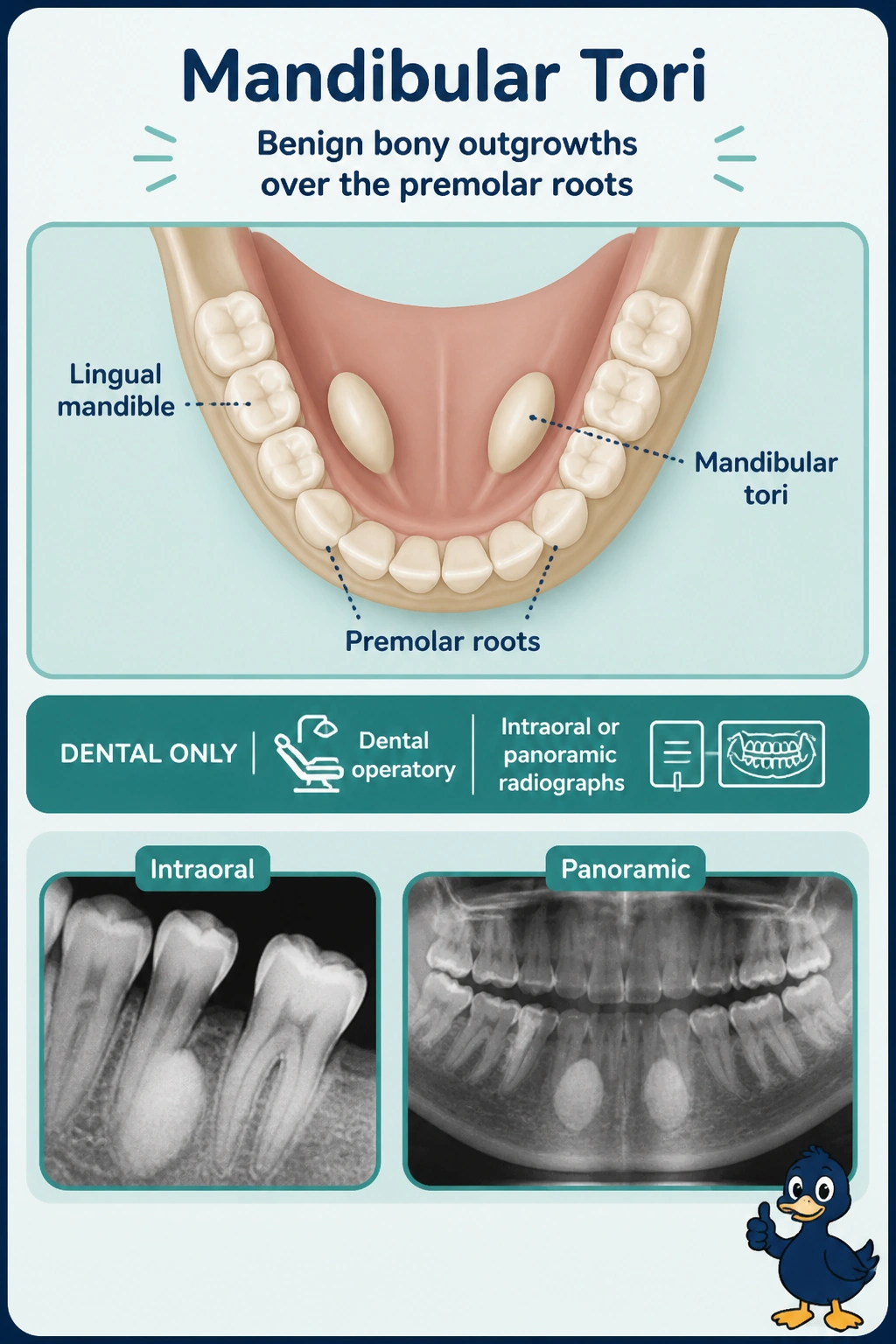
While reviewing a digital periapical radiograph of asymptomatic, vital mandibular premolars, a clinician observes two dense, well-defined, homogeneous radiopaque masses superimposed over the roots, and clinical exam reveals hard, smooth bony nodules on the lingual mandible. What do these radiographic findings represent?
Select an answer to reveal the explanation.
Short Explanation
Think of mandibular tori as extra bone cushions on the inside of the jaw—when you expose a periapical image, they show up as bright, smooth shadows right over the premolar roots. The trap is mistaking these harmless bony growths on your patient's radiograph for periapical pathosis or retained root tips.
Full Explanation
Mandibular tori (torus mandibularis) are benign, slow-growing cortical bone exostoses located along the lingual aspect of the mandible, most commonly in the canine and premolar region and frequently bilateral. Because dense cortical bone attenuates X-rays strongly, they appear as Mandibular tori projecting as benign bony outgrowths over the premolar roots, while the underlying teeth remain vital with an intact lamina dura. Choosing Condensing osteitis resulting from chronic pulpal inflammation around the premolar root apices is incorrect because condensing osteitis is a localized periapical reaction to a nonvital or inflamed tooth rather than bilateral, asymptomatic lingual nodules. Choosing Subgingival calculus deposits projecting horizontally from the proximal root surfaces is incorrect because calculus appears as small, pointed radiopaque spurs along the proximal root surfaces at the alveolar crest, not broad, smooth masses over the roots. Choosing Retained primary root tips embedded in the alveolar bone between the premolar roots is ruled out because root fragments display a pulp canal space and periodontal ligament outline, whereas tori are uniformly dense bone. As a caveat, tori can obscure root apices, so check clinical palpation before diagnosing. As an operational check, correlate radiographic radiopacities with intraoral lingual palpation and pulp vitality testing before planning treatment.
Prefer to study offline? Printable PDF study book + test engine ($7.50, unofficial). These questions stay free here.