
While reviewing a digital periapical radiograph of an asymptomatic maxillary central incisor with a history of childhood trauma and crown discoloration, a clinician notes that the coronal pulp chamber and root canal space are completely absent and replaced by uniform dentin-like radiopacity, while the lamina dura remains intact. What does this finding represent?
Select an answer to reveal the explanation.
Short Explanation
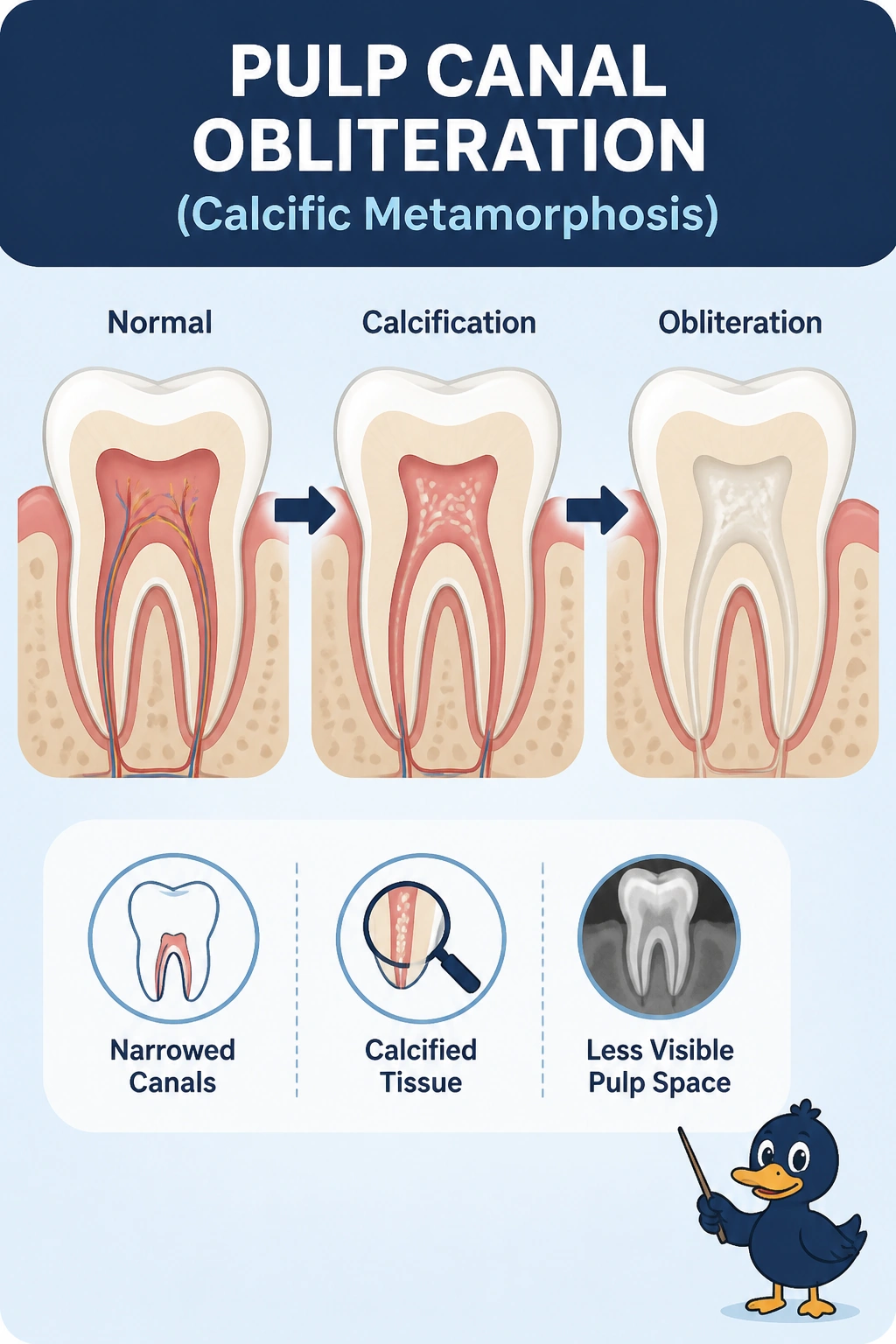
After a bump to a front tooth, the pulp can go into overdrive laying down hard dentin until the entire canal disappears on the X-ray! When you see a once-dark pulp chamber and canal completely filled in with dentin-like radiopacity, that is pulp canal obliteration. Don't mistake it for a pulp stone, which shows up as a discrete round pebble inside an otherwise visible chamber.
Full Explanation
Pulp canal obliteration (calcific metamorphosis) is a pulpal response to dental trauma in which odontoblasts rapidly deposit hard tissue along the canal walls, progressively narrowing and eventually obliterating the radiolucent pulp chamber and root canal space on a radiograph. Because the surrounding dentin and bone remain normal, the periodontal ligament space and lamina dura stay intact unless secondary necrosis develops. Internal root resorption within the middle third produces the opposite radiographic appearance: a smooth, round-to-oval radiolucent enlargement ballooning outward from the root canal space. Focal periapical condensing osteitis at the apex appears as a localized radiopaque mass in the periapical bone surrounding the root tip rather than inside the tooth's pulp space, and it is associated with pulpal inflammation. A radiopaque pulp stone floating inside the chamber appears as one or more distinct, well-defined calcified masses surrounded by a still-visible radiolucent pulp chamber rather than complete obliteration of the entire canal. Caveat: teeth with calcific metamorphosis often show yellowish crown discoloration and may not respond reliably to routine thermal pulp testing. Operational check: compare the suspect tooth's canal width against the adjacent normal incisors and document any periapical changes over time.
Prefer to study offline? Printable PDF study book + test engine ($7.50, unofficial). These questions stay free here.