
While reviewing a digital cone-beam computed tomography (CBCT) scan of a patient's mandible, a clinician observes bright radiating streaks and adjacent dark bands fanning outward from a titanium implant and large amalgam crowns, obscuring nearby bone trabeculae. What is the most likely cause of this image artifact?
Select an answer to reveal the explanation.
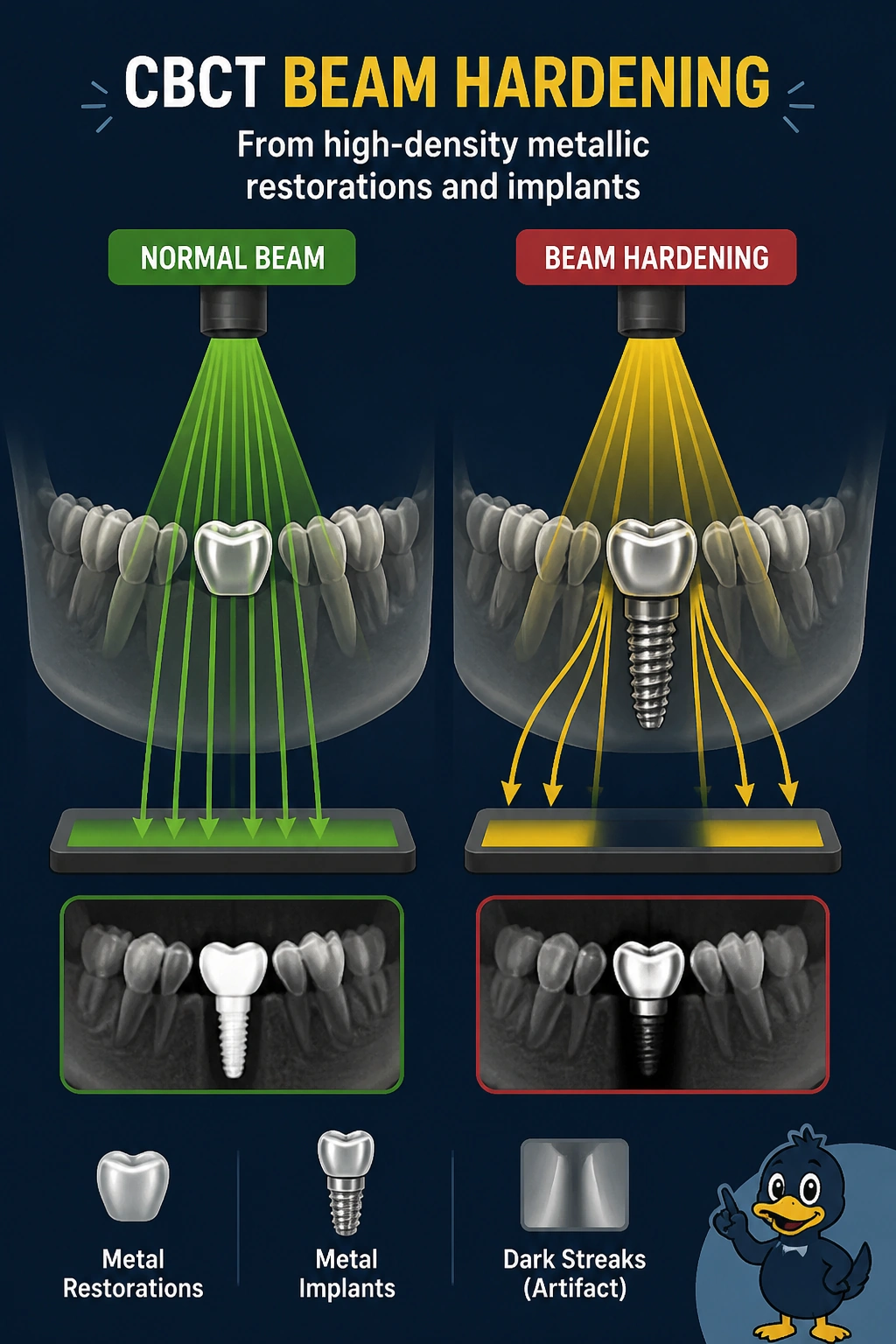
Short Explanation
When a CBCT X-ray beam hits dense metal like an implant or amalgam crown, it acts like sunlight hitting a prism—the low-energy photons get stripped out, leaving bright starbursts and dark shadows behind. You are looking at beam hardening, the classic metal streak artifact in 3D dental imaging. Don't blame patient movement, which blurs the entire jaw rather than radiating streaks from metal.
Full Explanation
In cone-beam computed tomography (CBCT), a polychromatic X-ray beam passes through tissues of varying density. Beam hardening from high-density metallic restorations and implants occurs when dense metals such as titanium, amalgam, or metal crowns preferentially absorb lower-energy X-ray photons, increasing the mean energy of the remaining beam and causing reconstruction errors that appear as bright starburst streaks and dark bands adjacent to the metal. Patient swallowing during the scan causing blurred double cortical borders produces generalized motion unsharpness or duplicated anatomical outlines across the entire volume rather than streaks radiating specifically from metal objects. Inadequate sensor barrier sealing allowing ambient room light in applies to intraoral photostimulable phosphor (PSP) plates exposed to room light before scanning, not CBCT flat-panel detectors. Setting the field of view too small to capture the mandibular canal crops peripheral anatomy outside the reconstructed volume without generating metallic streak artifacts. Caveat: metal artifacts can mimic or mask root fractures and peri-implant bone defects, making clinical correlation essential. Operational check: ask the patient to remove all removable metal appliances, jewelry, and eyeglasses before positioning, and use metal-artifact-reduction reconstruction modes only as an adjunct when evaluating areas near dense restorations.
Prefer to study offline? Printable PDF study book + test engine ($7.50, unofficial). These questions stay free here.