
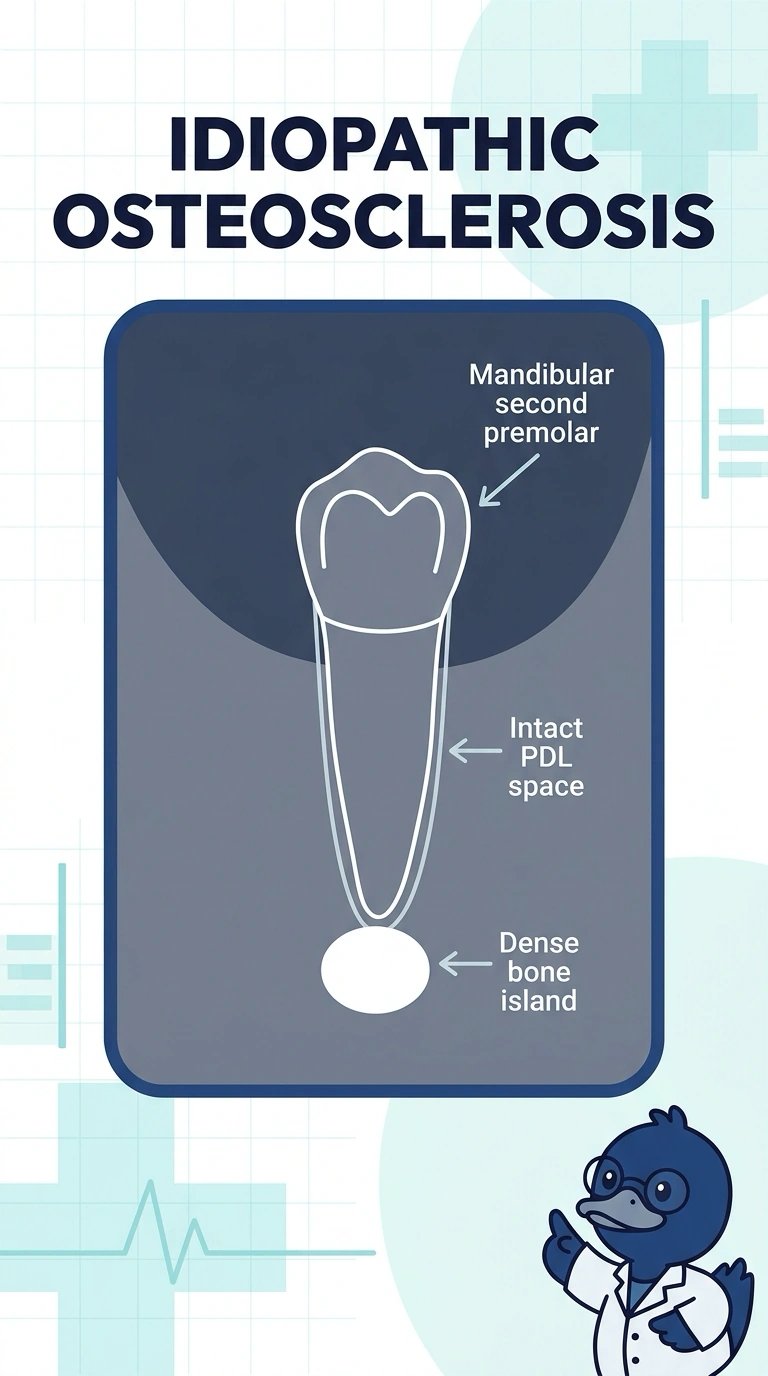
While reviewing a digital periapical radiograph of an asymptomatic, vital mandibular second premolar with no caries or restorations, a clinician observes a well-defined, localized radiopaque mass of dense bone near the root apex with an intact periodontal ligament space. Which condition does this finding most likely represent?
Select an answer to reveal the explanation.
Short Explanation
A dense bone island is basically a harmless knot of extra cortical bone sitting quietly in the jaw, just like a dense swirl in a piece of timber. When you see a localized radiopacity next to a completely healthy, vital tooth with an intact periodontal ligament space, think idiopathic osteosclerosis. The classic trap is confusing it with condensing osteitis, which always accompanies a diseased or nonvital tooth.
Full Explanation
Idiopathic osteosclerosis (dense bone island) is a localized, non-inflammatory area of increased bone density that develops spontaneously within cancellous bone, most commonly in the mandibular premolar-molar region. Because it is not caused by infection or trauma, the adjacent tooth tests vital, has no deep caries or restorations, and shows a normal, intact periodontal ligament space and lamina dura. Condensing osteitis secondary to pulpal inflammation looks similar radiographically, but it forms as a reactive bone response to low-grade pulpal or periapical inflammation and is associated with a nonvital, deeply restored, or carious tooth. Hypercementosis enveloping the apical third of the root produces a bulbous, club-shaped enlargement of the root surface itself rather than a separate bone mass, while still maintaining a surrounding periodontal ligament space. A radiopaque submandibular sialolith superimposed over bone typically projects inferior to the mandibular body or in the floor of the mouth and is often accompanied by mealtime salivary gland swelling. Caveat: because idiopathic osteosclerosis is benign and self-limiting, it requires no endodontic or surgical treatment once confirmed. Operational check: always correlate localized periapical radiopacities with clinical pulp vitality testing and caries history before diagnosing inflammatory bone disease.
Prefer to study offline? Printable PDF study book + test engine ($7.50, unofficial). These questions stay free here.