
A clinic transitions from photostimulable phosphor (PSP) plates to rigid wired CMOS digital sensors, and a dental assistant notices that the distal surfaces of second molars are repeatedly clipped even though the outer plastic housing appears properly positioned. Why does this occur?
Select an answer to reveal the explanation.
Short Explanation
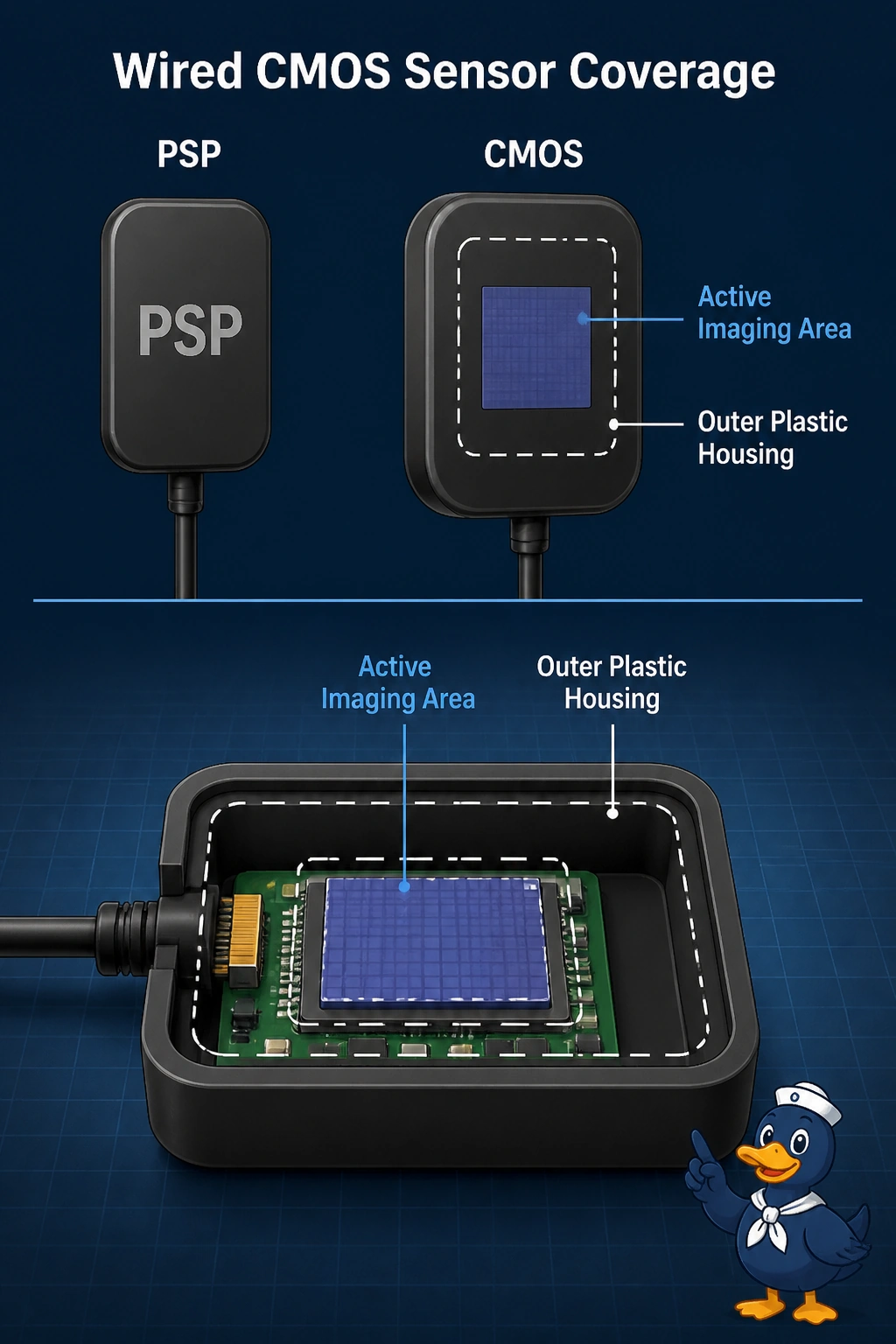
Think of a wired digital sensor like a framed photograph: the outer plastic border is much wider than the actual picture inside. Unlike thin PSP plates, whose active surface reaches nearly to the edge, a CMOS sensor has a non-imaging border, so you need to center the active area rather than the casing. You can rule out dynamic range, the radiolucent barrier sleeve, and PID length as causes of this clipping.
Full Explanation
The clipping occurs because the active imaging area inside a wired CMOS sensor sits well inside its thick outer plastic housing. Protective casing and electronic circuitry around the perimeter create a non-imaging border that can be several millimeters wide, whereas a photostimulable phosphor plate records nearly to its physical edge. When you align the outer plastic edge instead of the inner active area, the distal molar surface can fall outside the sensitive matrix. A narrower dynamic range does not explain the clipping: dynamic range affects grayscale latitude and contrast, not the physical field of view. A plastic sensor barrier sleeve does not cause it either, because thin disposable plastic barriers are radiolucent and do not attenuate diagnostic X-ray photons. A shorter PID also will not capture more of the tooth by changing the sensor’s internal dimensions; PID length controls beam divergence and magnification. One exam caveat is that rigid sensor housings can feel bulkier in shallow or narrow arches, tempting patients to push the sensor forward. As a practical check, inspect the manufacturer markings for the active-area boundary and verify on the monitor that the distal surface of the second molar is captured before dismissing the patient.
Prefer to study offline? Printable PDF study book + test engine ($7.50, unofficial). These questions stay free here.