
When arranging a digital full-mouth radiographic series in the imaging software for the dentist's clinical review, how should the images be oriented according to the ADA-recommended labial mounting method?
Select an answer to reveal the explanation.
Short Explanation
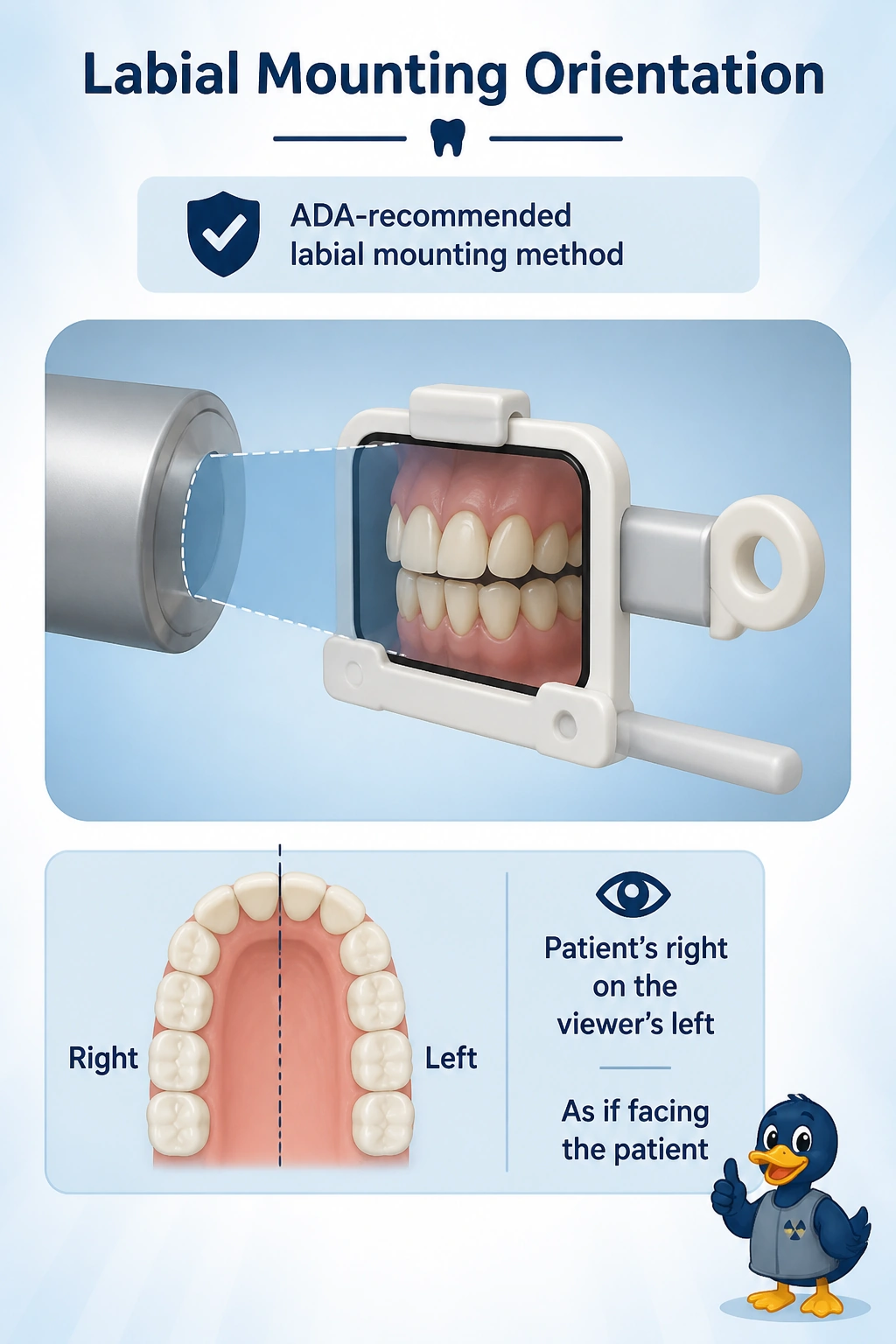
Picture yourself sitting face-to-face across from your patient in the dental chair—their right cheek sits directly across from your left hand. Labial mounting follows that exact perspective so the dentist's clinical exam matches the screen at a glance. The classic trap is flipping to lingual mounting, which reverses left and right as if viewing from behind the tongue.
Full Explanation
With the patient's right side on the viewer's left, as if facing the patient is the American Dental Association standard for labial mounting. This perspective aligns anatomical landmarks—such as the maxillary sinus floor, curve of Spee, and molar root inclination—directly with what the clinician sees during an intraoral examination, reducing wrong-side charting errors. With the patient's right side on the viewer's right, as if standing behind the patient describes lingual mounting, which is discouraged because it reverses right-left orientation relative to standard dental charting. With maxillary images along the bottom row and mandibular images along the top row describes an inverted arch layout that flips upper and lower anatomy, making bone levels harder to interpret. With anterior teeth on the outer edges and posterior molars centered in the template describes a reversed midline-to-distal order that breaks natural arch progression. Caveat: digital imaging software relies on sensor orientation and manual template placement, so an image can still appear mirrored if a receptor was rotated or placed into the wrong slot during capture. Operational check: before saving the series, confirm that the occlusal plane curves slightly upward toward the distal molars and that each arch matches the patient's charted restorations.
Prefer to study offline? Printable PDF study book + test engine ($7.50, unofficial). These questions stay free here.