
While reviewing a digital periapical radiograph of a maxillary central incisor taken with the bisecting-angle technique, you notice that the tooth roots appear abnormally long and stretched compared with the actual tooth length. How should you adjust the vertical angulation for the retake?
Select an answer to reveal the explanation.
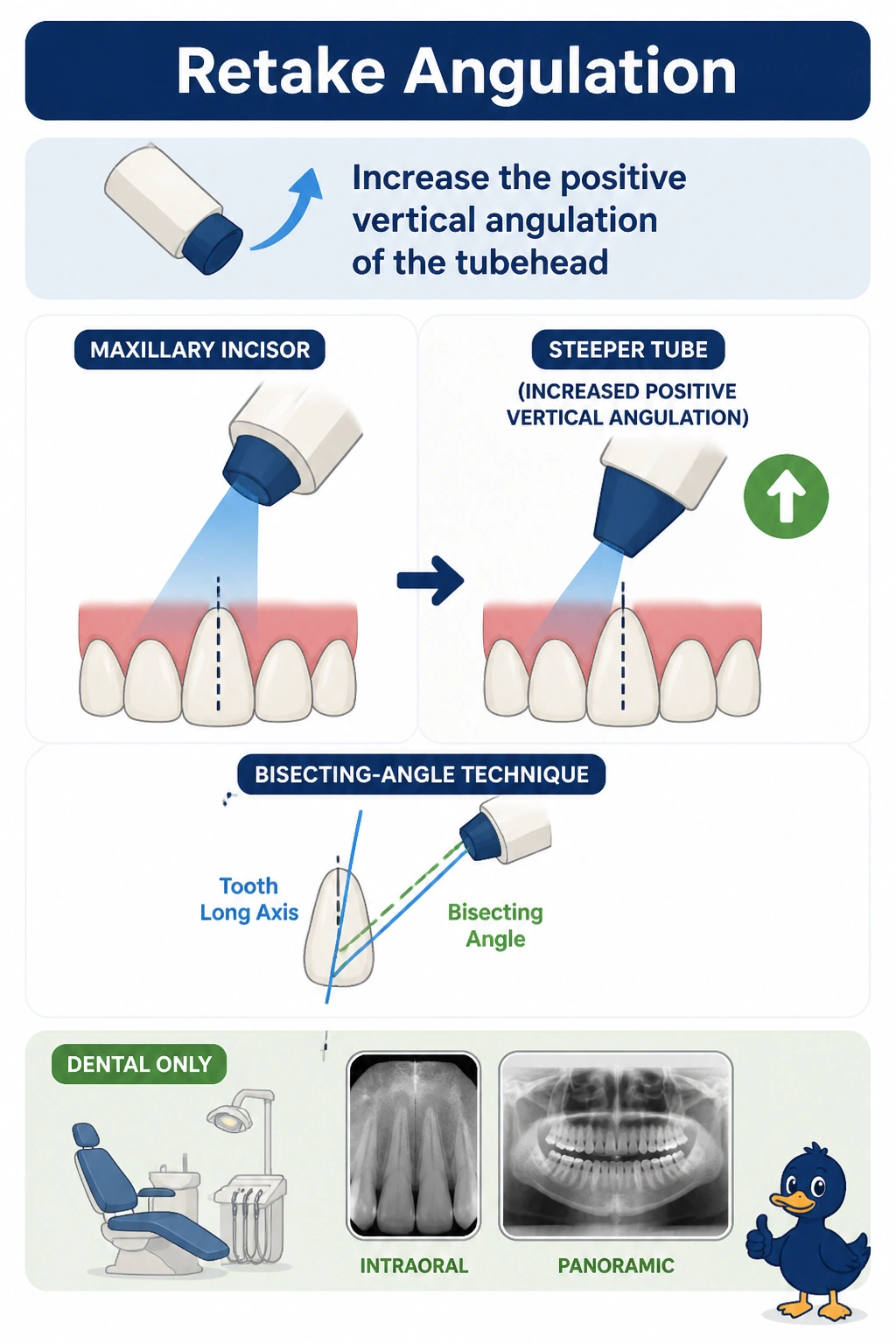
Short Explanation
Think of a shadow on a sidewalk at sunset—when the sun is too low, your shadow stretches way out across the pavement. The trap is backing off the vertical angle when you actually need to steepen it. When a bisecting-angle image shows elongated roots, you must increase the vertical angulation to bring that shadow back to true length.
Full Explanation
Elongation occurs in the bisecting-angle technique when the vertical angulation is too shallow, so you must Increase the positive vertical angulation of the tubehead to direct the central ray perpendicular to the imaginary bisector between the tooth and the receptor. Choosing to Decrease the positive vertical angulation of the tubehead makes the beam even flatter and worsens elongation, whereas excessive angulation causes foreshortening. Choosing to Shift the horizontal angulation mesially toward the midline changes the side-to-side projection and causes proximal overlap rather than correcting vertical length distortion. Choosing to Move the position-indicating device farther from the patient's face reduces magnification slightly and lowers beam intensity at the receptor, but it does not fix angular elongation. Caveat: if the patient's head tilts backward during placement, the effective vertical angle decreases even when the dial looks correct. Operational check: re-seat the receptor, confirm the occlusal plane is parallel to the floor, and add positive vertical angulation before re-exposing.
Prefer to study offline? Printable PDF study book + test engine ($7.50, unofficial). These questions stay free here.