
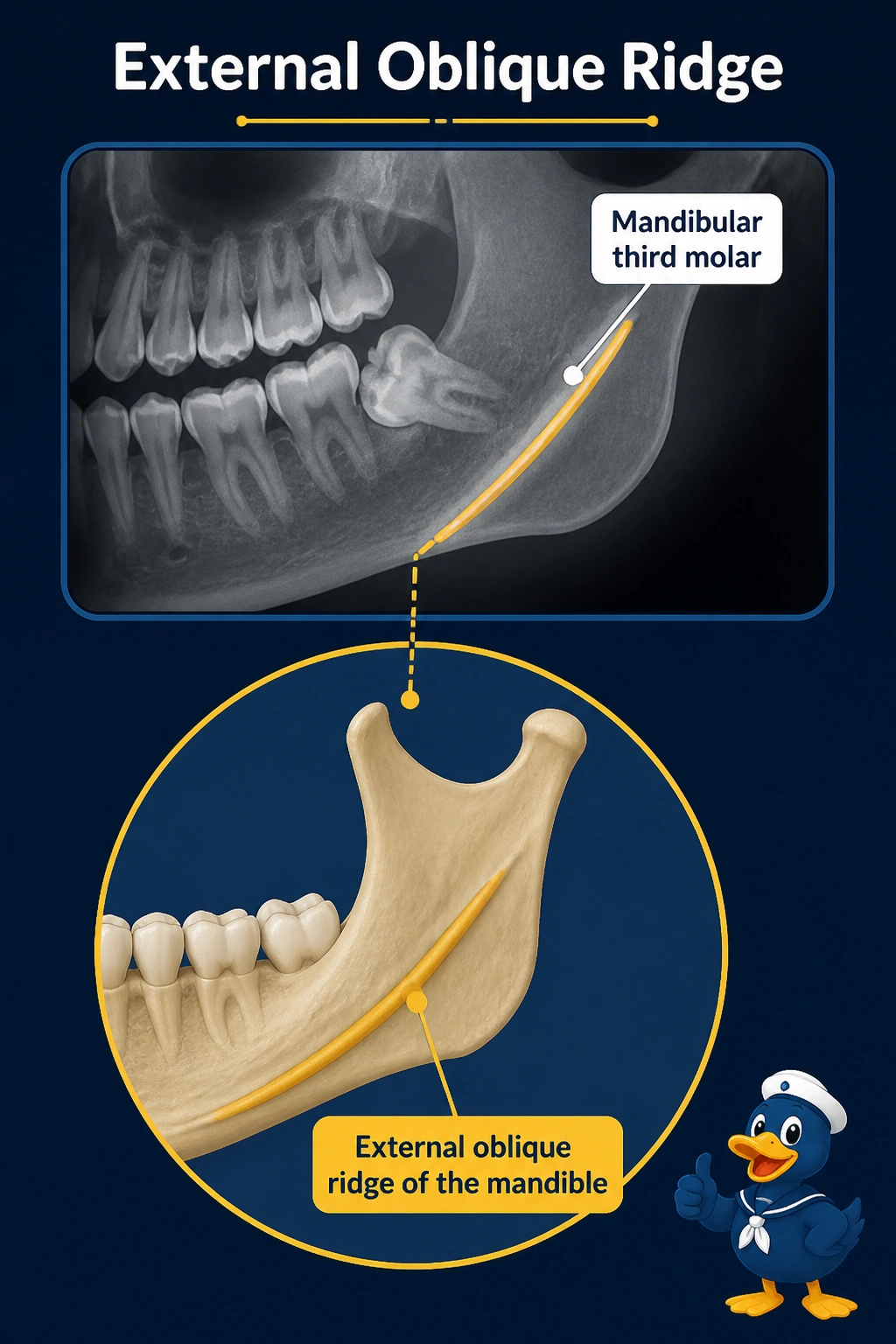
While reviewing a digital periapical radiograph of a mandibular third molar region, a clinician observes a dense radiopaque band sloping downward and forward from the anterior border of the ramus across the molar roots. Which normal anatomical landmark does this structure represent?
Select an answer to reveal the explanation.
Short Explanation
When you see a bright white ridge sweeping down from the ramus across the mandibular molars, you are looking at the mandible’s outer buttress, the external oblique ridge. You can distinguish it from the lower cortical plate and the mandibular canal by its diagonal course across the molar roots. Trace it back toward the anterior border of the ramus to recognize normal bone rather than pathology.
Full Explanation
On a mandibular molar periapical radiograph, cortical bone ridges appear distinctly radiopaque because their dense mineral content absorbs more X-ray photons than surrounding trabecular bone. The external oblique ridge is a prominent cortical ridge on the outer surface of the mandibular body; it appears as a dense white band sloping downward and forward from the anterior border of the ramus, often crossing the molar roots. The inferior border of the mandible is the lower cortical plate, seen much lower at the jaw’s bottom edge rather than sweeping diagonally across the molar roots. The radiopaque cortical wall of the mandibular canal appears as two thin parallel white lines bordering a radiolucent tube inferior to the molar apices, not as one broad diagonal ridge. The mental ridge extends toward the anterior midline in the mandibular premolar-to-incisor region, not the third molar area. As an exam caveat, radiographic projection can make these radiopaque structures overlap nearby anatomy, so density alone is not enough to identify the ridge. Confirm the external oblique ridge by tracing its course continuously upward into the anterior border of the ramus.
Prefer to study offline? Printable PDF study book + test engine ($7.50, unofficial). These questions stay free here.