
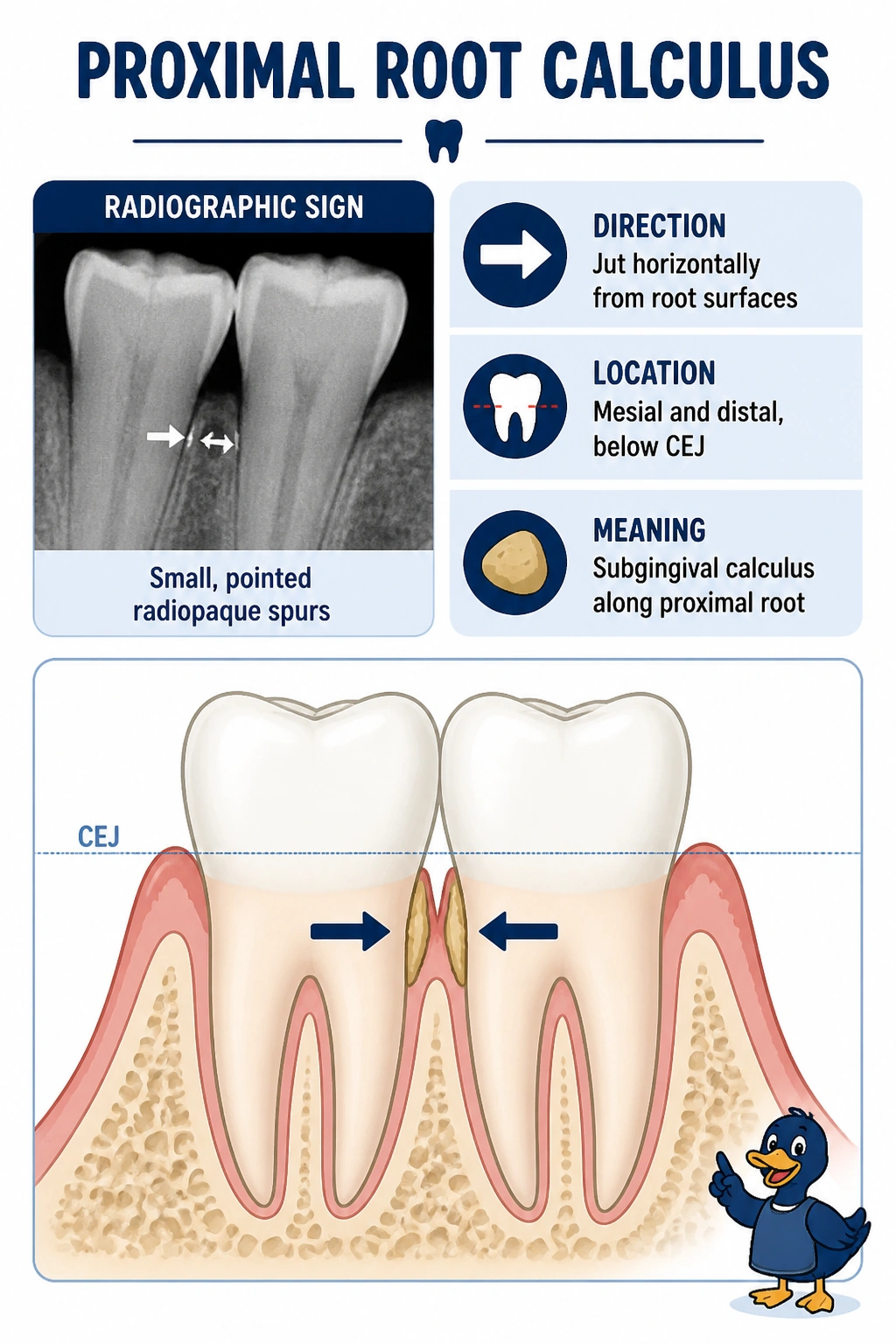
While evaluating a digital posterior bitewing radiograph for periodontal disease, a clinician notices small, pointed, spur-like radiopaque projections jutting horizontally from the mesial and distal root surfaces just apical to the cementoenamel junction. What do these radiographic findings most likely represent?
Select an answer to reveal the explanation.
Short Explanation
Think of those tiny horizontal spurs as miniature icicles of hardened plaque clinging to the tooth root just below the gumline on your bitewing. The trap is confusing these bright, outward-pointing projections with dark, destructive lesions like decay or root-surface indentation. Whenever you see sharp radiopaque ledges jutting off the proximal root surface near the cementoenamel junction, you are looking at mineralized tartar.
Full Explanation
Subgingival calculus deposits mineralized along the proximal root appear on digital bitewing radiographs as small, pointed, spur-like radiopaque projections extending horizontally into the interproximal space just apical to the cementoenamel junction. Because calculus consists of calcified dental plaque rich in calcium and phosphate salts, it attenuates more X-ray photons than the surrounding soft tissue and alveolar bone marrow, creating a bright white ledge on the root outline. Cervical burnout caused by decreased X-ray attenuation at the tooth neck produces a diffuse, wedge-shaped radiolucency rather than a radiopaque projection. Recurrent interproximal caries undermining the cervical enamel margin also appears radiolucent because demineralization reduces tooth density and allows more photons to reach the digital receptor. External root resorption resulting from chronic occlusal trauma creates a concave, scooped-out radiolucent defect or blunted root apex rather than an additive radiopaque spur. As a clinical caveat, radiographs only reveal calculus located on the mesial and distal surfaces, because buccal and lingual deposits are superimposed over the dense root structure. For an operational check, correlate these interproximal radiopaque spurs with tactile periodontal probing and explorer detection during the clinical exam.
Prefer to study offline? Printable PDF study book + test engine ($7.50, unofficial). These questions stay free here.