
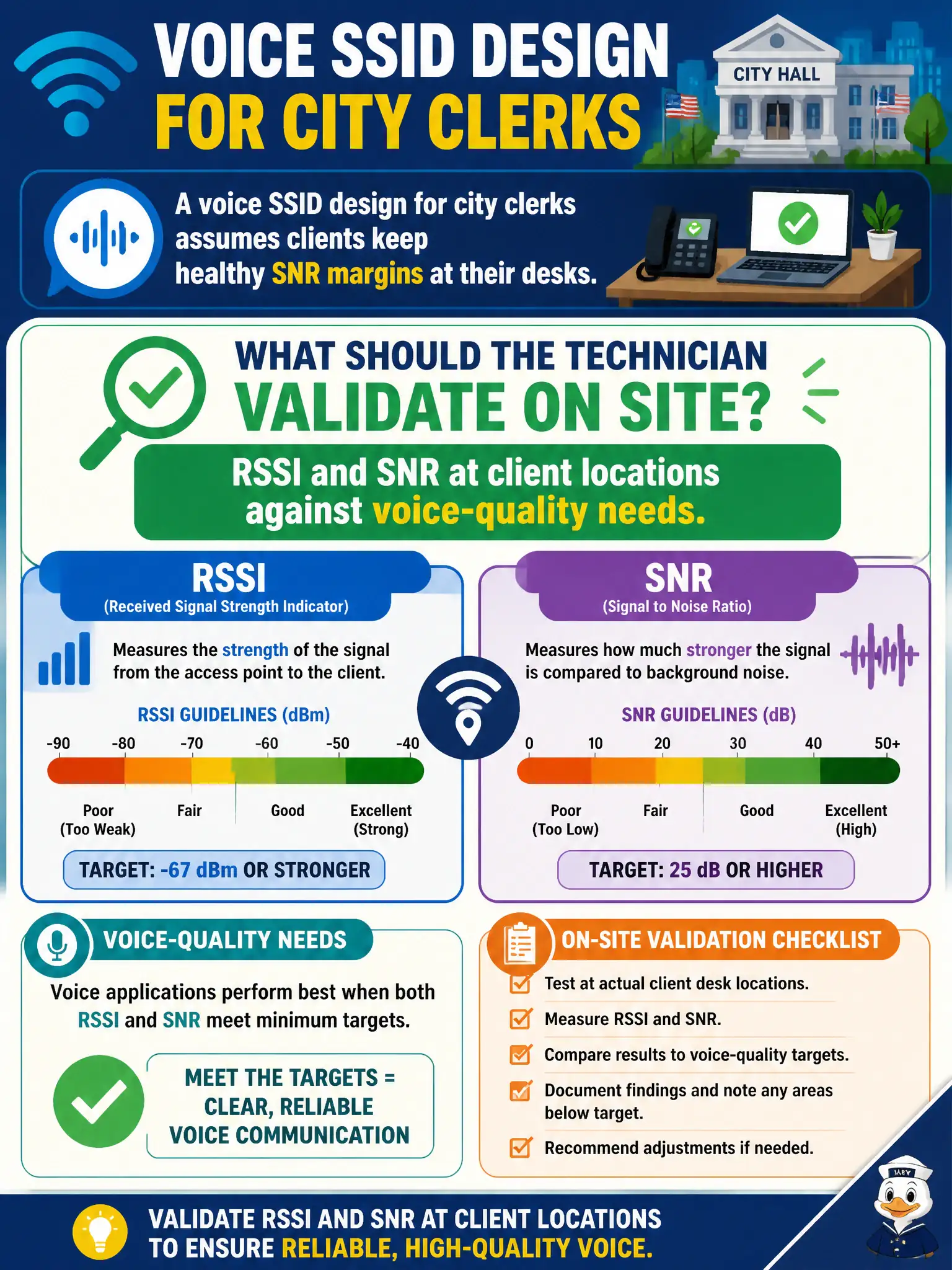
A voice SSID design for city clerks assumes clients keep healthy SNR margins at their desks. What should the technician validate on site?
Select an answer to reveal the explanation.
Short Explanation
The design's 'healthy SNR' promise is only real if you measure where people actually sit. Walk the desks with RSSI/SNR in mind the way a sound tech checks levels before a meeting. Association without margin still drops calls.
Full Explanation
A voice SSID design for city clerks that assumes healthy SNR margins at desks requires the technician to validate RSSI and SNR at client locations against voice-quality needs. On-site measurements confirm whether clerk desks and counters meet the RF quality assumptions in the design, not just whether devices can associate. Voice workloads fail at marginal SNR even when data browsing feels acceptable on the same civic SSID.
Validating only softphone wallpaper themes does not measure RF quality. Checking whether the default gateway MAC is odd or even is unrelated to voice SNR margins. Reviewing only DNS suffix search order on wired docks does not validate wireless voice RF at clerk seats.
Exam caveat: voice designs live or die by measured RSSI/SNR at the ear of the user device—association tests are incomplete. Operational check: survey clerk desk positions with a status tool or survey client, compare RSSI and SNR to voice targets in the design document, correct AP placement or power/channel issues where margins fail, and re-measure before sign-off. Store survey screenshots with desk identifiers in the voice SSID acceptance package so future moves of furniture or APs can be compared to the baseline.