
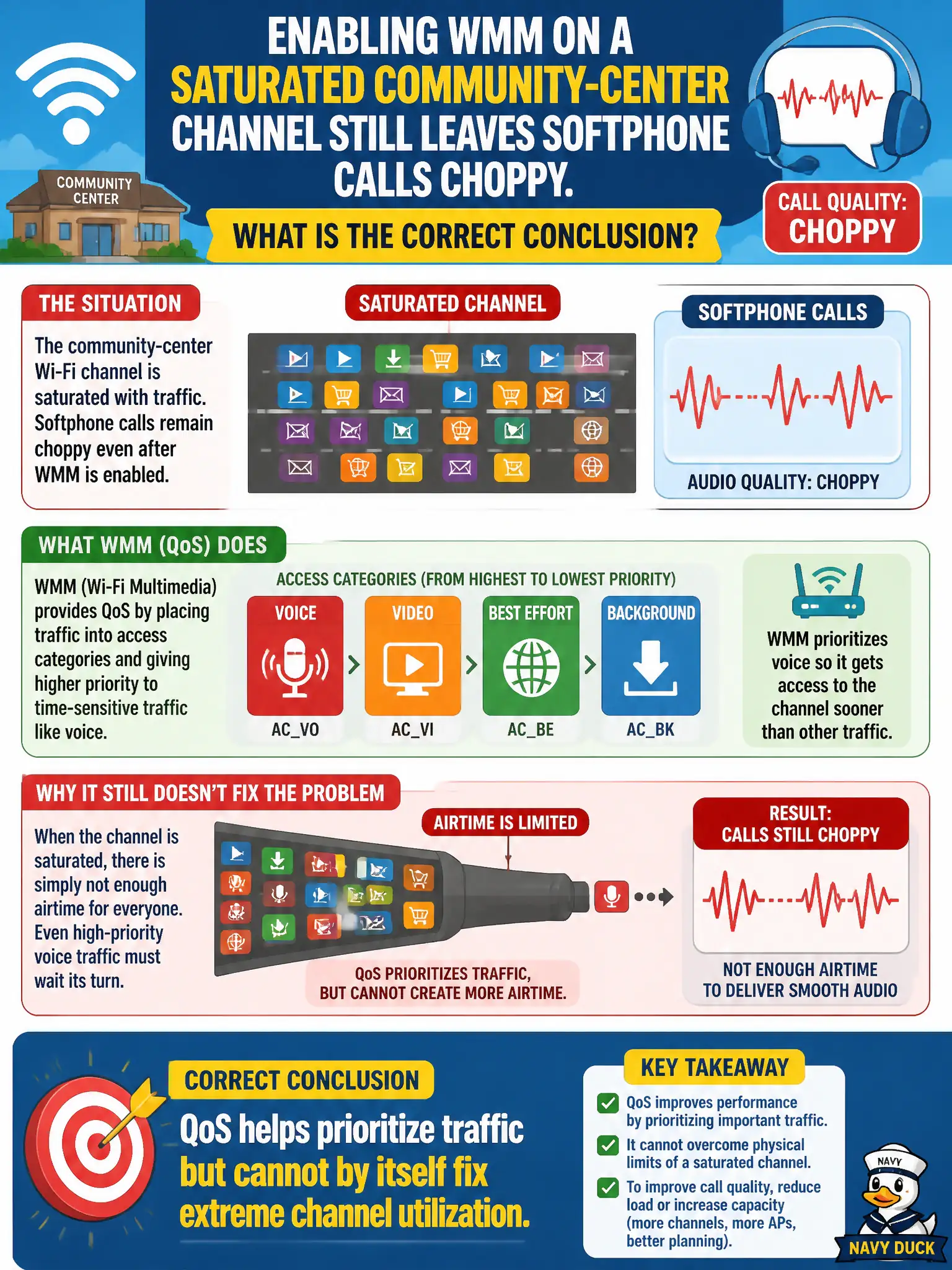
Enabling WMM on a saturated community-center channel still leaves softphone calls choppy. What is the correct conclusion?
Select an answer to reveal the explanation.
Short Explanation
WMM is an express lane sticker—not a second freeway. On a jammed channel, priority helps a little but cannot invent empty airtime. Fix utilization; do not pretend QoS alone is a miracle cure.
Full Explanation
Enabling WMM on a saturated community-center channel that still leaves softphone calls choppy supports the conclusion that QoS helps prioritize traffic but cannot by itself fix extreme channel utilization. WMM reorders contention advantages among access categories; it does not create infinite airtime on a fully congested civic channel. Technicians must remediate utilization—clients, duty cycle, channel width, AP density, or offload—while keeping WMM enabled for voice.
WMM does not create infinite airtime on a congested channel. Saturation is not a reason to disable WMM permanently on all voice SSIDs; that removes prioritization without solving congestion. Choppy audio is not proof that AP mounting height is the only possible cause, though mounting can matter for coverage—utilization remains a primary suspect here.
Exam caveat: QoS and capacity are complementary—do not treat WMM as a cure for overload. Operational check: measure utilization during choppy calls, reduce nonessential load or improve channel plan, keep WMM on, and verify softphone quality improves as utilization drops in the community center. If utilization stays high after offloading bulk clients, add AP capacity or narrow nonessential SSIDs before the next community-center event.