
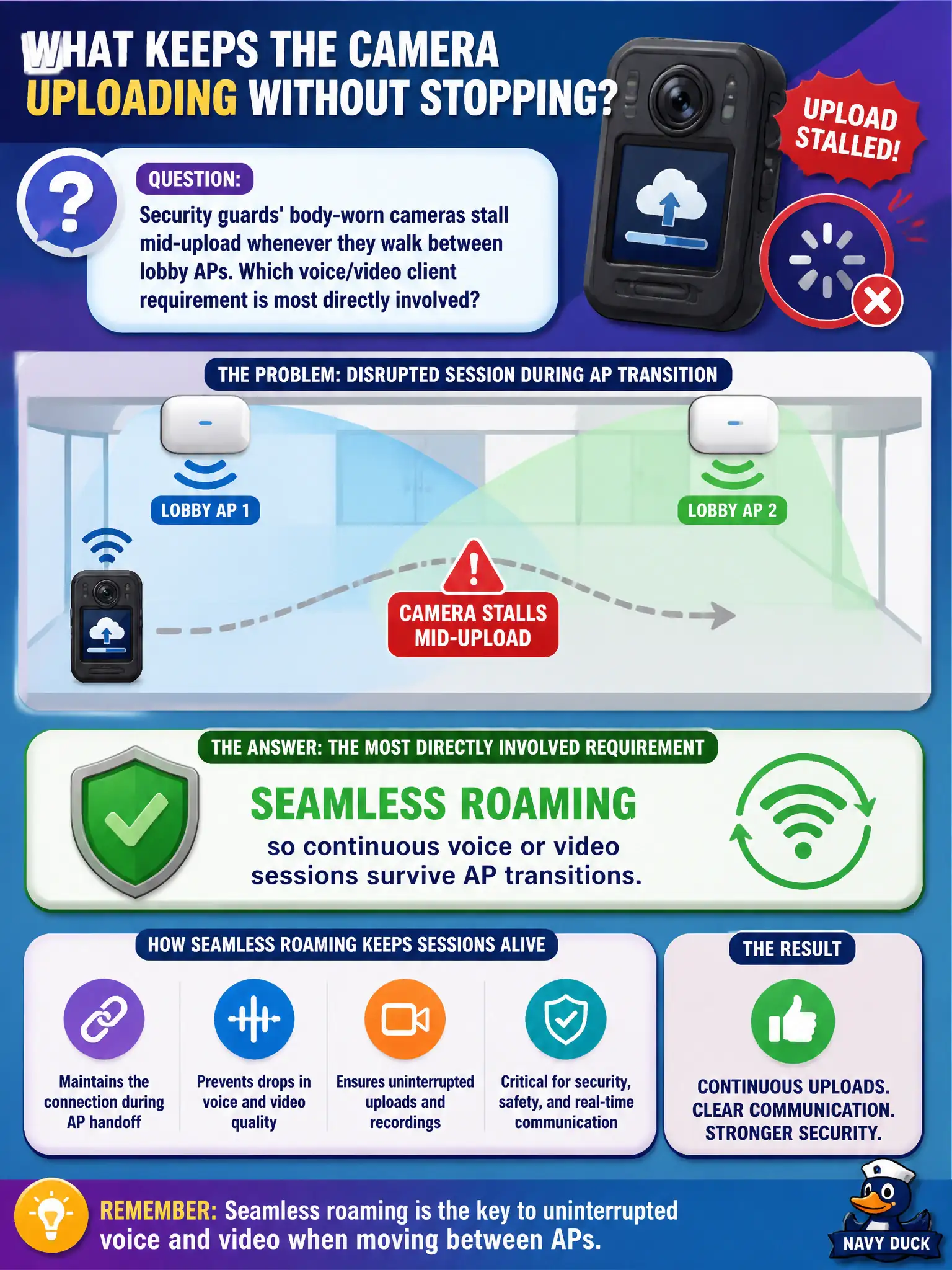
Security guards' body-worn cameras stall mid-upload whenever they walk between lobby APs. Which voice/video client requirement is most directly involved?
Select an answer to reveal the explanation.
Short Explanation
Bodycam video mid-roam is like a phone call that drops every time you pass a doorway. Seamless roaming keeps the session alive while the guard moves. Sticky or harsh handoffs show up as stalled uploads.
Full Explanation
Security guards' body-worn cameras that stall mid-upload when walking between lobby APs most directly implicate the need for seamless roaming so continuous voice or video sessions survive AP transitions. Municipal real-time and streaming workloads require roam designs and client capabilities that minimize authentication and association interruptions. Seamless roaming—supported by adequate overlap, matching security parameters, and optional fast-roam features—keeps uploads and streams alive as guards move through civic lobbies.
Captive-portal branding colors on a guest network do not address roam continuity for staff camera uploads. Mandating static 802.11b-only data rates citywide typically harms throughput and is not a seamless-roaming solution. Disabling client drivers so uploads freeze by policy is the opposite of an operational requirement for public-safety video continuity.
Exam caveat: continuous media over Wi-Fi elevates roaming quality from an optional nicety to a stated requirement on technician exams. Operational check: walk a guard camera along the lobby path while uploading, measure roam events and stalls, enable appropriate client and infrastructure roam assists if available, and improve AP overlap or security roam settings where handoffs fail.