
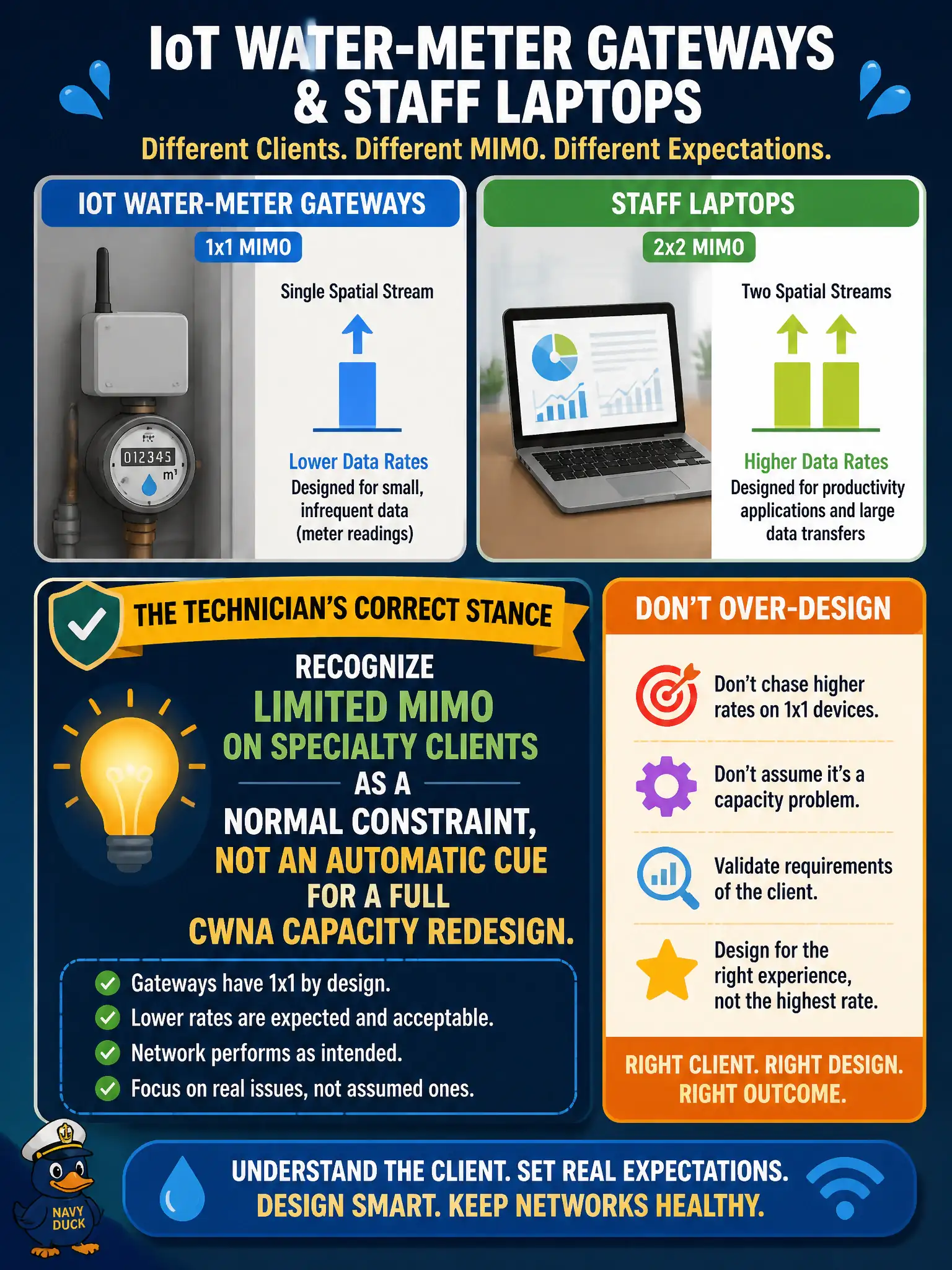
IoT water-meter gateways in a utility closet are 1x1 MIMO while staff laptops are 2x2. Design expects lower rates on the gateways. What is the technician's correct stance?
Select an answer to reveal the explanation.
Short Explanation
A 1x1 IoT gadget is a one-lane scooter next to a two-lane laptop. Lower rates are often normal, not a five-alarm redesign. Identify the MIMO limit, set expectations, and leave the deep capacity rework to the design role.
Full Explanation
IoT water-meter gateways in a utility closet that are 1x1 MIMO while staff laptops are 2x2 illustrate that limited MIMO on specialty clients is a normal constraint, not an automatic cue that every closet AP must be replaced. Specialty municipal IoT devices often ship with single-stream radios for cost, power, and enclosure size. Technicians should recognize that constraint when setting throughput expectations and SSID placement rather than treating every 1x1 association as an infrastructure defect in the water utility WLAN.
Limited MIMO does not justify disabling encryption on utility SSIDs or moving meters to open authentication. It does not mean gateways should use ad-hoc mode to somehow gain spatial streams. Replacing every AP because a meter gateway is 1x1 wastes budget when the device itself caps the number of streams it can use.
Exam caveat: differentiate client-imposed MIMO limits from AP radio failures—check device specifications before escalating RF plant changes. Operational check: document gateway MIMO capability in the utility inventory, measure realistic throughput at installed RSSI, and only escalate if a multi-stream staff laptop also underperforms at the same location on the same BSS.