
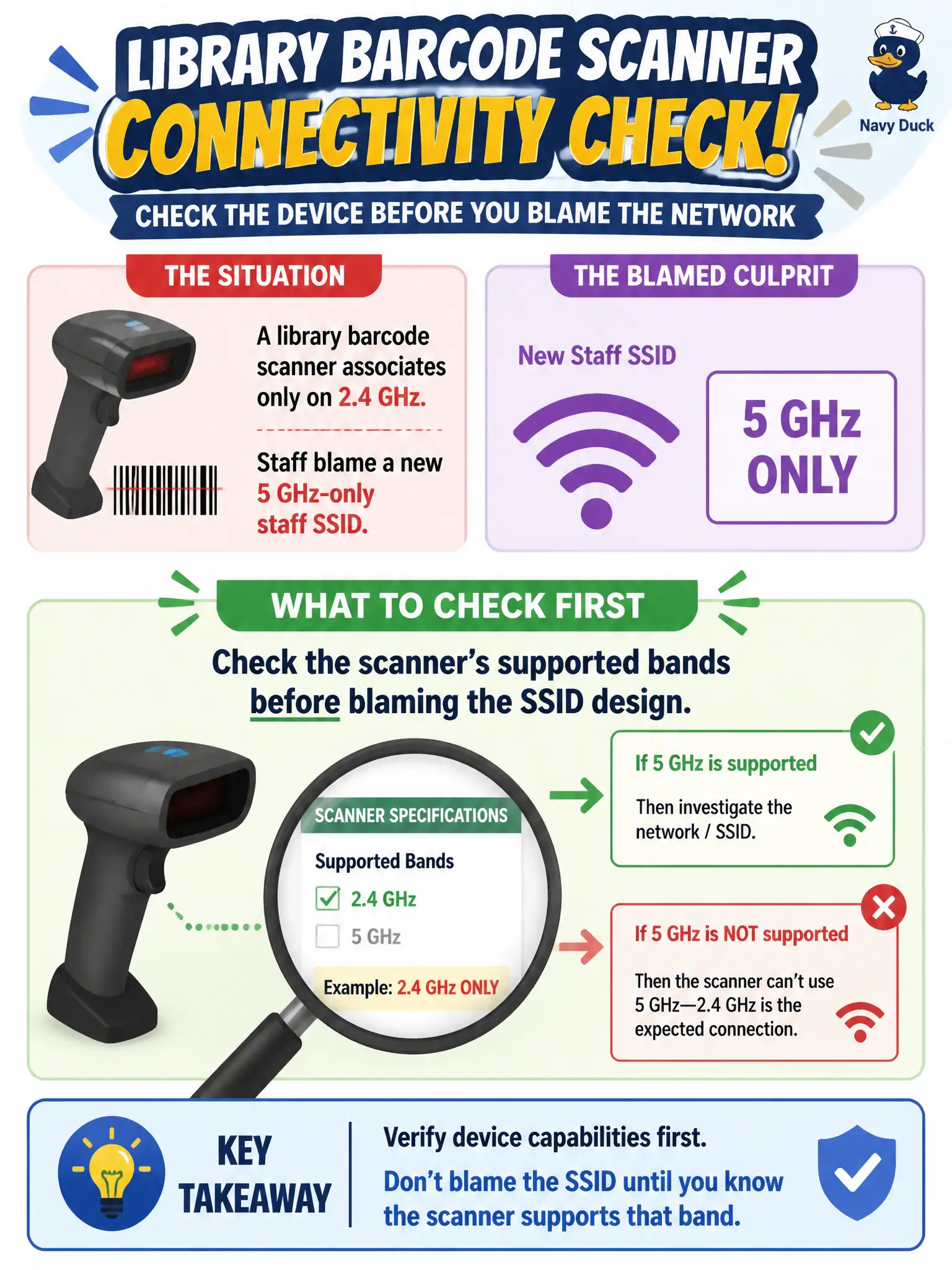
A library barcode scanner associates only on 2.4 GHz. Staff blame a new 5 GHz-only staff SSID. What should the technician check first?
Select an answer to reveal the explanation.
Short Explanation
If the scanner only speaks 2.4 GHz, a 5 GHz-only SSID is like inviting it to a meeting on a floor it cannot reach. Check supported bands on the client before rewriting the WLAN. Capability limits beat blame games.
Full Explanation
When a library barcode scanner associates only on 2.4 GHz, technicians should first verify whether the scanner's supported bands include 5 GHz before blaming a new 5 GHz-only staff SSID design. Many specialty civic scanners are single-band 2.4 GHz devices; they cannot join a 5 GHz-only BSS regardless of passphrase correctness or measured signal strength near the stacks. Band capability is a hardware checklist item at technician depth, not merely an SSID naming, VLAN, or DHCP issue.
Increasing 5 GHz transmit power does not add a 5 GHz radio to a 2.4 GHz-only scanner and will not create a band the hardware lacks. Clearing ARP caches does not change PHY band support on the handheld. Forcing the scanner into 6 GHz-only mode is impossible if it lacks that radio and is irrelevant when the root limitation is missing 5 GHz support.
Exam caveat: always inventory client band support when devices fail against band-limited SSIDs in municipal libraries, depots, and clinics. Operational check: read the scanner's radio specifications, attempt association to a known 2.4 GHz civic SSID if policy allows, and either provide a dual-band SSID path or replace the scanner with a dual-band model approved for 5 GHz-only staff networks.