
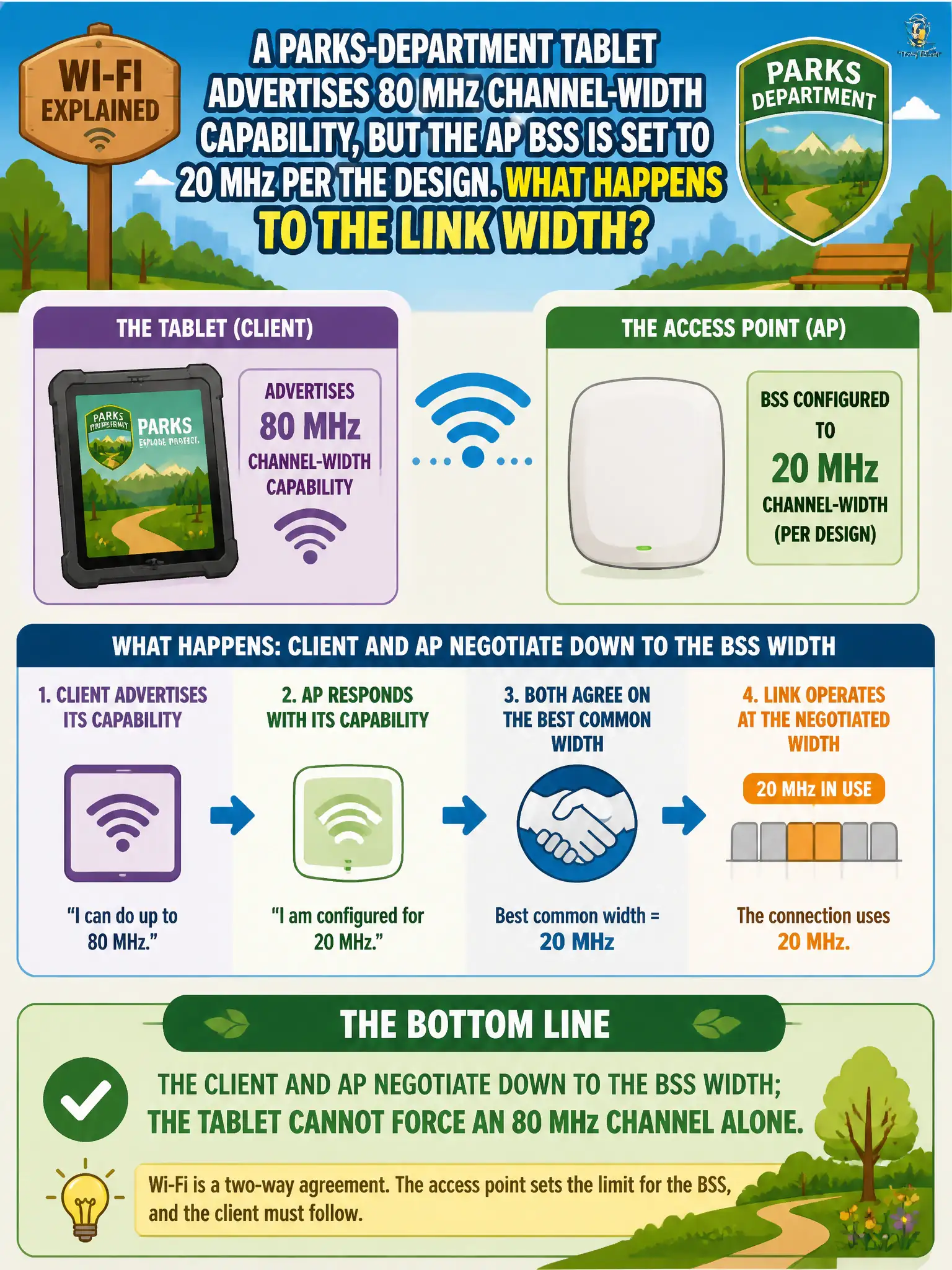
A parks-department tablet advertises 80 MHz channel-width capability, but the AP BSS is set to 20 MHz per the design. What happens to the link width?
Select an answer to reveal the explanation.
Short Explanation
Capability is the ceiling, not a remote control for the AP. If the BSS is 20 MHz, the link settles there even if the tablet could do 80 MHz in a wider BSS. Read both sides before chasing a 'slow Wi-Fi' ghost.
Full Explanation
A parks-department tablet that advertises 80 MHz channel-width capability still negotiates down to the BSS operating width when the AP is set narrower (for example 20 or 40 MHz). The client cannot unilaterally force an 80 MHz channel on a BSS configured otherwise; channel width is constrained by AP settings, regulatory limits, and coexistence with neighboring networks. Technicians should explain negotiation to the BSS width rather than blaming the tablet for refusing to run 80 MHz alone inside the park facility or recreation building.
Raising client transmit power does not expand channel width beyond the BSS configuration published by the AP. Disabling encryption does not unlock 80 MHz operation for parks tablets. Moving the tablet to ad-hoc mode to force 80 MHz abandons the parks infrastructure design and still may not achieve the intended coverage or capacity plan for staff devices.
Exam caveat: client capability is an upper bound; the BSS and environment determine the working width you will observe in status tools. Operational check: inspect AP channel-width settings for the parks SSID, confirm the tablet association reports the negotiated width, and only widen channels after surveying interference and neighboring civic BSSs.