
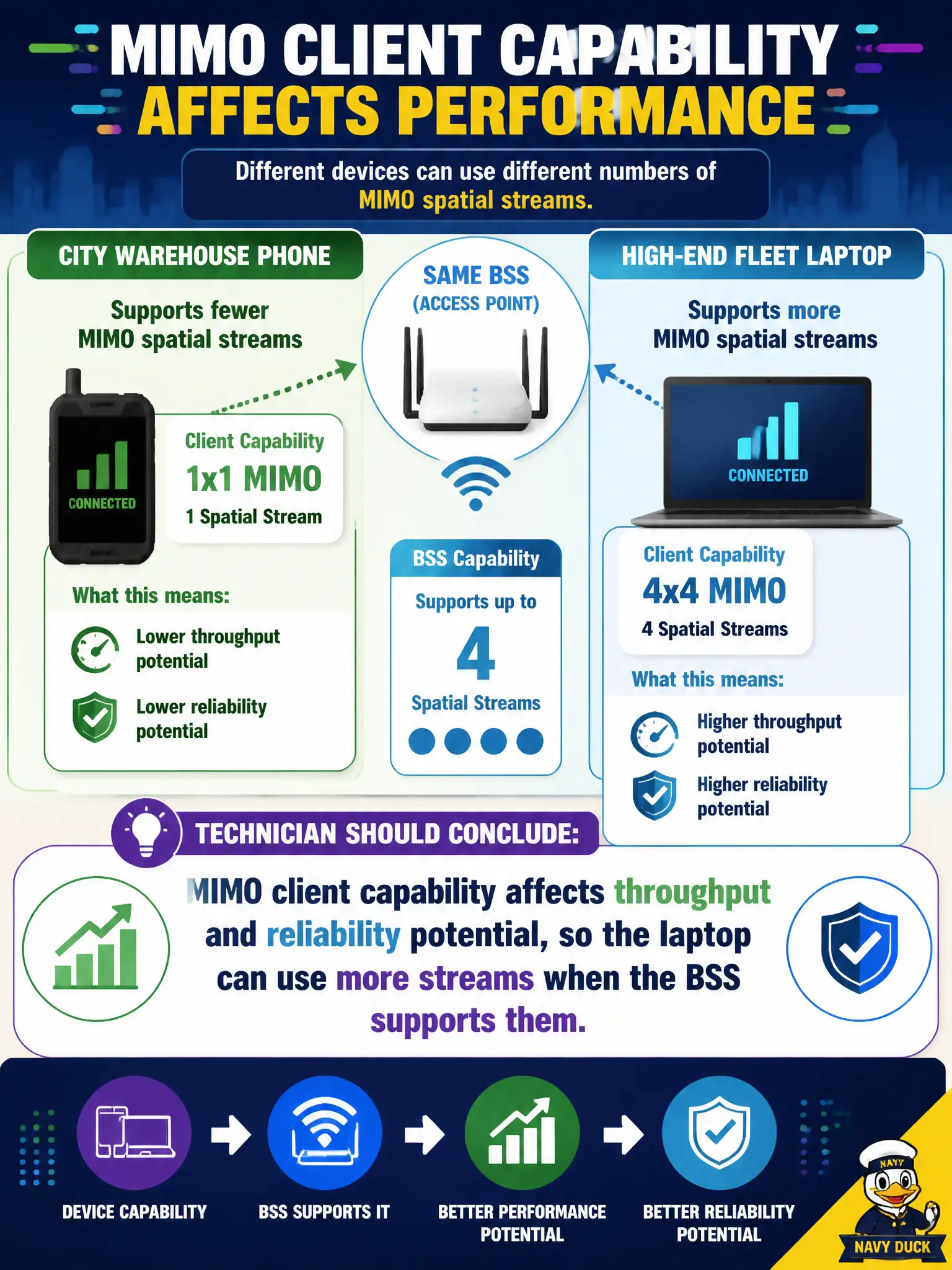
A city warehouse phone supports fewer MIMO spatial streams than a high-end fleet laptop. What should the technician conclude?
Select an answer to reveal the explanation.
Short Explanation
MIMO streams are like lanes on a bridge—more lanes can move more traffic when the road (AP and channel) allows it. A phone with fewer streams is not broken; it simply has less parallel capacity than a 3x3 or 4x4 laptop. Match expectations to the client's MIMO feature set.
Full Explanation
A city warehouse phone that supports fewer MIMO spatial streams than a high-end fleet laptop will generally have lower throughput and reliability potential under the same municipal RF conditions. MIMO client capability is a station resource: more spatial streams can exploit multipath and higher MCS opportunities when the AP and channel conditions allow. The laptop can therefore use more of the BSS MIMO capacity than the phone, all else equal, which matters when comparing device classes for warehouse apps.
Fewer streams on the phone do not mean the phone should be forced onto an open SSID, nor do they prove the AP is misconfigured. Increasing only the phone's screen brightness will not add radio chains or spatial streams. Claiming that 1x1 devices always outperform 2x2 devices on the same AP reverses MIMO fundamentals taught at technician depth.
Exam caveat: map MIMO spatial-stream counts to client capability expectations when comparing devices on civic WLANs. Operational check: note each device's reported spatial streams or antenna configuration in inventory, run a throughput sample at similar RSSI in the warehouse, and set realistic application expectations for the phone versus fleet laptops.