
A municipal inspector's laptop lists support for 802.11k/v/r-style roaming assists. How should a technician treat that information?
Select an answer to reveal the explanation.
Short Explanation
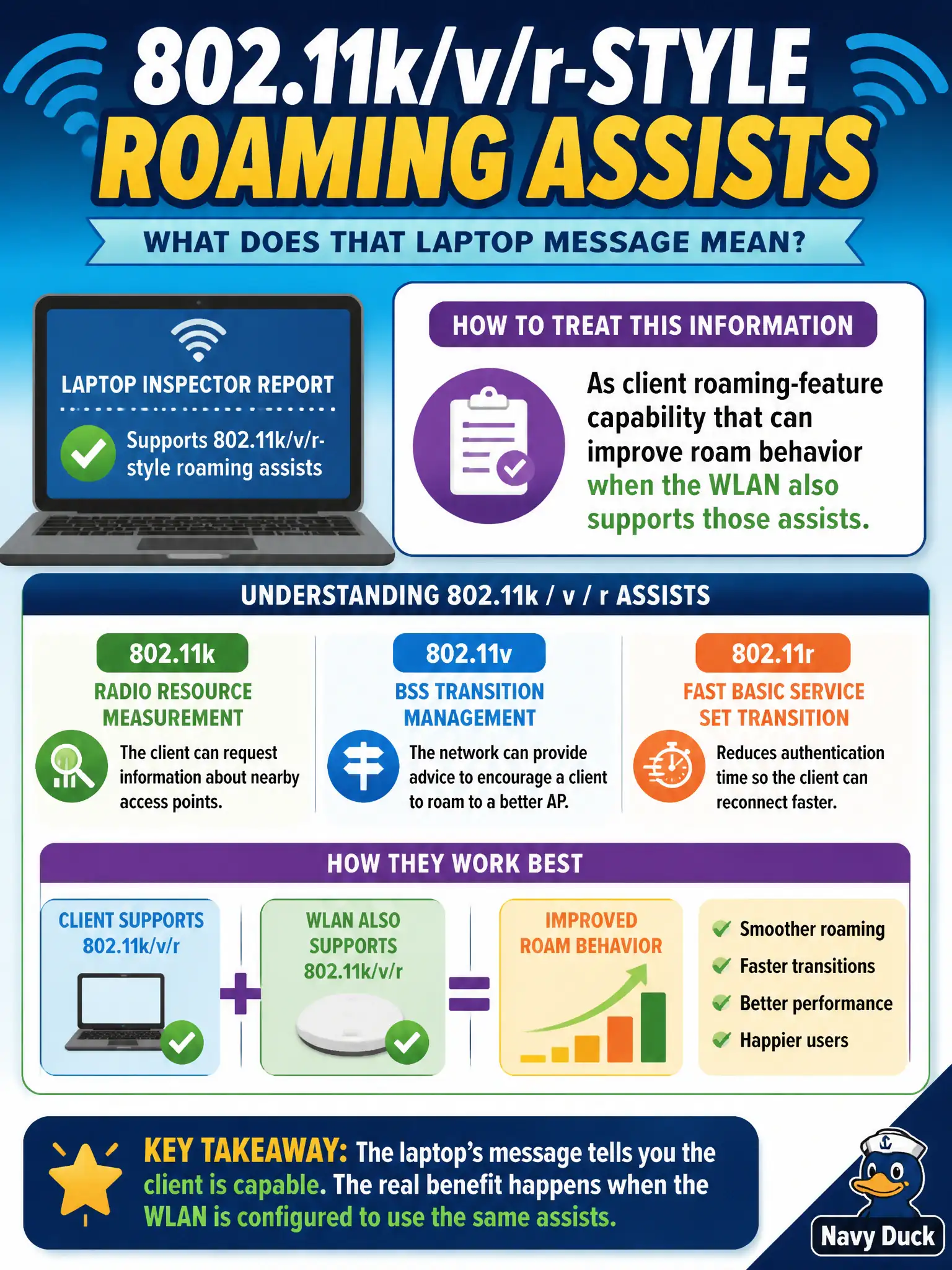
Those k/v/r-style assists are like GPS hints for the laptop when it decides which AP to jump to next. They are client (and WLAN) capabilities that can smooth roaming—not a free pass to ignore the design or dump security. Capability awareness beats wishful thinking.
Full Explanation
When a municipal inspector's laptop lists support for 802.11k/v/r-style roaming assists, technicians should interpret that as client roaming-feature capability that can improve roam behavior when the WLAN infrastructure also supports the corresponding features. Neighbor reports, directed transition guidance, and fast BSS transition reduce roam latency and poor AP selection for mobile civic workers when both ends participate. Capability on the laptop alone is necessary but not sufficient.
Client support does not force a non-supporting autonomous AP network to deliver 802.11r fast transitions. These features are not substitutes for correct security profiles, nor a reason to rip out Ethernet in every office. Treating k/v/r enablement as a requirement to disable WMM confuses roaming assists with multimedia QoS and can harm softphone quality.
Exam caveat: roaming assists help only when client and infrastructure capabilities align—printed capability lists are not automatic on-air magic. Operational check: verify controller or AP support for the same assists, enable compatible settings on the inspector laptop, and perform a walking roam test while monitoring voice or session continuity across floors.