
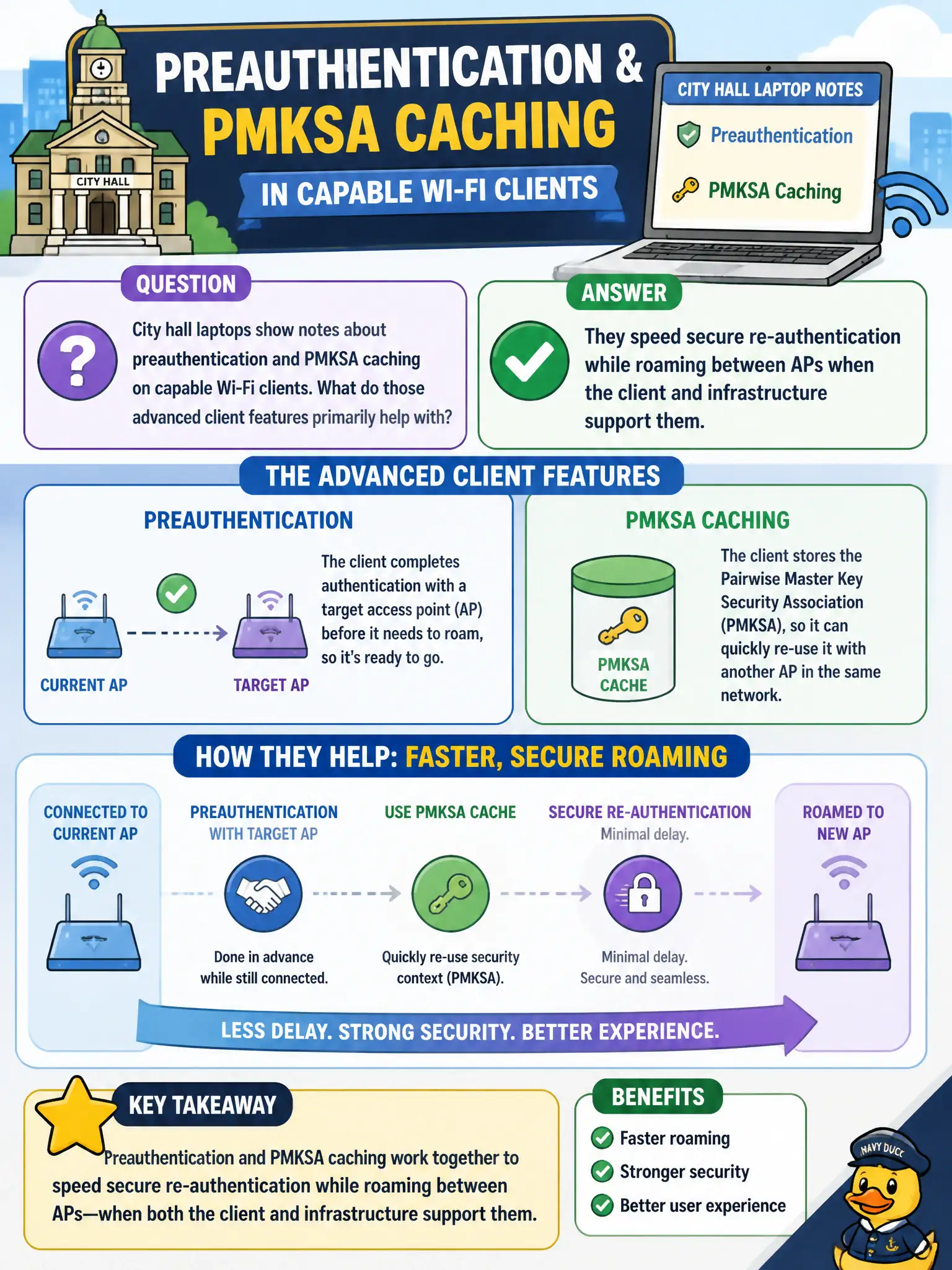
City hall laptops show notes about preauthentication and PMKSA caching on capable Wi-Fi clients. What do those advanced client features primarily help with?
Select an answer to reveal the explanation.
Short Explanation
Think of preauth and PMKSA caching like keeping your building badge warm in your pocket so the next door opens faster. They help capable clients re-authenticate quicker when roaming—not skip security setup. You still need the right SSID and security settings.
Full Explanation
Notes about preauthentication and PMKSA caching on capable city hall Wi-Fi clients indicate features that speed secure re-authentication while roaming between APs when both the client and infrastructure support them. By caching pairwise master key security associations or preauthenticating to candidate APs, the laptop can complete secure roaming with less full EAP delay. That matters for Enterprise staff SSIDs across large municipal buildings where voice and session continuity suffer from slow full reauthentication at every roam.
These features do not replace the need for correct Enterprise credentials or certificates, nor do they increase transmit power to fix coverage holes. They are not mechanisms for pushing full PSKs through beacon frames to guest devices. Disabling them as a first response to slow DHCP is usually misdirected when the symptom is roam authentication latency rather than address assignment.
Exam caveat: preauthentication and PMKSA caching improve secure roam performance—they are not general cures for poor SNR or misconfigured profiles. Operational check: on a capable courthouse laptop, confirm roaming assists or PMK caching are enabled per vendor guidance, walk between APs on the staff SSID, and compare re-authentication time and dropouts with the features disabled.