
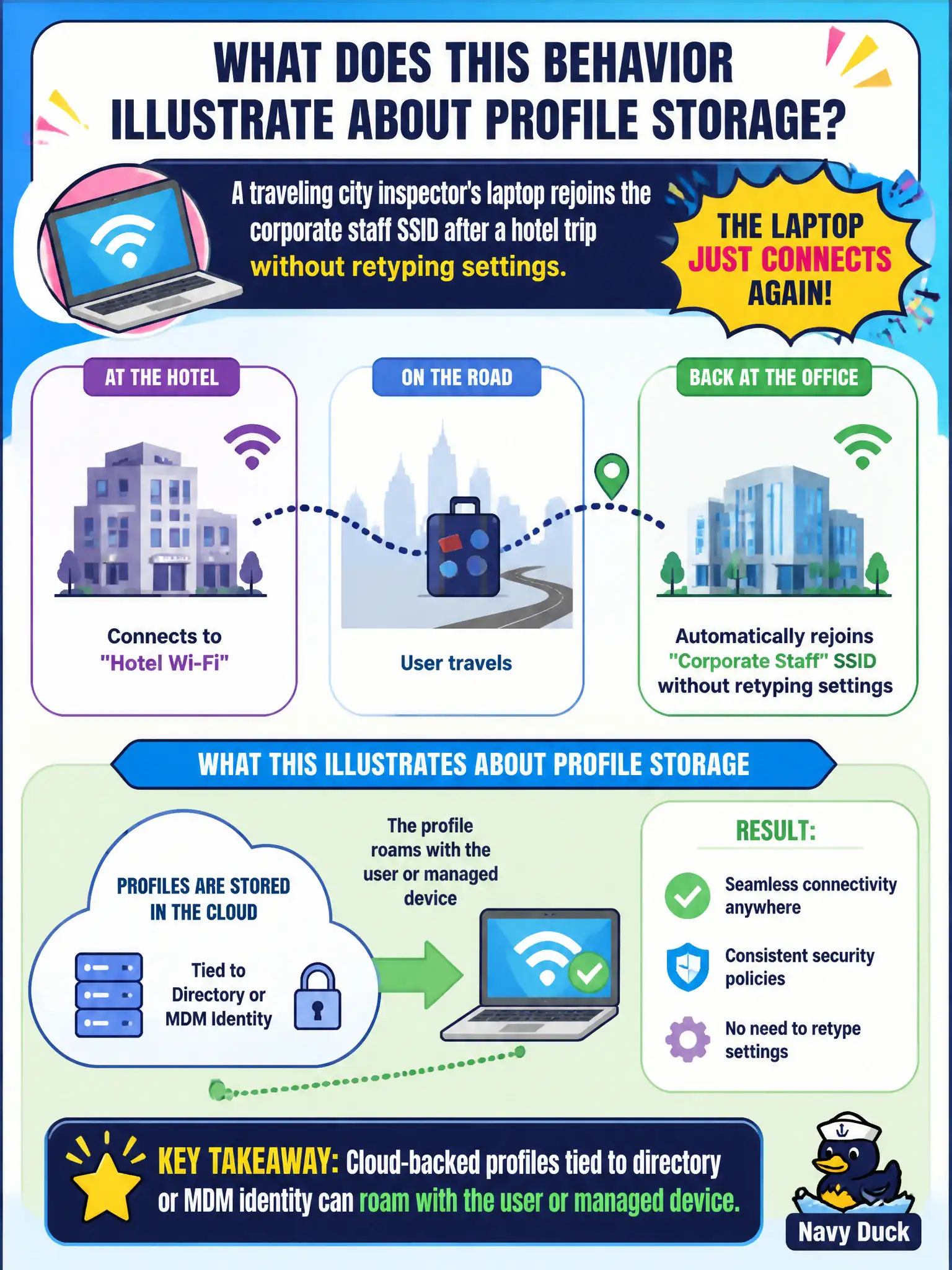
A traveling city inspector's laptop rejoins the corporate staff SSID after a hotel trip without retyping settings. What does that behavior illustrate about profile storage?
Select an answer to reveal the explanation.
Short Explanation
Picture the inspector's badge traveling with them—cloud-backed profiles follow the managed identity. Directory or MDM can deliver the wireless settings so the laptop reconnects without a hotel rewrite party. Beacons and EEPROM myths don't ship the corporate profile.
Full Explanation
When a traveling city inspector's laptop rejoins the corporate staff SSID after a hotel stay without retyping settings, that behavior illustrates cloud-backed or directory/MDM-delivered wireless profiles that travel with the user or managed device identity. Municipal device management can push SSID, security mode, and credentials (or certificate bindings) so the laptop reconstitutes the correct profile after roaming outside city limits. The profile is therefore not merely a one-time local type-in; it is bound to managed identity and can reappear when the device returns to policy reach.
Profiles are not limited to static files burned into NIC EEPROM, and requiring a full recreate after every roam outside city limits contradicts how modern managed clients behave. Beacon frames advertise BSS capabilities; they do not push full PSK or EAP credentials to arbitrary visiting laptops. Treating beacons as a credential delivery channel confuses discovery with authentication provisioning.
Exam caveat: distinguish local-only profile stores from cloud/MDM-backed ones—both are valid, but only identity-backed delivery explains seamless rejoin after travel without manual re-entry. Operational check: after a hotel trip simulation, confirm the inspector laptop still lists the staff profile with expected Enterprise or Personal settings and reconnects without technician retyping.