
A mixed 802.11n and 802.11ax client hall at the community college is dragging because slow stations dominate. Which AP feature should be enabled to protect aggregate performance?
Select an answer to reveal the explanation.
Short Explanation
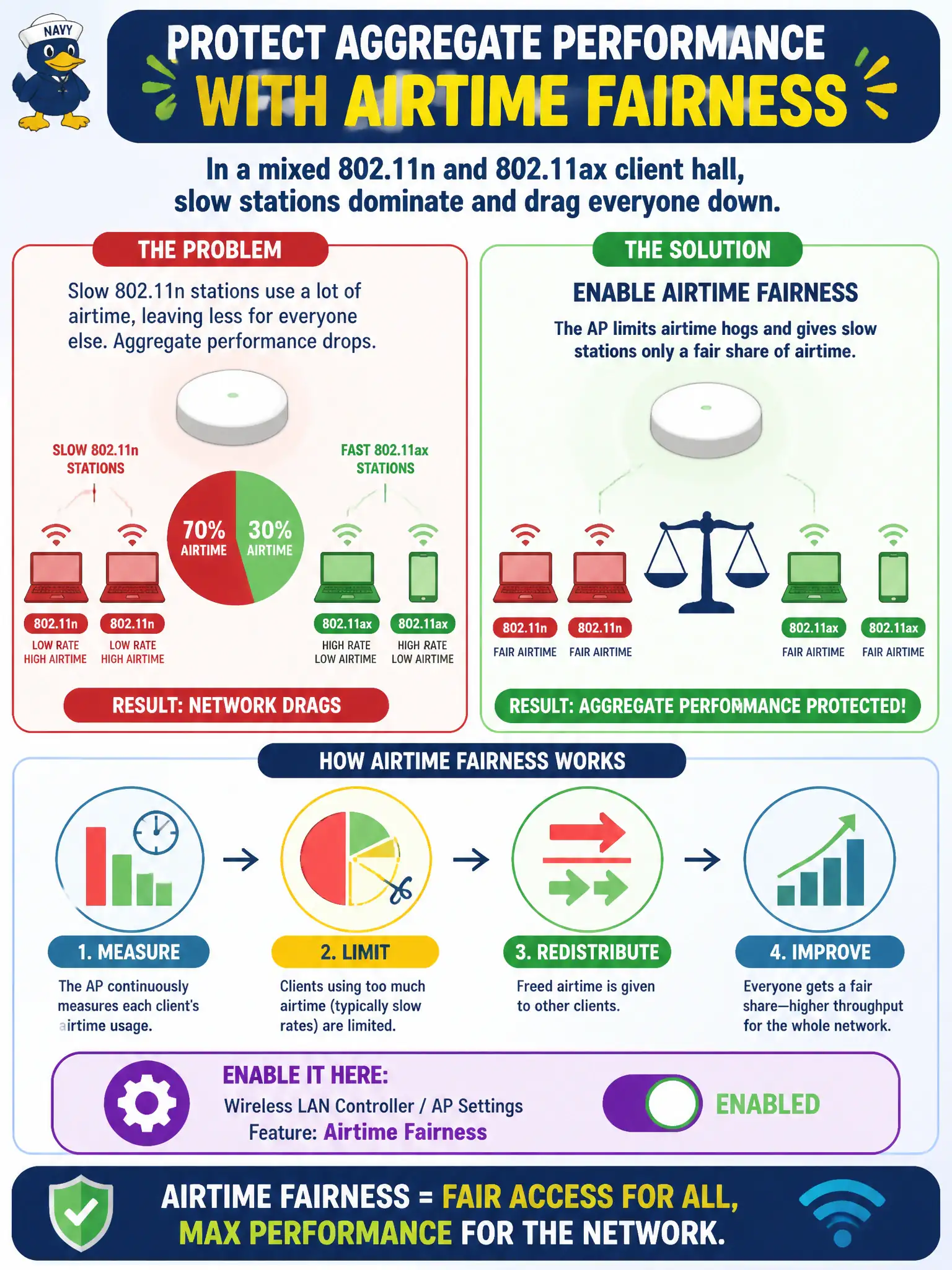
Old slow clients and shiny ax laptops sharing a hall is a classic airtime trap. Flip on airtime fairness so the slow stations do not eat the whole medium. Hiding the SSID will not magically balance transmit time.
Full Explanation
A mixed 802.11n and 802.11ax client hall at a community college that drags because slow stations dominate is a textbook case for airtime fairness. Enabling that AP feature protects aggregate performance by allocating airtime more evenly instead of letting legacy stations consume disproportionate medium time. Municipal and campus training spaces commonly need this control during phased client refreshes.
Shared Key Authentication is legacy insecure auth, not a capacity feature. A permanent hidden SSID as capacity control does not equalize airtime. Disabling WMM on all multimedia SSIDs harms QoS and does not implement airtime fairness.
Exam caveat: slow-station dominance → airtime fairness. Do not reach for hidden SSIDs, Shared Key, or WMM disablement as substitutes.
Operational check: enable airtime fairness on the hall APs per design, retest mixed n/ax client load, and keep WMM enabled for any voice/video SSIDs still serving the space. Municipal technicians document the verified setting in the as-built packet so the next shift inherits a known-good civic configuration rather than tribal knowledge. Municipal technicians document the verified setting in the as-built packet so the next shift inherits a known-good civic configuration rather than tribal knowledge.