
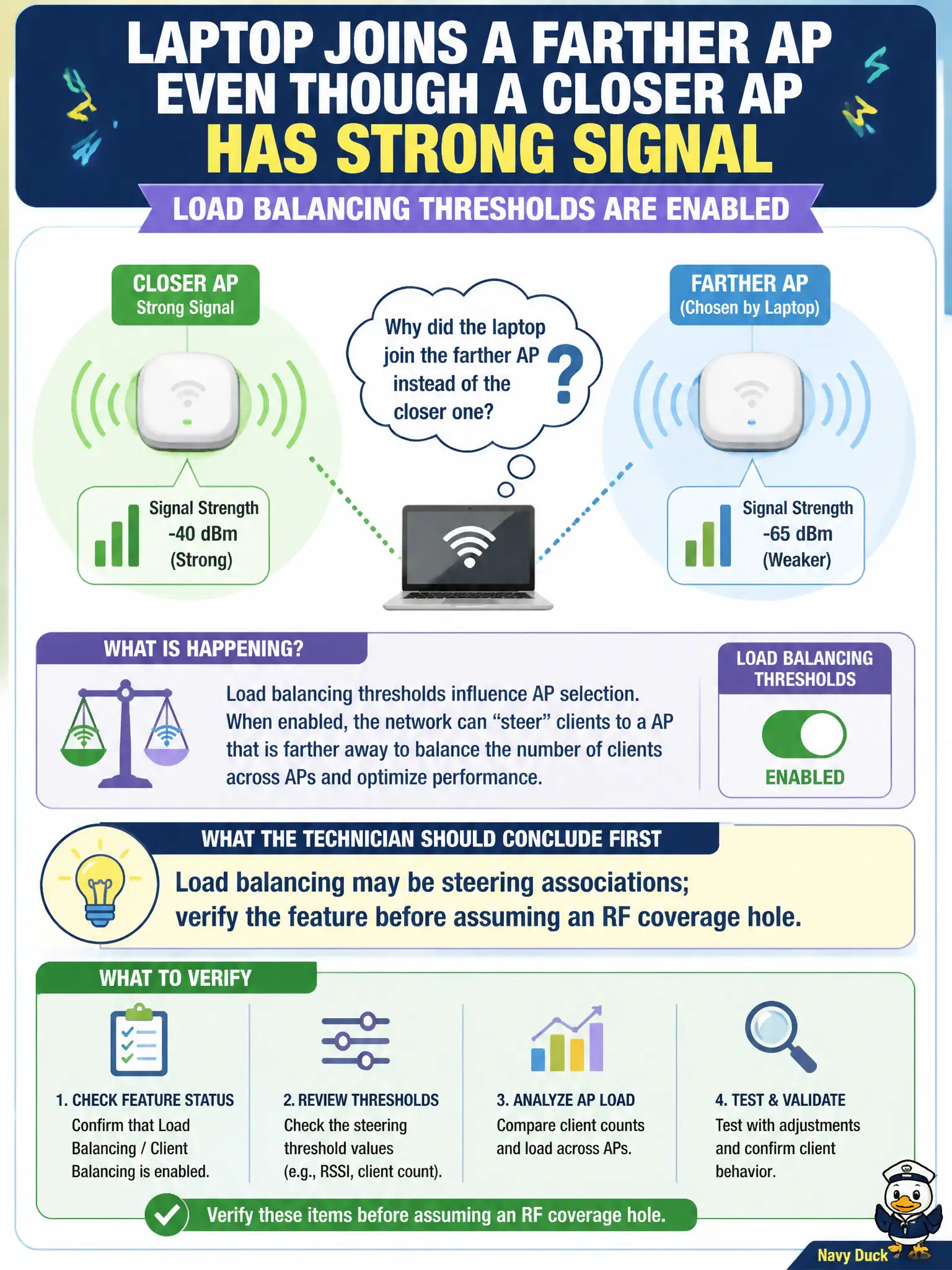
A laptop joins a farther AP even though a closer AP has strong signal. Load balancing thresholds are enabled. What should the technician conclude first?
Select an answer to reveal the explanation.
Short Explanation
If a client parks on a farther AP while load balancing is on, do not instantly declare an RF black hole. The feature may be steering associations on purpose. Prove whether balancing or real coverage is the cause before moving antennas.
Full Explanation
When a laptop joins a farther AP even though a closer AP has strong signal and load balancing thresholds are enabled, the technician should first conclude that load balancing may be steering associations and verify the feature before assuming an RF coverage hole. Balancing can intentionally deflect clients from busy radios. Misdiagnosing that as hardware failure wastes civic maintenance cycles.
Assuming the closer AP radio hardware has necessarily failed skips feature verification. Claiming fiber to the farther AP must be down contradicts successful association to that farther AP. Blaming a hidden SSID for skipping the near AP ignores the stated load-balancing context.
Exam caveat: unexpected AP selection with balancing enabled is a feature check first, not an automatic coverage-hole or hardware-failure declaration.
Operational check: review load-balancing thresholds and statistics on both APs, temporarily compare behavior with balancing per design guidance, confirm the near AP radio is actually up, and only then open an RF coverage investigation if steering does not explain the choice. Municipal technicians document the verified setting in the as-built packet so the next shift inherits a known-good civic configuration rather than tribal knowledge.