
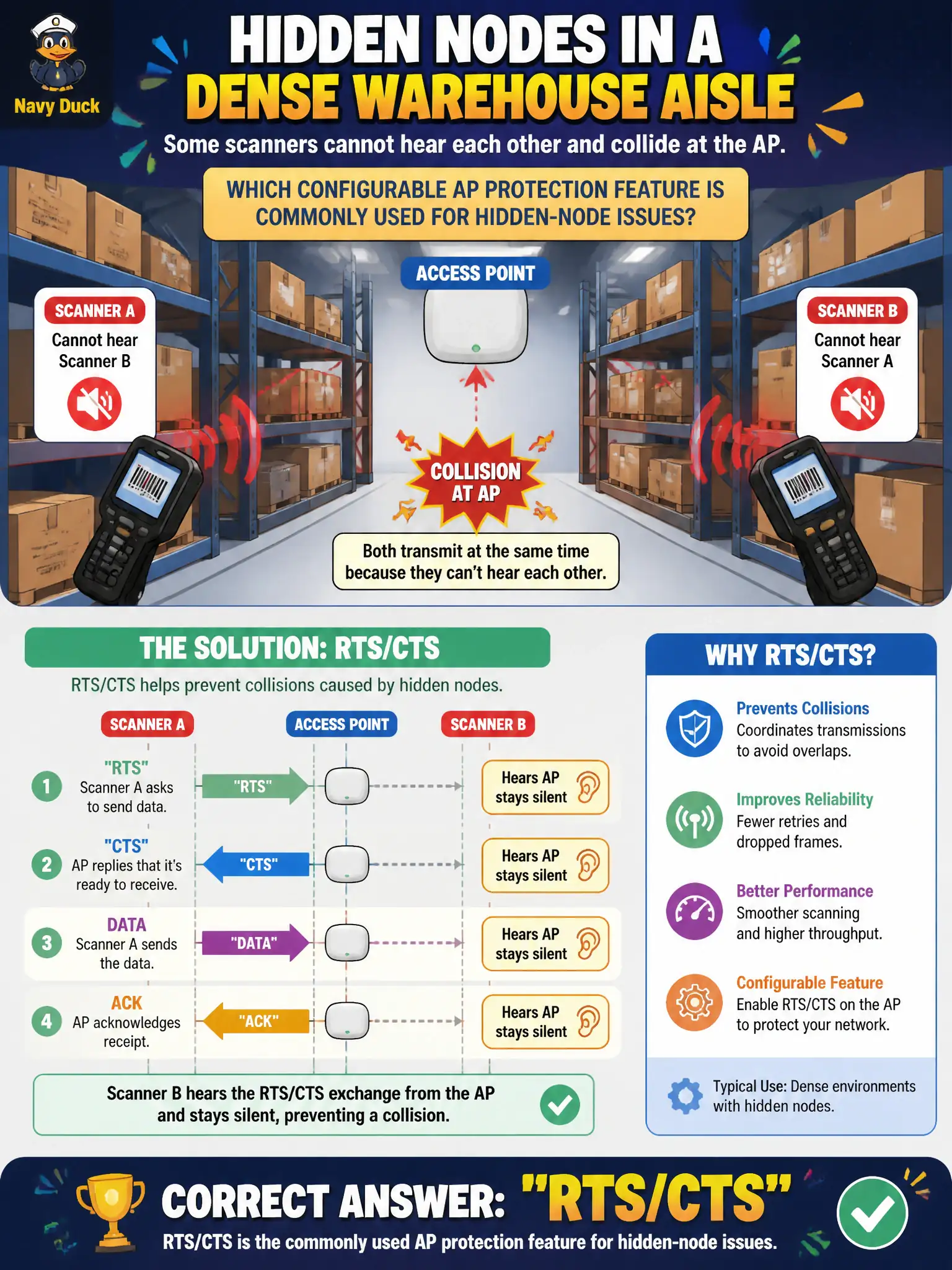
In a dense warehouse aisle, some scanners cannot hear each other and collide at the AP. Which configurable AP protection feature is commonly used for hidden-node issues?
Select an answer to reveal the explanation.
Short Explanation
Hidden nodes are like two forklifts around a corner that both think the intersection is clear. RTS/CTS is the AP-configurable 'honk before entering' protection mechanism. Hiding the SSID or enabling WEP does not fix that collision pattern.
Full Explanation
In a dense warehouse aisle, scanners that cannot hear each other may collide at the AP—the classic hidden-node problem. RTS/CTS is the configurable AP protection feature commonly used to mitigate that class of collisions by coordinating access before data frames. Municipal warehouse WLANs with metal racking often need this tool when design or troubleshooting indicates hidden nodes.
Disabling all acknowledgements breaks reliability rather than protecting against hidden nodes. Turning off SSID broadcast permanently as collision control does not address hidden-node collisions. Forcing WEP to serialize frames is insecure and is not a hidden-node protection mechanism.
Exam caveat: RTS/CTS is the named protection for hidden-node collision scenarios—not SSID hiding, ACK disablement, or WEP.
Operational check: enable RTS/CTS per design or vendor guidance on the warehouse SSID/AP, retest scanner reliability in the problem aisle, and avoid leaving RTS thresholds overly aggressive if throughput suffers without benefit. Municipal technicians document the verified setting in the as-built packet so the next shift inherits a known-good civic configuration rather than tribal knowledge. Municipal technicians document the verified setting in the as-built packet so the next shift inherits a known-good civic configuration rather than tribal knowledge.