
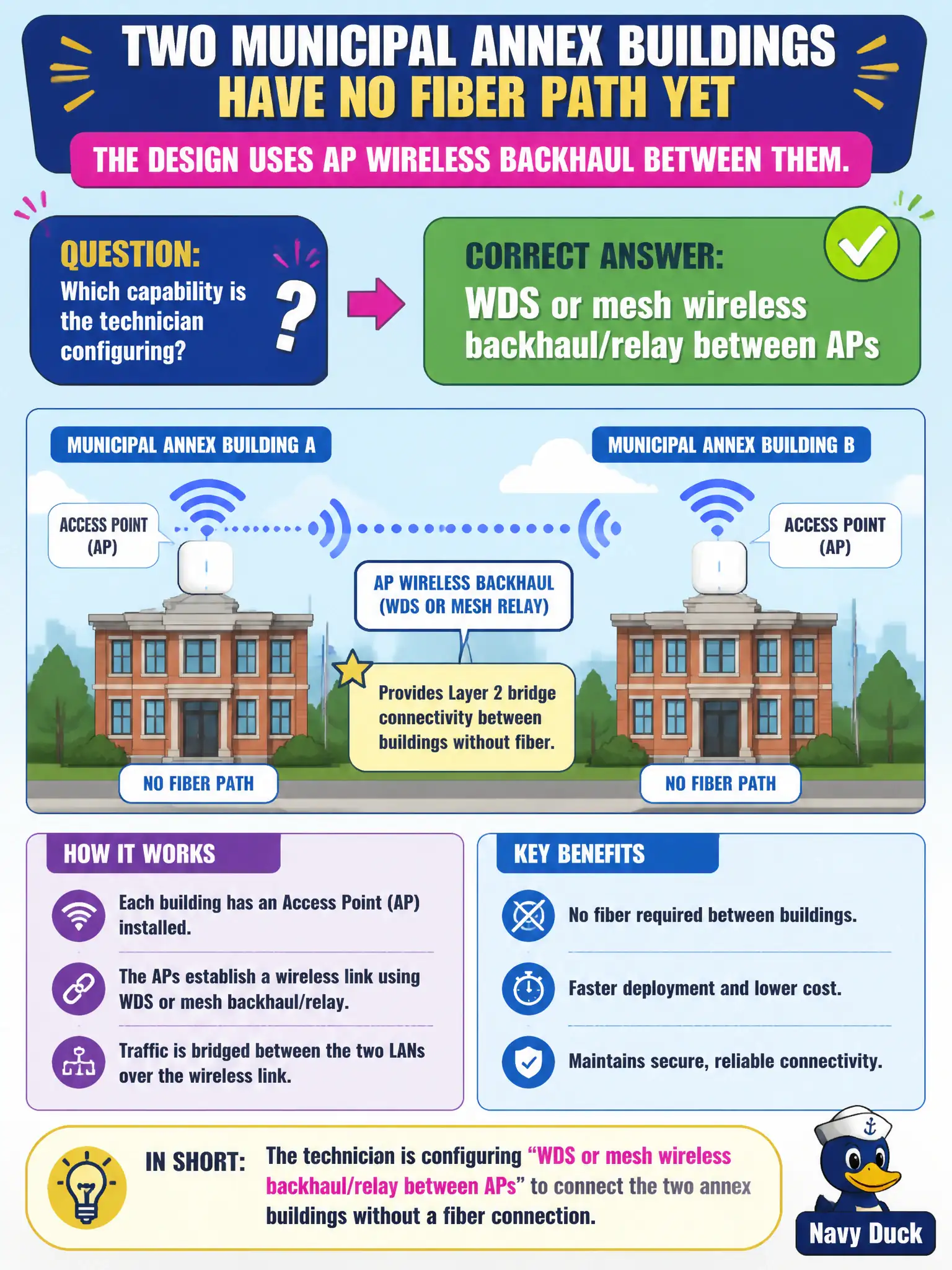
Two municipal annex buildings have no fiber path yet, and the design uses AP wireless backhaul between them. Which capability is the technician configuring?
Select an answer to reveal the explanation.
Short Explanation
No fiber between annexes? The design may call for APs to relay for each other—that is WDS/mesh backhaul territory. You are configuring wireless links between APs, not a guest splash page. Follow the design roles and links exactly.
Full Explanation
When two municipal annex buildings lack a fiber path and the design uses AP wireless backhaul between them, the technician is configuring WDS or mesh wireless backhaul/relay between APs. That capability extends civic connectivity building-to-building over radio until wired backhaul arrives. Roles, SSIDs, and security for the backhaul hop must follow the design rather than ad-hoc bridging.
Captive portal for staff 802.1X confuses guest portals with Enterprise auth and is not building-to-building backhaul. Band steering for single-band IoT meters only does not create an annex backhaul link. MAC filtering as the sole building-to-building security control is spoofable and incomplete for backhaul protection.
Exam caveat: wireless backhaul/mesh/WDS is the feature class for AP-to-AP relay when fiber is absent. Do not substitute portals or MAC filtering for that capability.
Operational check: configure mesh or WDS roles exactly as designed between the annex APs, verify backhaul link state and user SSID passthrough, and document hop dependency so fiber cutovers can retire the temporary radio path later. Municipal technicians document the verified setting in the as-built packet so the next shift inherits a known-good civic configuration rather than tribal knowledge.