
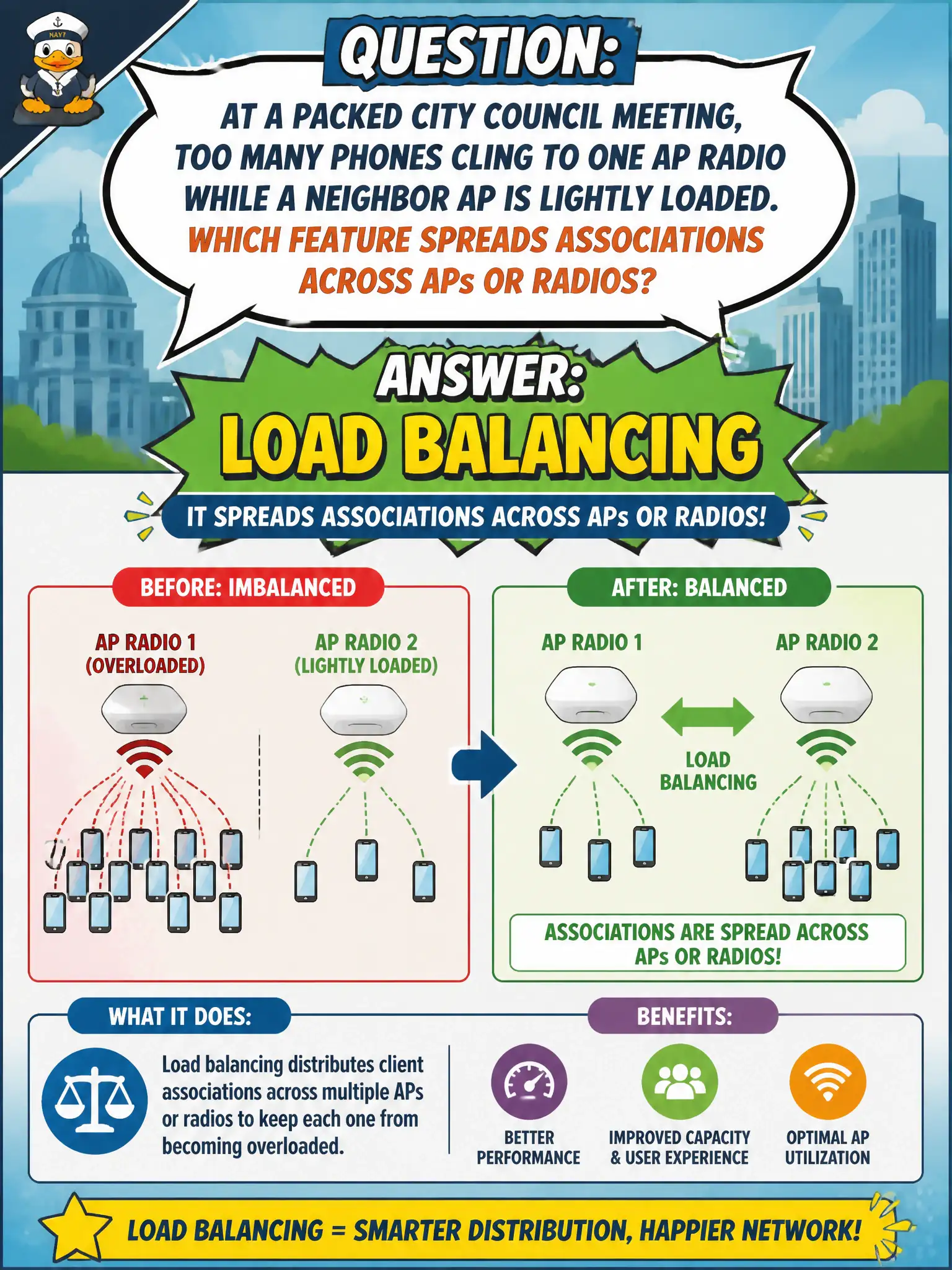
At a packed city council meeting, too many phones cling to one AP radio while a neighbor AP is lightly loaded. Which feature spreads associations across APs or radios?
Select an answer to reveal the explanation.
Short Explanation
When one AP is a mosh pit and the next is empty, load balancing is the feature that spreads the crowd. It reduces overcrowding on a single radio or AP. Isolation and cloaking do not move clients to quieter neighbors.
Full Explanation
At a packed city council meeting, too many phones may cling to one AP radio while a neighbor AP is lightly loaded. Load balancing is the feature that spreads associations across APs or radios according to thresholds and capacity. Used per design, it improves municipal event capacity by discouraging piles of clients on a single radio when alternatives exist.
Client isolation blocks peer traffic; it does not distribute associations across APs. WEP open-system fallback is insecure legacy behavior, not a load distributor. SSID cloaking hides the network name and does not balance clients.
Exam caveat: load balancing addresses uneven association distribution. Do not confuse it with isolation, cloaking, or WEP modes when meetings overload one AP.
Operational check: verify load-balancing thresholds match the council-chamber design, observe associations during a crowd test, and ensure sticky RF holes are not misdiagnosed when balancing is intentionally steering clients. Municipal technicians document the verified setting in the as-built packet so the next shift inherits a known-good civic configuration rather than tribal knowledge. Municipal technicians document the verified setting in the as-built packet so the next shift inherits a known-good civic configuration rather than tribal knowledge.