
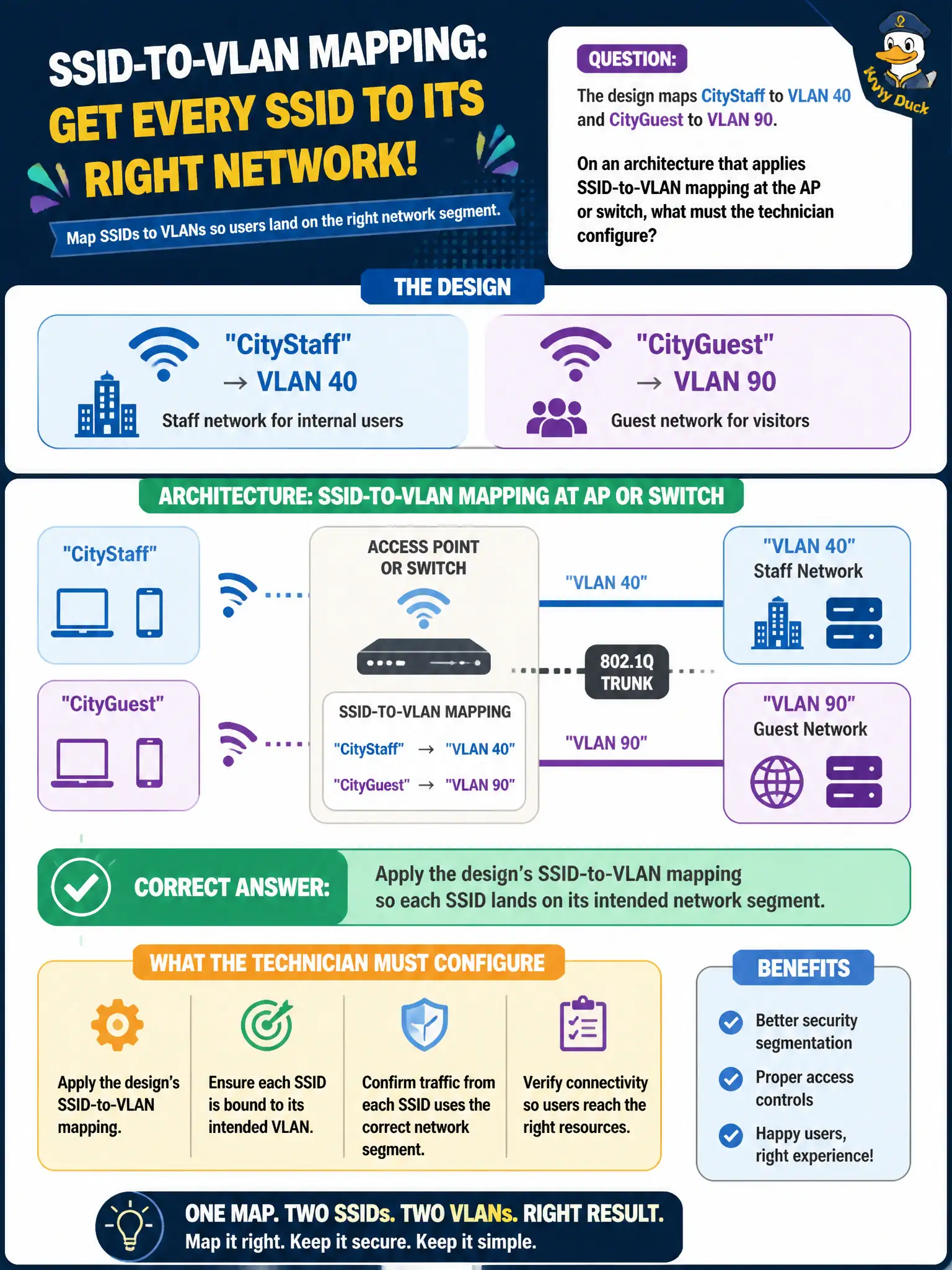
The design maps CityStaff to VLAN 40 and CityGuest to VLAN 90. On an architecture that applies SSID-to-VLAN mapping at the AP or switch, what must the technician configure?
Select an answer to reveal the explanation.
Short Explanation
CityStaff → VLAN 40, CityGuest → VLAN 90—map it like the sheet. Passphrases are not VLANs. Wrong mapping dumps guests onto staff copper and ruins the whole segmentation story.
Full Explanation
Designs that map CityStaff to VLAN 40 and CityGuest to VLAN 90 depend on correct SSID-to-VLAN mapping at the AP or switch architecture in use. The technician must apply that mapping so each SSID lands on its intended network segment. Without it, guests may land on staff networks or staff may hit guest firewalls, breaking both security and service for municipal users and visitors.
Putting both SSIDs on VLAN 1 so tagging is unnecessary everywhere collapses segmentation the design required. Ignoring VLANs and relying on different WPA passphrases for segmentation confuses Layer-2/3 separation with encryption secrets. Bridging CityGuest into the staff VLAN so printers are reachable from guest intentionally breaks guest isolation and policy boundaries.
Exam caveat: passphrase differences do not replace VLAN segmentation. CWTS items that publish VLAN IDs expect those IDs to be configured in the SSID-to-VLAN mapping.
Operational check: configure CityStaff to VLAN 40 and CityGuest to VLAN 90 as designed, verify client DHCP or gateway results differ by SSID, confirm guest cannot reach staff resources, and document the mapping in the switch or AP as-built. Municipal technicians document the verified setting in the as-built packet so the next shift inherits a known-good civic configuration rather than tribal knowledge.