
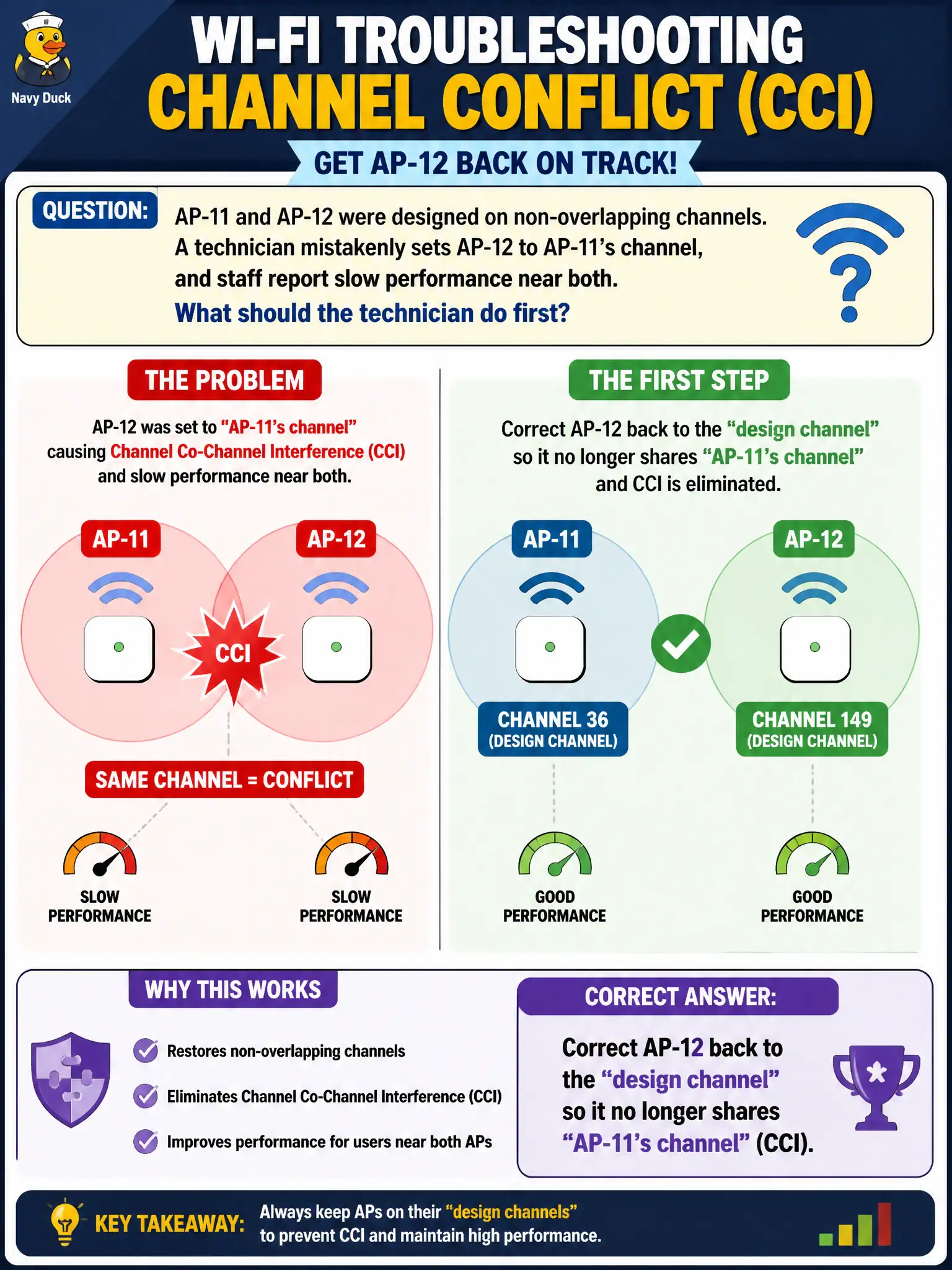
AP-11 and AP-12 were designed on non-overlapping channels. A technician mistakenly sets AP-12 to AP-11’s channel, and staff report slow performance near both. What should the technician do first?
Select an answer to reveal the explanation.
Short Explanation
Same channel on neighbor APs is co-channel interference—classic self-inflicted wound. Put AP-12 back on the design channel and the air calms down. Cranking power just makes the argument louder.
Full Explanation
When AP-11 and AP-12 were designed on non-overlapping channels but a technician mistakenly sets AP-12 onto AP-11’s channel, staff slowdowns near both are classic co-channel interference (CCI). The first corrective action is to return AP-12 to the design channel so the APs no longer share a channel. Restoring the planned channel plan recovers airtime without opening a full RF redesign engagement. Municipal performance tickets frequently start with someone having changed design channels during install.
Doubling both APs’ transmit power to overpower CCI usually worsens contention and sticky-client coverage. Disabling encryption to save airtime on CCMP headers trades security for a negligible myth and does not fix co-channel contention. Converting both APs to autonomous mode with identical BSSIDs invents a bridging mess unrelated to correcting the channel mistake.
Exam caveat: CCI from identical channels is remediated by returning to the design channel plan first—not by power wars, security disablement, or mode conversions outside the ticket.
Operational check: reset AP-12 to its documented non-overlapping channel, confirm AP-11 and AP-12 differ as designed, retest staff throughput in the overlap zone, and note the misconfiguration cause so install QA catches repeats.