
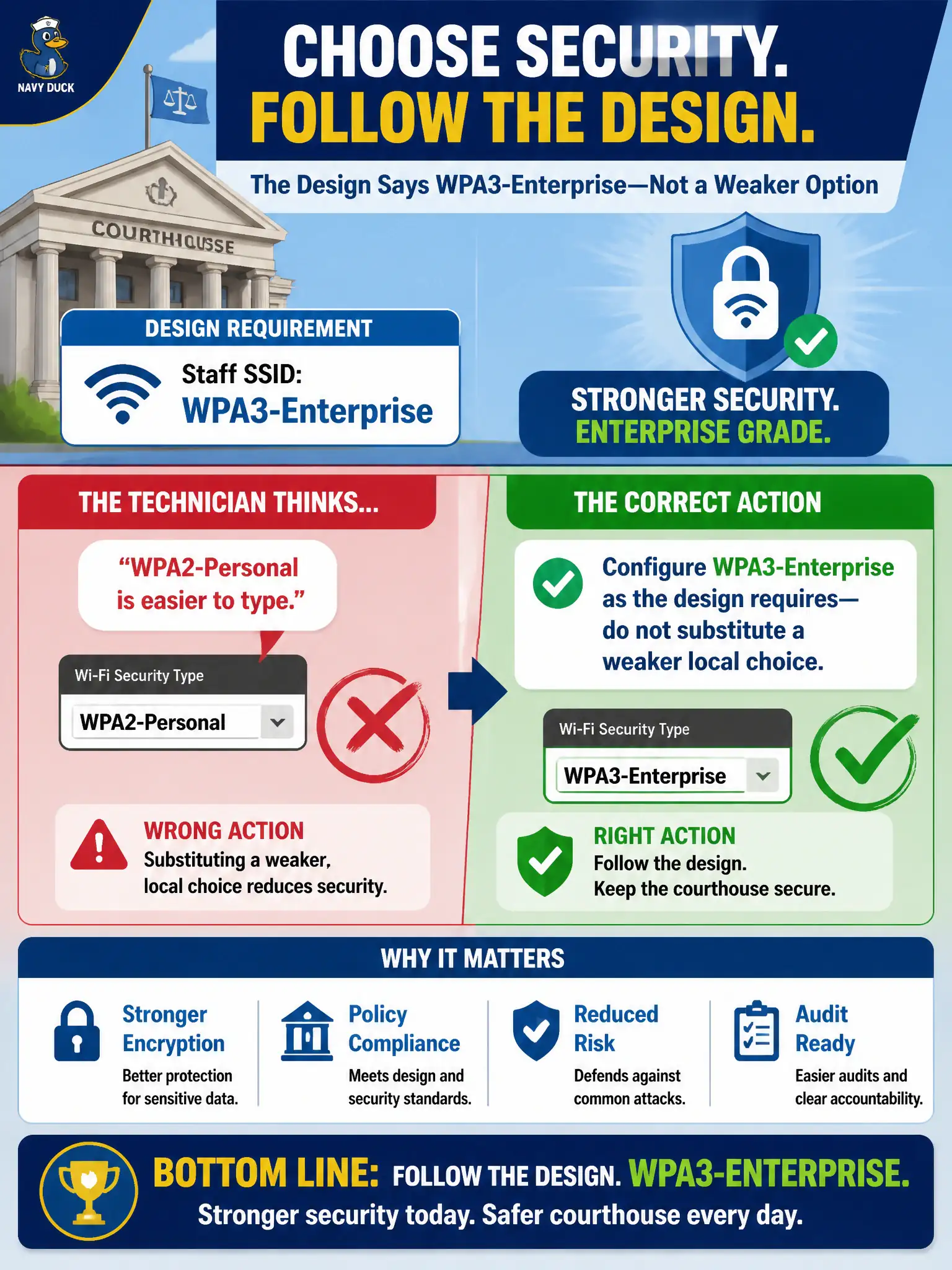
A courthouse design specifies WPA3-Enterprise on the staff SSID. The on-site technician finds WPA2-Personal easier to type. What is the correct action?
Select an answer to reveal the explanation.
Short Explanation
Design says WPA3-Enterprise—that is what goes on the AP. Convenience is not a security profile. Weaker “just for today” choices are how municipal WLANs get soft.
Full Explanation
Courthouse designs that specify WPA3-Enterprise on the staff SSID exist for per-user accountability and modern cryptography. The on-site technician must configure WPA3-Enterprise as required and must not substitute a weaker local choice merely because WPA2-Personal is easier to type. Civic staff networks that carry sensitive casework follow the written security baseline, not closet convenience during cutover.
Using open authentication overnight for faster cutover testing exposes production airtime without encryption and fails municipal policy expectations. Enabling WEP temporarily for legacy chamber clients reintroduces broken ciphers the design already rejected. Hiding the SSID instead of applying any encryption suite confuses obscurity with confidentiality and leaves traffic unprotected on the air.
Exam caveat: ease of typing a PSK never authorizes downgrading an Enterprise design. Escalate genuine client compatibility issues through change control; do not silently weaken security.
Operational check: set the staff SSID to WPA3-Enterprise per design, validate 802.1X success with a test account on a courthouse laptop, confirm no open, WEP, or Personal substitute remains, and attach the validation evidence to the install ticket.