
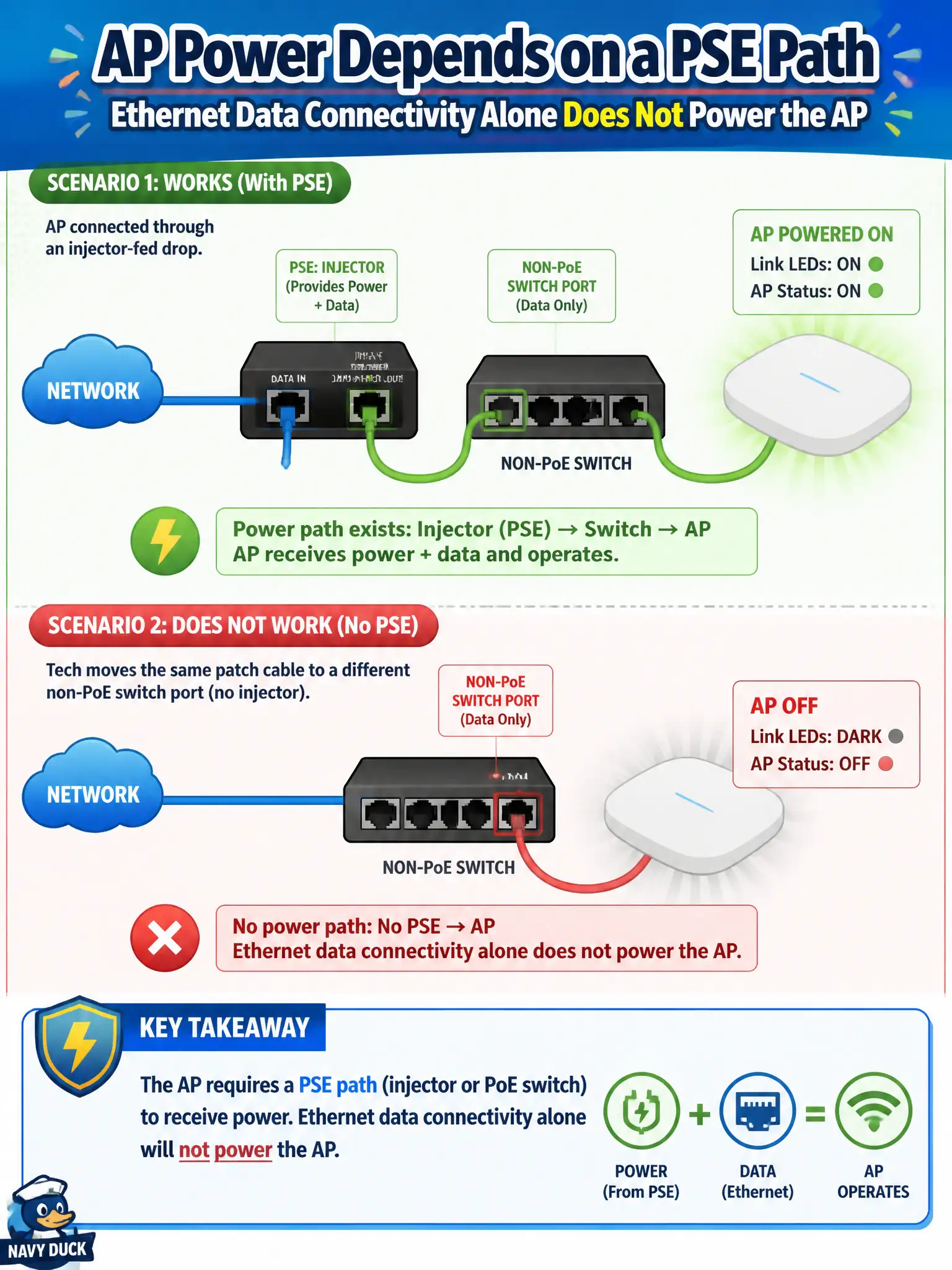
A clinic AP worked on an injector-fed drop. After a tech moves the same patch to a different non-PoE switch port with no injector, the AP has link LEDs dark and stays off. What does this illustrate?
Select an answer to reveal the explanation.
Short Explanation
Data jack ≠ free lunch. That AP was alive because an injector (or PoE switch) was feeding it. Park it on a plain port with no PSE and it goes dark—even if the cable still “looks” like Ethernet.
Full Explanation
Clinic APs that worked on injector-fed drops illustrate a core PoE truth when someone moves the same patch to a different non-PoE switch port with no injector: link LEDs stay dark and the AP stays off because AP power depends on a PSE path—injector or PoE switch—and Ethernet data connectivity alone does not power the AP. Twisted-pair wiring without a PSE is simply unpowered copper. Municipal troubleshooting must separate “cable present” from “power sourced” before escalating radio or controller issues.
Claiming SSID broadcast was disabled by moving the patch cord so the AP cannot boot confuses RF beacon settings with DC power delivery. Saying every AP move requires a full predictive survey before PoE will accept power mixes RF redesign scope with basic PSE presence. Asserting that WPA3-Enterprise keys live in the injector so authentication power fails without it invents cryptographic storage inside midspan gear.
Exam caveat: a dark AP after a patch move to a non-PoE port is a power-path problem first, not an encryption, SSID, or survey problem at CWTS depth.
Operational check: restore an injector or PoE switch port on the clinic drop, confirm AP boot and client association, update the port map so future moves keep a documented PSE path, and note the outage cause in the ticket for facilities training.