
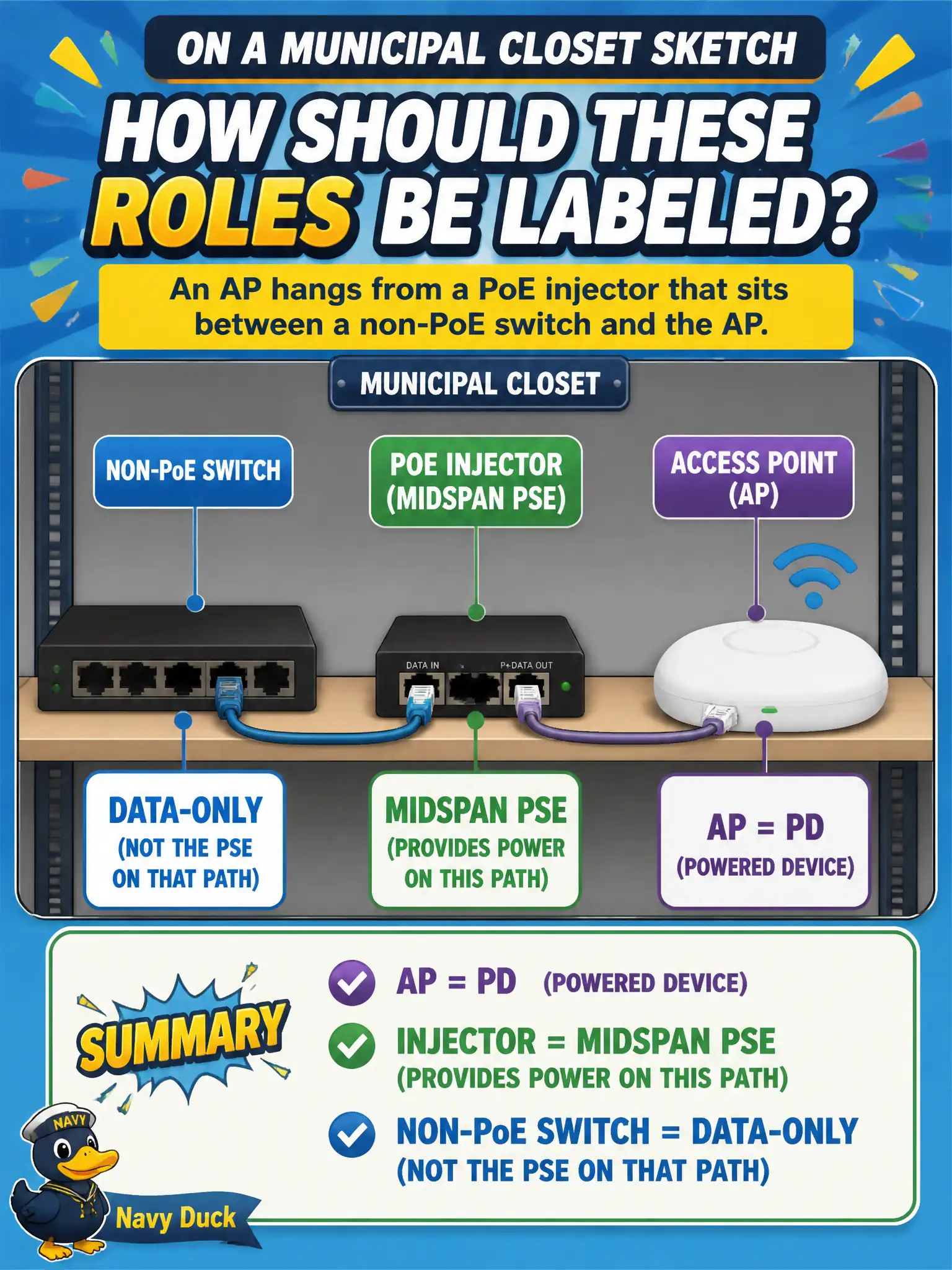
On a municipal closet sketch, an AP hangs from a PoE injector that sits between a non-PoE switch and the AP. How should those roles be labeled?
Select an answer to reveal the explanation.
Short Explanation
Picture the food chain: AP eats (PD), injector cooks in the middle (midspan PSE), plain switch just passes data. Label it that way on the closet sketch and future techs will thank you.
Full Explanation
Municipal closet sketches that show an injector between a non-PoE switch and an AP must label roles correctly: the AP is the powered device (PD), the injector is the midspan PSE, and the non-PoE switch is data-only—not the PSE on that path. Clear labeling prevents later technicians from chasing PoE settings on a switch that never sourced power. Documentation quality is part of maintainable civic WLAN installs and speeds after-hours troubleshooting.
Labeling the AP as PSE, the injector as PD, and the switch as midspan endpoint reverses every role on the link. Calling the switch the PD and the AP a midspan PSE invents a nonsensical topology. Claiming all three devices are endpoint PSEs because Ethernet always sources power erases the midspan-versus-endpoint distinction and ignores switches that provide data only.
Exam caveat: midspan topology specifically means the injector—not the switch—is the PSE. Endpoint PSE applies when the switch itself sources PoE on its ports.
Operational check: annotate the sketch with PD, midspan PSE, and data-only switch labels, verify power appears only with the injector inline, and file the labeled drawing with the municipal closet packet for the next change window.