
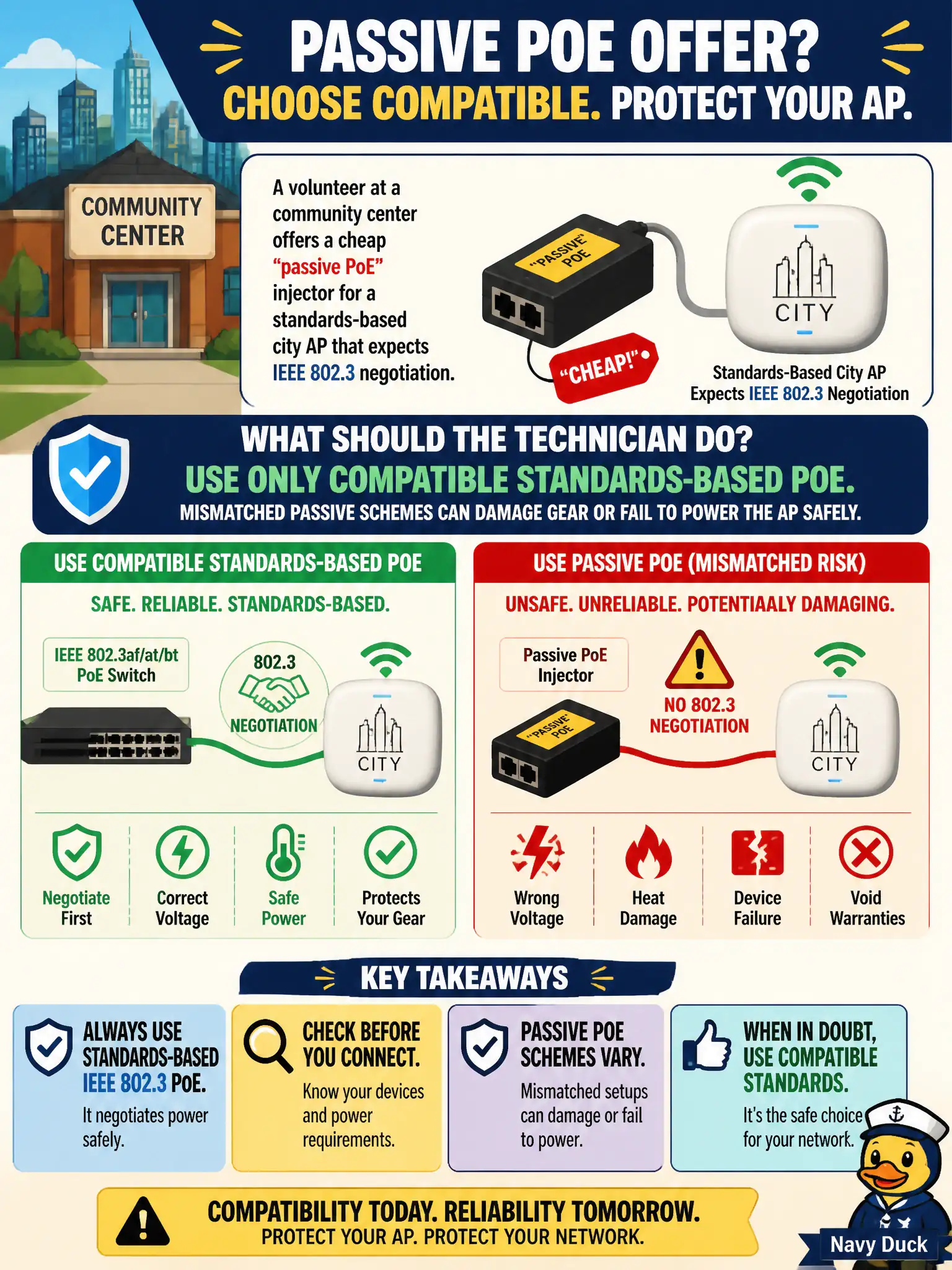
A volunteer at a community center offers a cheap “passive PoE” injector for a standards-based city AP that expects IEEE 802.3 negotiation. What should the technician do?
Select an answer to reveal the explanation.
Short Explanation
“Passive PoE” and real IEEE PoE are not the same animal. Wrong voltage or always-on power can fry an AP that expected polite negotiation. Stick to the standards-based PSE the design calls for.
Full Explanation
Community-center volunteers sometimes offer cheap “passive PoE” injectors for city APs that expect IEEE 802.3 negotiation. The technician must use only compatible standards-based PoE; mismatched passive schemes can damage gear or fail to power the AP safely. IEEE 802.3af/at/bt-style negotiation protects PSE and PD; passive injectors may apply voltage without that handshake and with incompatible pinouts or voltages. Municipal assets deserve standards-compliant power paths, not bargain-bin risk at a volunteer closet.
Always preferring passive injectors because they supposedly deliver higher voltage than any IEEE PoE switch fails as an unsafe generalization and ignores negotiation requirements. Mixing passive and IEEE PoE on the same pairs to double available watts can damage ports and violates proper PSE design. Accepting any injector labeled PoE because pinouts never matter for WLAN APs ignores real pinout and voltage mismatches that brick civic hardware.
Exam caveat: a retail “PoE” label is not proof of IEEE compatibility. CWTS stresses safe PSE/PD pairing over improvisation when powering city access points.
Operational check: refuse passive injectors for IEEE-expecting city APs, deploy an approved 802.3-compatible injector or PoE switch, verify successful negotiation via LEDs or logs, and record the PSE type in the community-center install inventory.