
A municipal warehouse must keep its existing non-PoE switches but still power new APs over Ethernet. Which PSE approach fits that constraint?
Select an answer to reveal the explanation.
Short Explanation
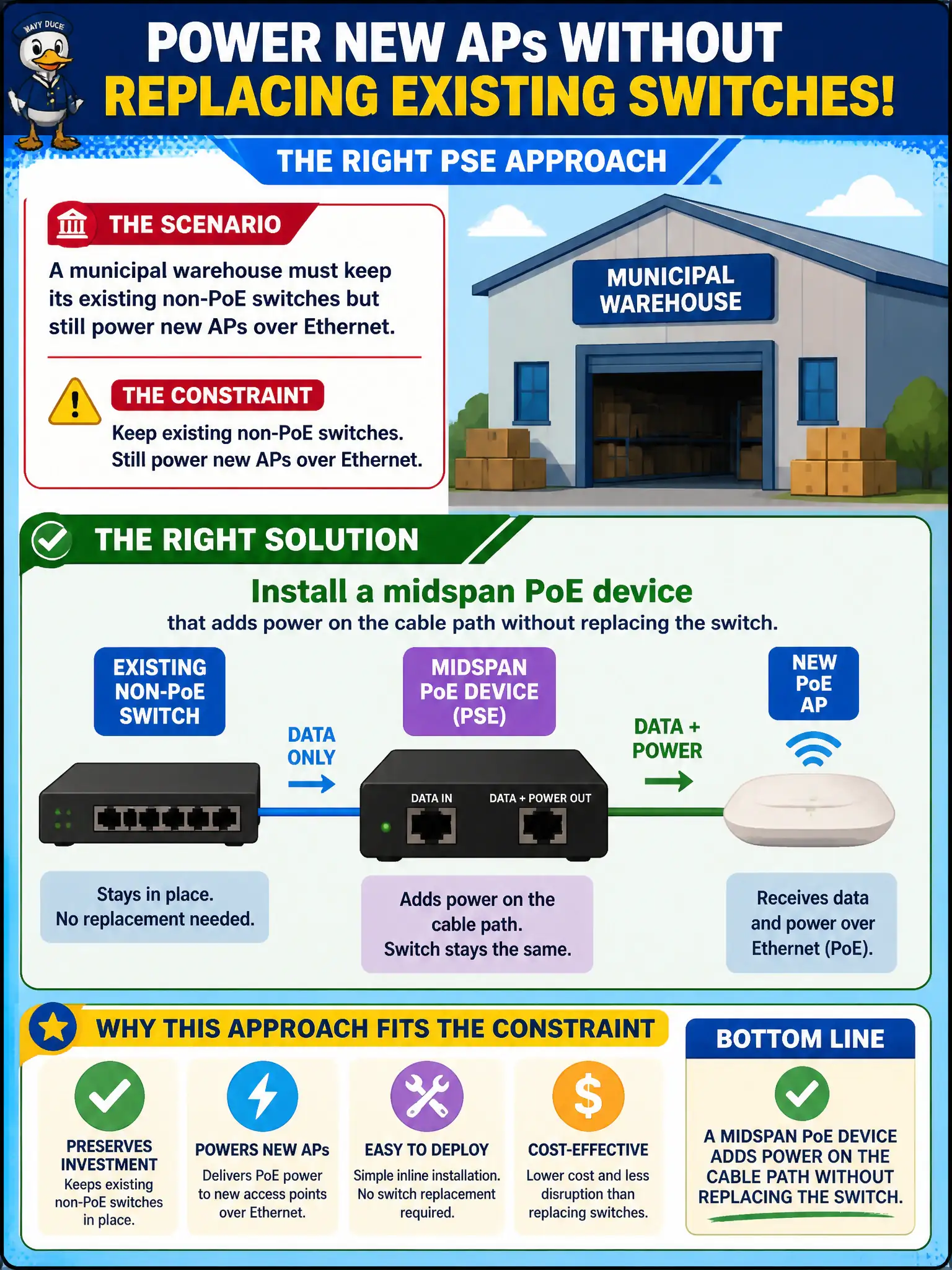
Stuck with a plain switch? Drop a midspan injector in the path—power joins the party without ripping out the switch. The AP still drinks; the old switch still only does data.
Full Explanation
Municipal warehouses frequently must keep existing non-PoE switches yet still power new APs over Ethernet. The PSE approach that fits that constraint is installing a midspan PoE device that adds power on the cable path without replacing the closet switch. Data continues through the legacy switch while the midspan injector supplies negotiated power to the AP PD. That preserves budget and change-control limits common in civic facilities.
Configuring the AP for “software PoE” so no PSE hardware is required fails: PoE needs real PSE hardware delivering DC power—there is no software-only substitute. Enabling WMM so QoS supposedly injects DC power on unused pairs confuses multimedia QoS with power sourcing. Raising transmit power so radios harvest energy from nearby clients invents RF energy harvesting that does not replace Ethernet PoE for AP boot and operation.
Exam caveat: midspan is the classic answer when the switch cannot be replaced; do not equate “keep non-PoE switch” with “skip PoE entirely” or with endpoint PSE labeling.
Operational check: place a compatible IEEE midspan injector on the warehouse AP drop, verify PD negotiation and AP boot under radio load, and label the injector as the PSE in the closet documentation so later techs do not hunt for PoE on the switch.