
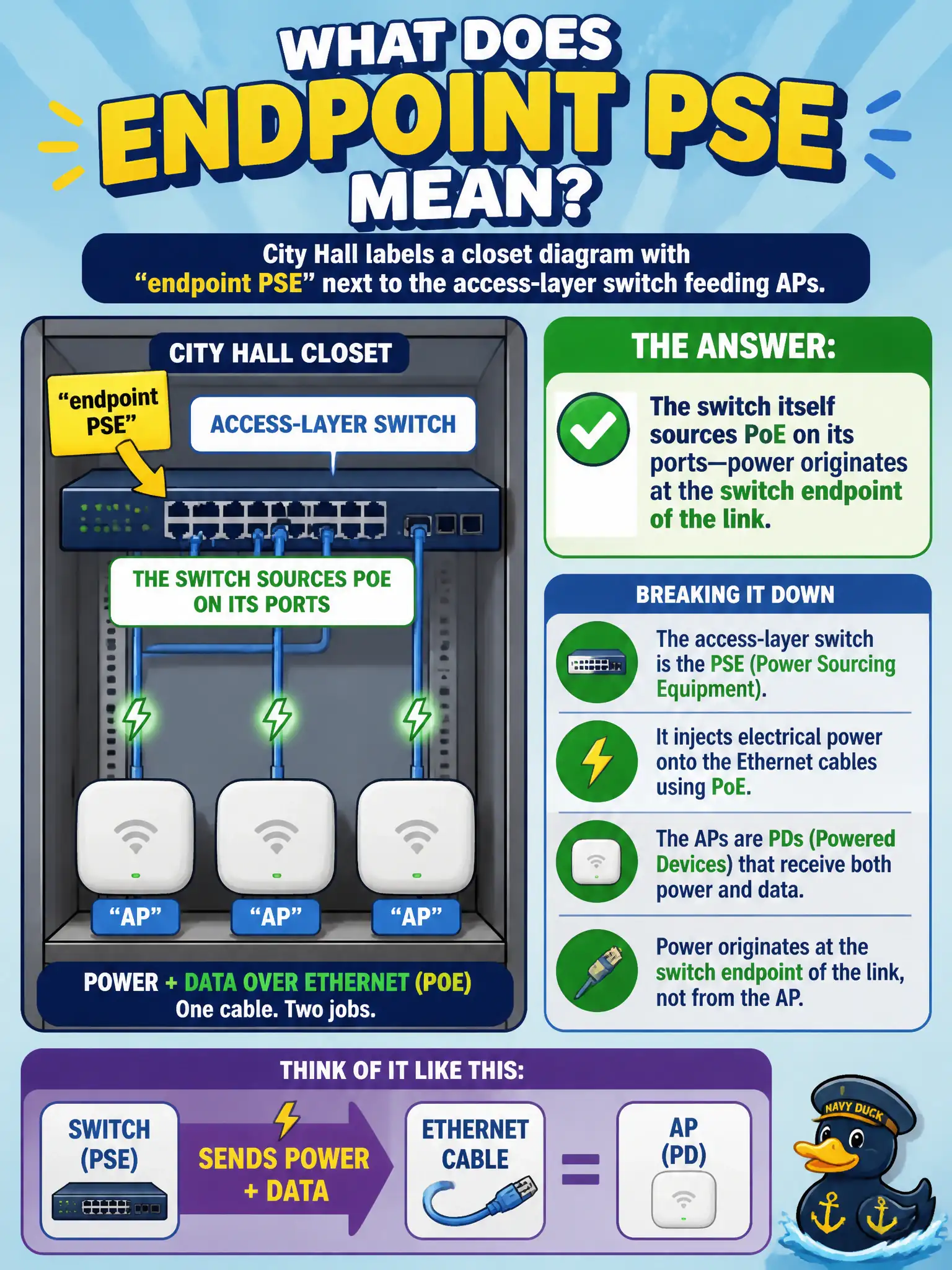
City Hall labels a closet diagram with “endpoint PSE” next to the access-layer switch feeding APs. What does endpoint PSE mean in this context?
Select an answer to reveal the explanation.
Short Explanation
Endpoint PSE is the friendly way of saying the switch is the power plant. Power starts at the switch port, rides the cable, and feeds the AP. Midspan is the other flavor—an injector in the middle.
Full Explanation
City Hall closet diagrams often label “endpoint PSE” next to the access-layer switch that feeds APs. In this context, endpoint PSE means the switch itself sources PoE on its ports—power originates at the switch endpoint of the Ethernet link rather than from a separate midspan box. The AP remains the powered device. That vocabulary helps municipal teams document whether closet switching or injectors provide power for each civic AP path.
Saying power is injected only by a midspan box and the switch never sources PoE describes midspan PSE, not endpoint PSE—so the label would be wrong for a PoE switch. Claiming the AP itself is the endpoint PSE and pushes power back to the switch reverses PD and PSE roles. Defining endpoint PSE as only USB-C docks powering WLAN APs invents an unrelated powering method and ignores IEEE PoE switch terminology.
Exam caveat: endpoint versus midspan is about where the PSE sits on the link, not about whether PoE is “better.” Both can be valid municipal designs; the diagram label must match the actual power source.
Operational check: on the City Hall drawing, mark each AP path as endpoint (PoE switch) or midspan (injector), confirm live ports show PoE enabled where labeled endpoint, and update inventory so future moves do not assume injectors exist on switch-powered drops.