
A parks department run to an outdoor pavilion uses Cat5e toward a PoE AP. Before blaming the AP, what practical PoE delivery awareness should the technician apply?
Select an answer to reveal the explanation.
Short Explanation
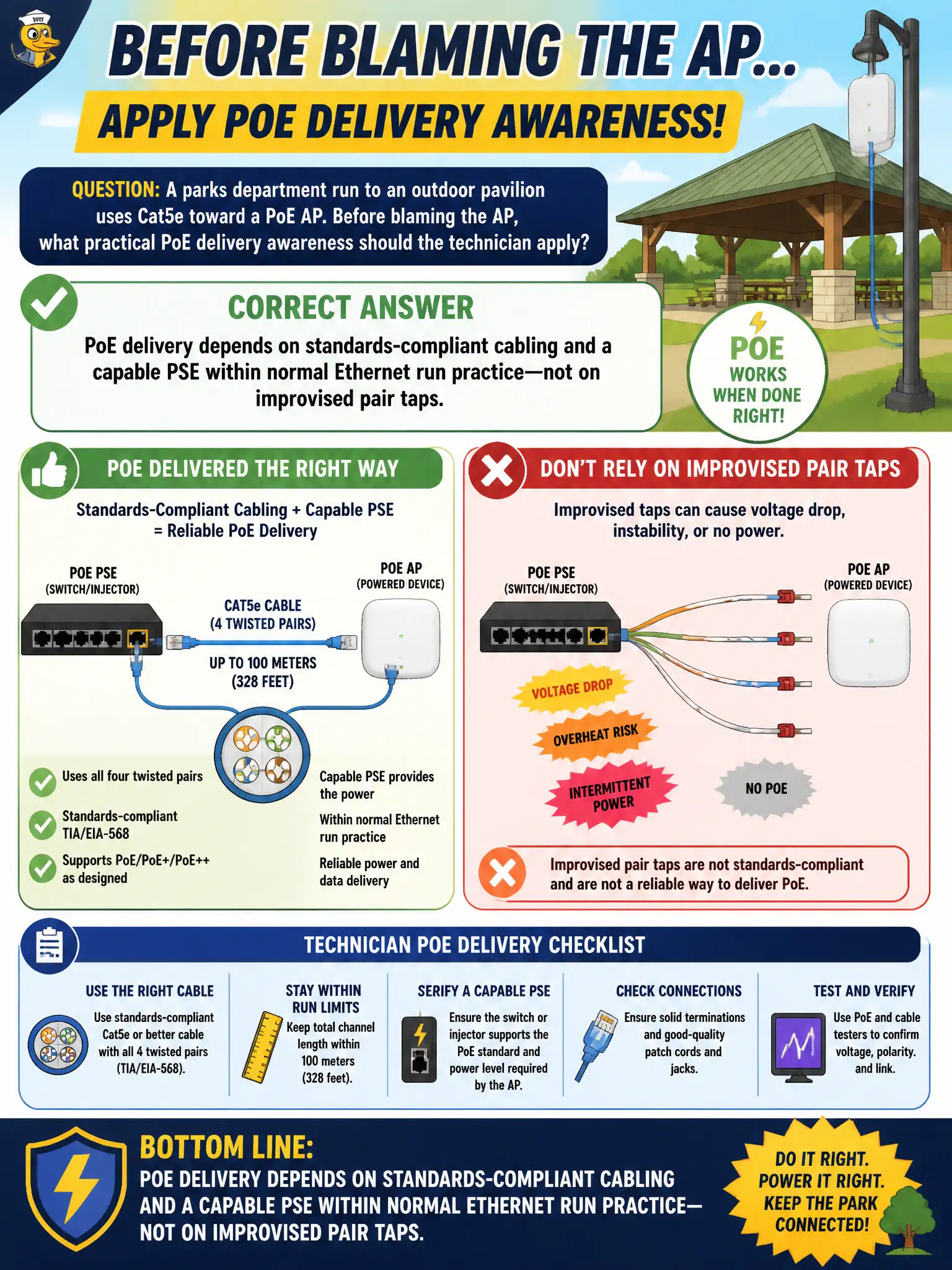
PoE is not magic fairy dust on every random wire. You need decent copper, a real PSE, and runs that stay inside normal Ethernet practice. If the path is junk, the AP starves even when the switch says “PoE on.”
Full Explanation
Parks runs to outdoor pavilions often use Cat5e toward PoE APs across long outdoor pathways. Before blaming the AP hardware, the technician must apply practical PoE delivery awareness: successful power depends on standards-compliant twisted-pair cabling and a capable PSE within normal Ethernet run practice—not on improvised pair taps or wishful media myths. Damaged pairs, excessive length, poor terminations, or a weak PSE defeat PoE even when the AP itself is healthy. Civic outdoor installs fail more often on plant and PSE than on mysterious radio defects.
Claiming PoE always works at any cable length because voltage rides in a fiber core of Cat5e fails conceptually: Cat5e is copper twisted pair, not fiber-core power delivery, and length/attenuation still matter. Insisting only Cat3 voice cable is rated for PoE so Cat5e must be replaced inverts cable practice; Cat5e/Cat6 families are the normal PoE plant. Saying cable length is irrelevant and only SSID encryption type affects PoE negotiation confuses RF security suites with PSE/PD DC power negotiation.
Exam caveat: CWTS expects technicians to validate the Ethernet power path before escalating to AP RMA. Encryption settings never substitute for a working PSE and compliant copper run.
Operational check: verify cable category/condition and length against PoE guidance, confirm PSE class and port status, test with a known-good injector or PoE tester at the pavilion drop, and only then suspect the AP if power delivery still fails.