
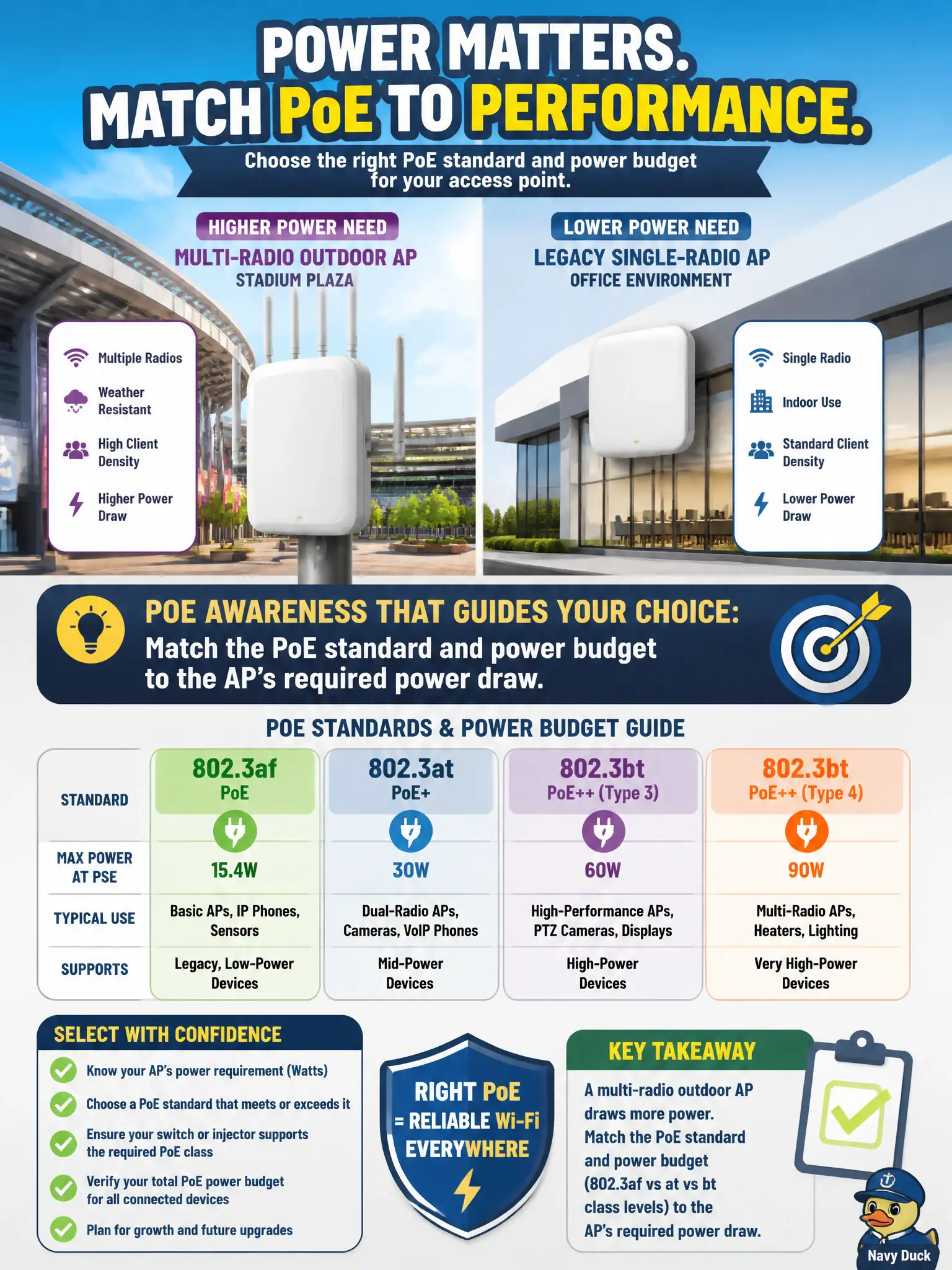
A multi-radio outdoor AP for a stadium plaza draws more power than a legacy single-radio office AP. What PoE awareness should guide switch/injector selection?
Select an answer to reveal the explanation.
Short Explanation
More radios usually means a bigger appetite. Check whether the port is af, at, or bt-class enough before the AP browns out at kickoff. Speed settings do not feed wattage.
Full Explanation
A multi-radio outdoor AP for a stadium plaza that draws more power than a legacy single-radio office AP requires matching the PoE standard and power budget—for example 802.3af versus at versus bt class levels—to the AP's required power draw. Higher radio counts and outdoor features often need more wattage than older af-only ports supply. Technicians must read AP power requirements and PSE capabilities before plaza install day to avoid brown-outs at kickoff.
Any 802.3af port does not always supply enough power for every modern multi-radio AP regardless of draw. PoE class is not irrelevant with only Ethernet speed mattering for AP power—link speed settings do not feed watts to the radios. Disabling PoE and running AC mains through the Ethernet jack for higher wattage is unsafe and incorrect for municipal installs.
Exam caveat: map AP power draw to PSE standard and budget; multi-radio outdoor units often need at or bt-class power. Operational check: read the plaza AP's wattage requirement, confirm switch or injector budget and PoE standard meet or exceed it, boot the AP, and verify all radios come up without brown-out or PoE fault logs. Re-check PoE budget after adding cameras or other PDs to the same plaza switch so the multi-radio AP does not lose power unexpectedly.