
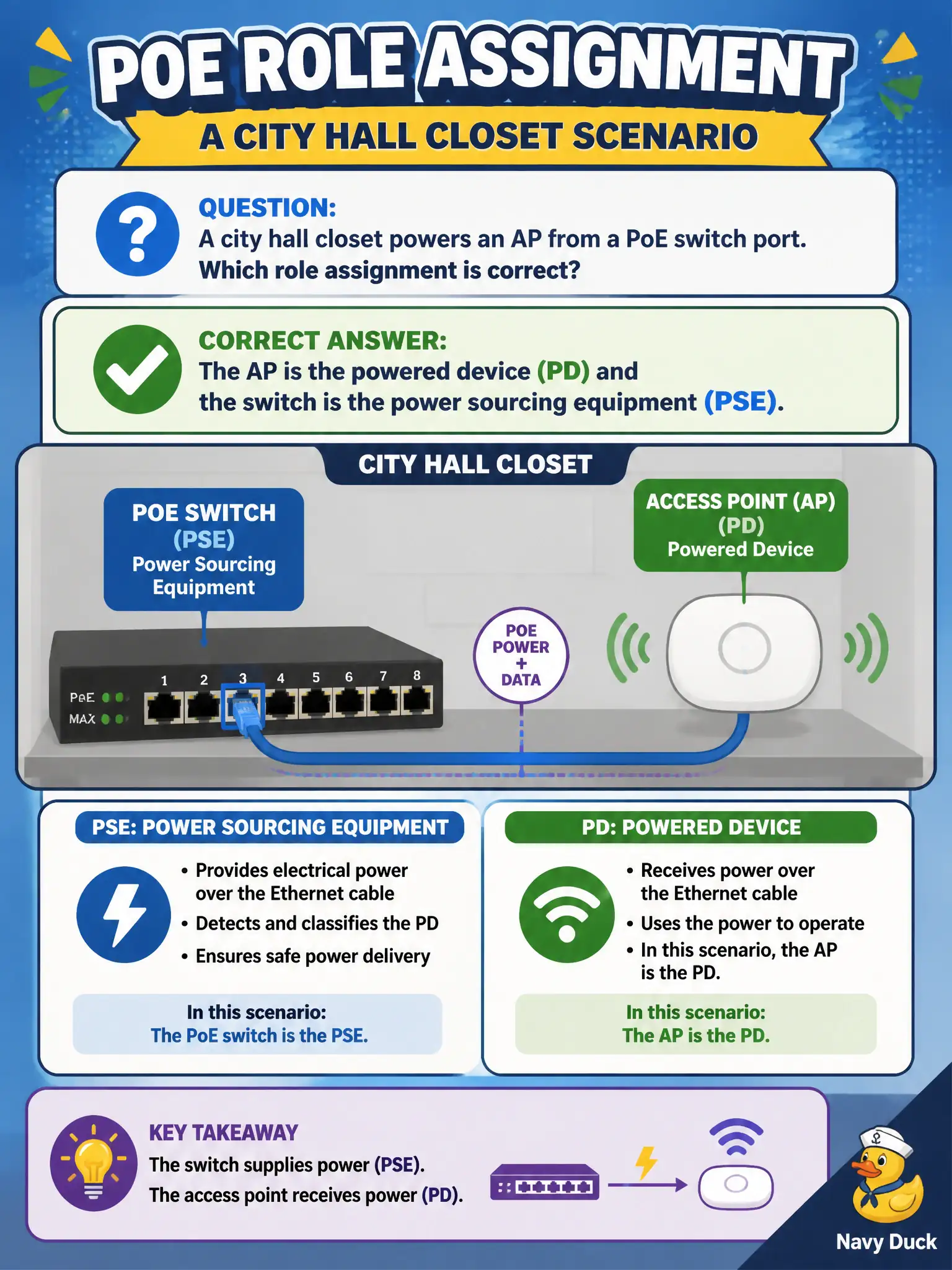
A city hall closet powers an AP from a PoE switch port. Which role assignment is correct?
Select an answer to reveal the explanation.
Short Explanation
Remember who is hungry and who is cooking: the AP eats power (PD), the switch cooks and serves it (PSE). Flip those labels and every PoE diagram starts lying to you.
Full Explanation
When a city hall closet powers an AP from a PoE switch port, the AP is the powered device (PD) and the switch is the power sourcing equipment (PSE). PoE role assignment is foundational: the PSE sources DC power over Ethernet, and the PD draws that power to operate the radios and electronics. Correct labeling prevents confusion during municipal closet troubleshooting, capacity planning, and ticket handoffs between network and facilities teams.
The AP is not the PSE with the switch waiting as a PD for power from the AP. Both devices are not PDs on the claim that Ethernet never sources power—PoE switches do source power by design. PSE and PD roles are not limited to USB chargers; they apply directly to 802.3 PoE WLAN installs in civic buildings and closets.
Exam caveat: remember PSE sources, PD consumes—switch or injector versus AP is the classic mapping. Operational check: identify the closet switch as PSE, confirm the AP negotiates as PD, check PoE port status for allocated power draw, and remediate if the AP fails to power due to budget or PoE standard mismatch. Label PSE switch ports with AP names and expected wattage class to speed after-hours troubleshooting in city hall closets.