
A temporary city inspection trailer has a non-PoE switch but needs to power one indoor AP over Ethernet. What should the technician use, and how is that PSE role commonly classified?
Select an answer to reveal the explanation.
Short Explanation
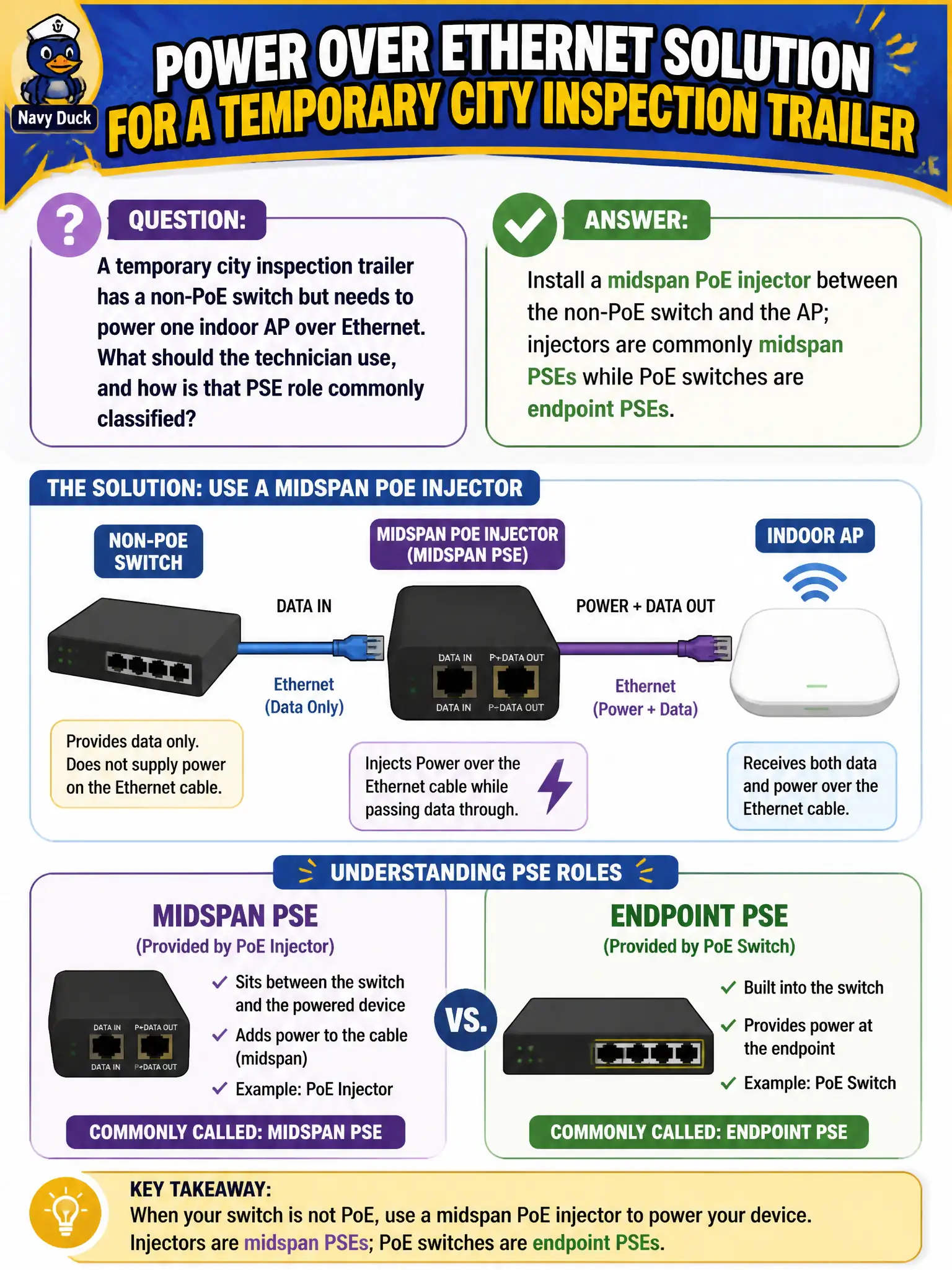
No PoE switch? Slide an injector into the middle of the run—that midspan PSE adds power without replacing the whole switch. The AP still sits at the far end as the PD.
Full Explanation
A temporary city inspection trailer with a non-PoE switch that still needs to power one indoor AP over Ethernet should use a midspan PoE injector between the non-PoE switch and the AP; injectors are commonly midspan PSEs while PoE switches are endpoint PSEs. The injector adds power on the Ethernet path without replacing the trailer switch. The AP remains the PD at the far end of the powered copper link serving inspectors.
Replacing copper Ethernet with pure fiber to the AP makes PoE impossible and does not solve powering the AP over the existing copper design. Asking the AP to source power back into the non-PoE switch as if the AP were the PSE reverses PD and PSE roles. Using a passive USB charger spliced into pairs without PoE negotiation is unsafe and nonstandard for 802.3 AP powering on civic trailers.
Exam caveat: midspan injector equals PSE when the switch is not PoE; endpoint PSE equals PoE switch—keep the AP as PD. Operational check: install a standards-based midspan injector sized for the AP's draw, connect switch to injector to AP, confirm PD negotiation succeeds, and verify the inspection-trailer AP boots and serves the temporary SSID. Prefer injector models that support the AP's PoE standard with headroom, and secure the injector inside the trailer away from trip hazards.