
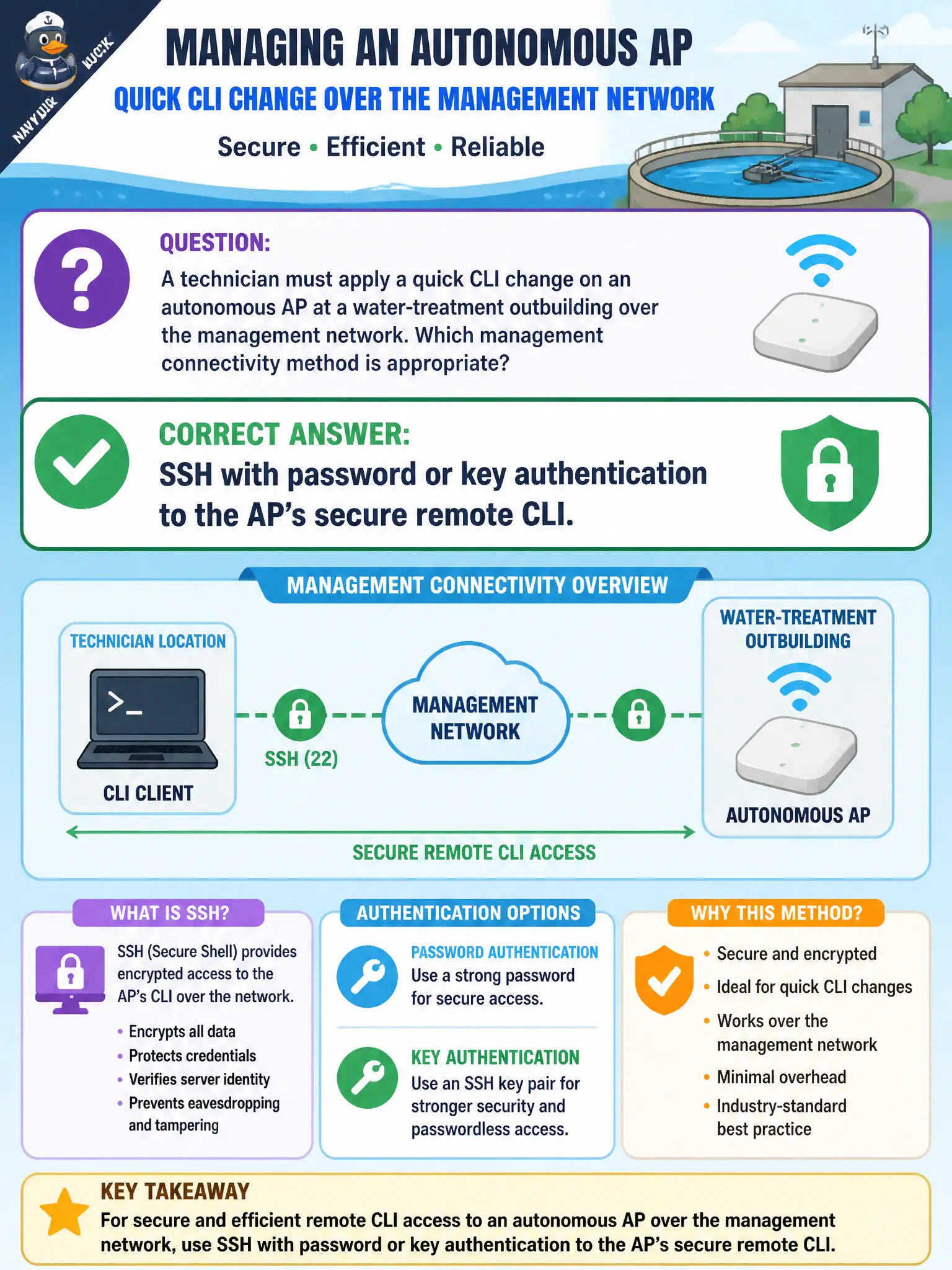
A technician must apply a quick CLI change on an autonomous AP at a water-treatment outbuilding over the management network. Which management connectivity method is appropriate?
Select an answer to reveal the explanation.
Short Explanation
SSH is the standard secure remote screwdriver for AP CLIs—password or key, encrypted tunnel, done. Emailing configs or yelling NetBIOS into the LAN is not a management plan.
Full Explanation
Applying a quick CLI change on an autonomous AP at a water-treatment outbuilding over the management network is appropriately done with SSH using password or key authentication to the AP's secure remote CLI. SSH encrypts the session and is the standard secure remote management method for municipal AP CLIs when IP management is healthy. Prefer SSH whenever it is enabled and reachable on the outbuilding management path.
Using unencrypted Telnet only, even though SSH is enabled and reachable, unnecessarily exposes credentials and configuration commands on the utility network. SMTP email commands to the AP with no authentication are not a valid AP management channel. Broadcast NetBIOS name announcements cannot securely push configuration to an autonomous AP at a treatment facility.
Exam caveat: choose SSH for remote CLI on reachable management networks—Telnet is the insecure distractor. Operational check: SSH to the outbuilding AP management address, authenticate with vaulted credentials or keys, apply the CLI change, save configuration, and confirm Telnet remains disabled before closing the change window. Use change windows for water-treatment AP CLI edits and keep a console cable on site if SSH becomes unreachable mid-change.