
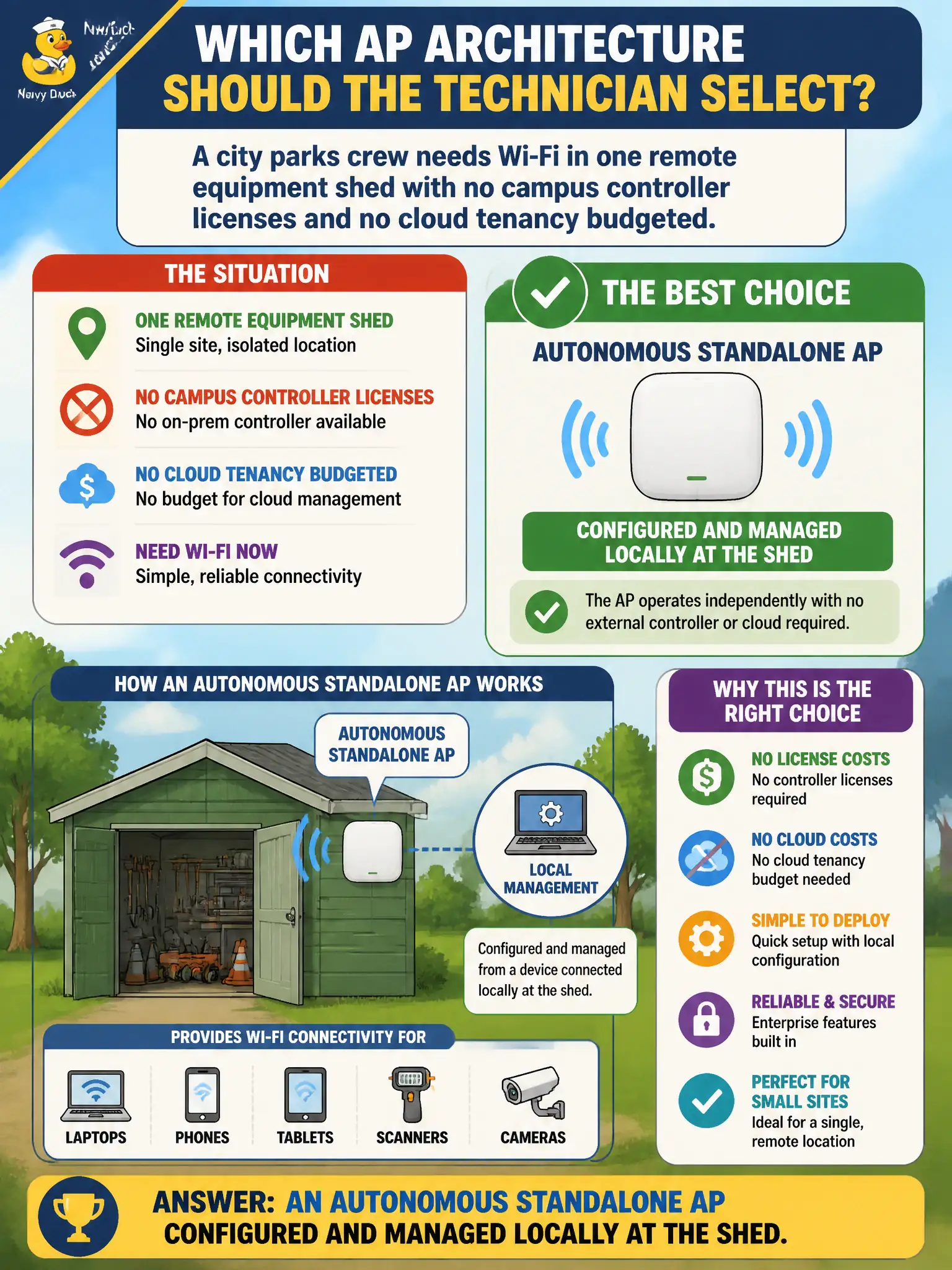
A city parks crew needs Wi-Fi in one remote equipment shed with no campus controller licenses and no cloud tenancy budgeted. Which AP architecture should the technician select for that single site?
Select an answer to reveal the explanation.
Short Explanation
One lonely shed does not need a whole orchestra conductor. An autonomous AP is the solo act—set it up on site and it plays without a controller license or cloud seat. Match the architecture to the scale you actually have.
Full Explanation
A city parks crew needing Wi-Fi in one remote equipment shed with no campus controller licenses and no cloud tenancy budgeted should select an autonomous standalone AP configured and managed locally at the shed. That architecture avoids controller join requirements and cloud subscriptions the city explicitly did not fund. Local configuration meets a single-site, low-budget municipal use case without introducing unfunded dependencies.
A controller-based lightweight AP that must join a downtown WLC before serving clients fails when licenses and WAN dependency are unavailable. Building a full mesh of outdoor bridge APs pointed at city hall overserves a single shed requirement. A cloud-managed AP that still requires a paid cloud dashboard subscription the city refused does not fit the budget constraint stated in the stem.
Exam caveat: architecture selection follows licensing and management constraints—autonomous is correct when controller and cloud are both off the table. Operational check: configure the shed AP locally with the parks SSID and security settings, save to onboard storage, verify client association inside the shed, and document local admin credentials in the city's approved secret store.