
A county courthouse design package calls for an AP in a long public hallway and lists directional external antennas instead of the usual omnidirectional internals. What antenna consideration should the technician honor when selecting and installing that AP?
Select an answer to reveal the explanation.
Short Explanation
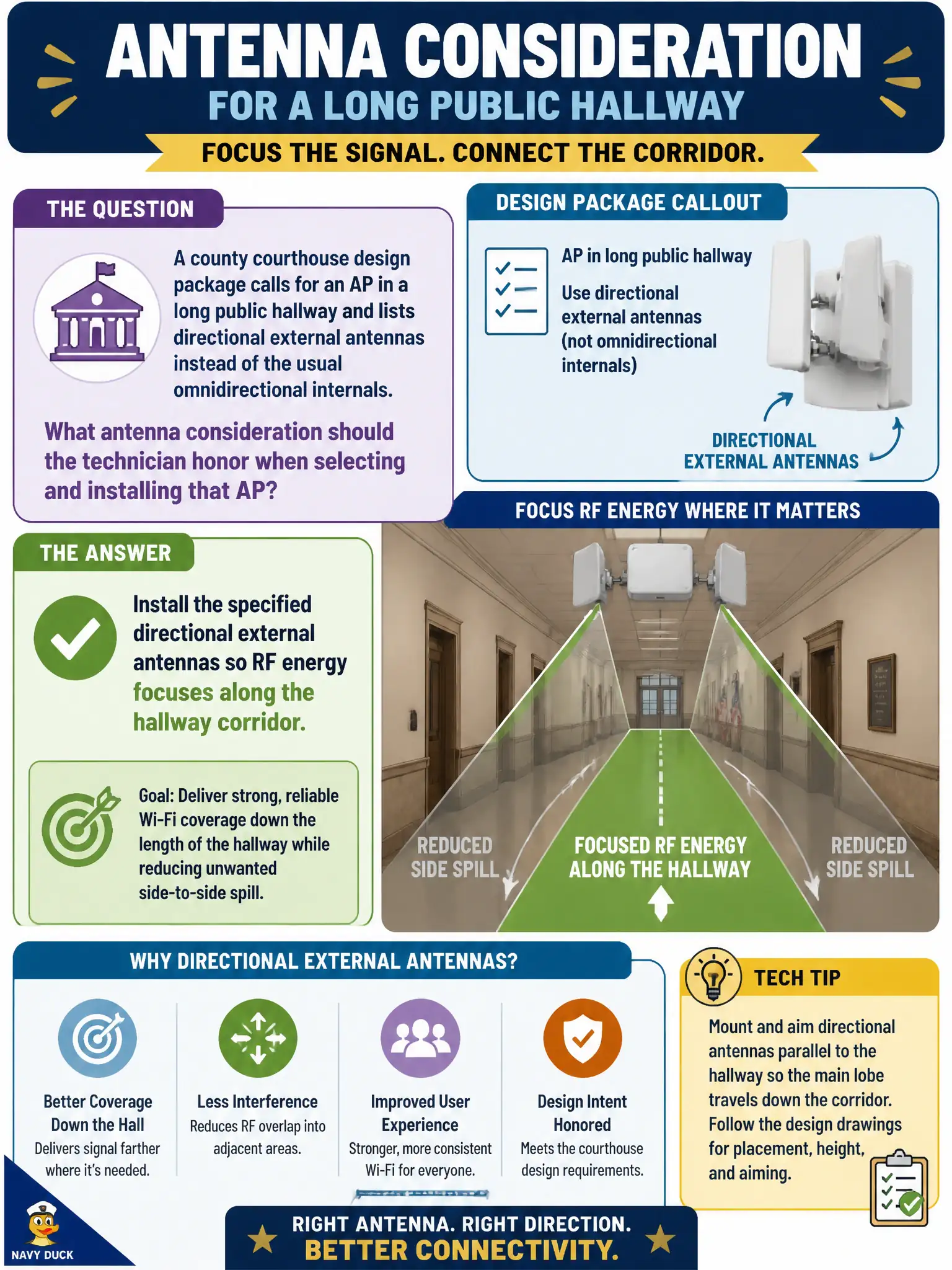
Think of a hallway like a bowling lane—you want the ball to roll down the lane, not bounce into every side room. Directional antennas aim the RF where the design says people walk. Honor that call-out instead of improvising an omni spray.
Full Explanation
When a county courthouse design package places an AP in a long public hallway and lists directional external antennas instead of usual omnidirectional internals, the technician should install the specified directional external antennas so RF energy focuses along the hallway corridor. Antenna pattern selection is a deliberate design tool for covering linear civic spaces without unnecessarily illuminating adjacent courtrooms. Honoring the antenna note preserves the intended coverage geometry for public circulation.
Ignoring the antenna note and reusing leftover indoor omni antennas from the records room changes the pattern and may interfere with adjacent spaces. Mounting the AP outdoors on a light pole to rely on bleed-through abandons the hallway design. Replacing directional antennas with high-gain omnis to flood every adjacent courtroom equally contradicts the corridor-focus intent.
Exam caveat: antenna type and pattern are install requirements when the design specifies them—not optional accessories. Operational check: mount the specified directional antennas with correct orientation along the hallway, verify connector seating and grounding per instructions, and walk the corridor to confirm coverage concentration matches the design sketch.