
After adjusting sticky-client settings for county warehouse scanners, the technician needs to confirm the fix. What validation best proves mobility improved?
Select an answer to reveal the explanation.
Short Explanation
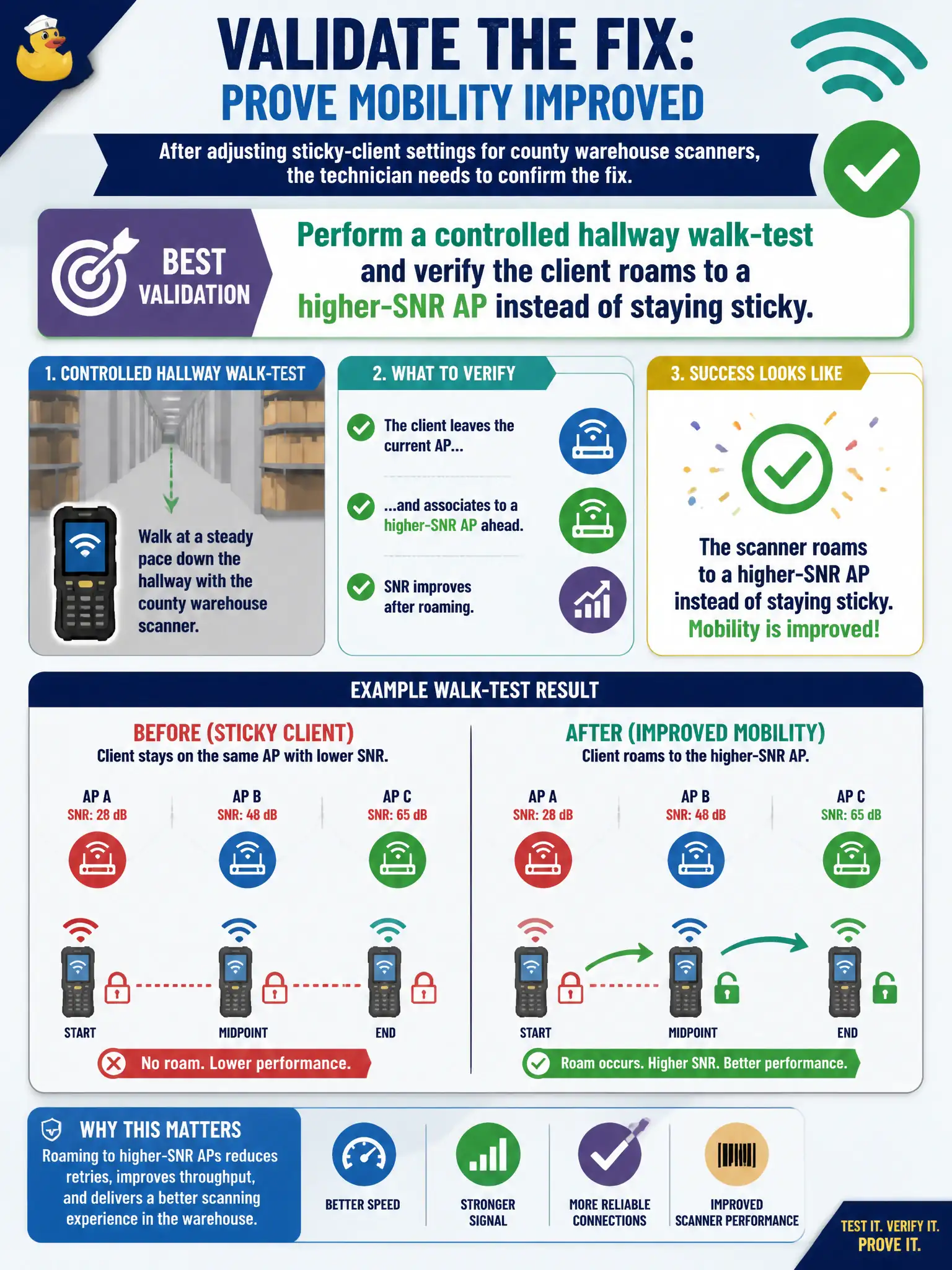
Mobility fixes get proven on a walk—watch the scanner leave the old AP for a stronger neighbor. Standing still under one AP doesn’t test roam. Get eyes on BSSID and SNR while moving.
Full Explanation
After adjusting sticky-client settings for county warehouse scanners, the technician confirms the fix by performing a controlled hallway walk-test and verifying the client roams to a higher-SNR AP instead of staying sticky. Mobility validation requires observing BSSID changes and RF quality during motion. Subjective email alone is insufficient evidence for civic change control.
Only pinging the default gateway once while standing still under the original AP fails because a stationary ping cannot prove roam improvement. Deleting the SSID from the controller and recreating it without testing any roam fails change discipline and does not validate stickiness fixes. Relying solely on a user’s email that “it feels better” with no association or SNR observation fails as unverified anecdote.
Exam caveat: mobility fixes need walk-test evidence—BSSID/SNR/rate under motion—not stillness or vibes.
Operational check: walk the warehouse path with the scanner; record old vs new BSSID, SNR, and rate at decision points; confirm roam to the nearer higher-SNR AP; attach results to the change ticket before closing. Attach walk-test screenshots or notes (BSSID, SNR, rate at each checkpoint) to the warehouse change record so sticky-client mitigations are proven under motion, not by a stationary ping.