
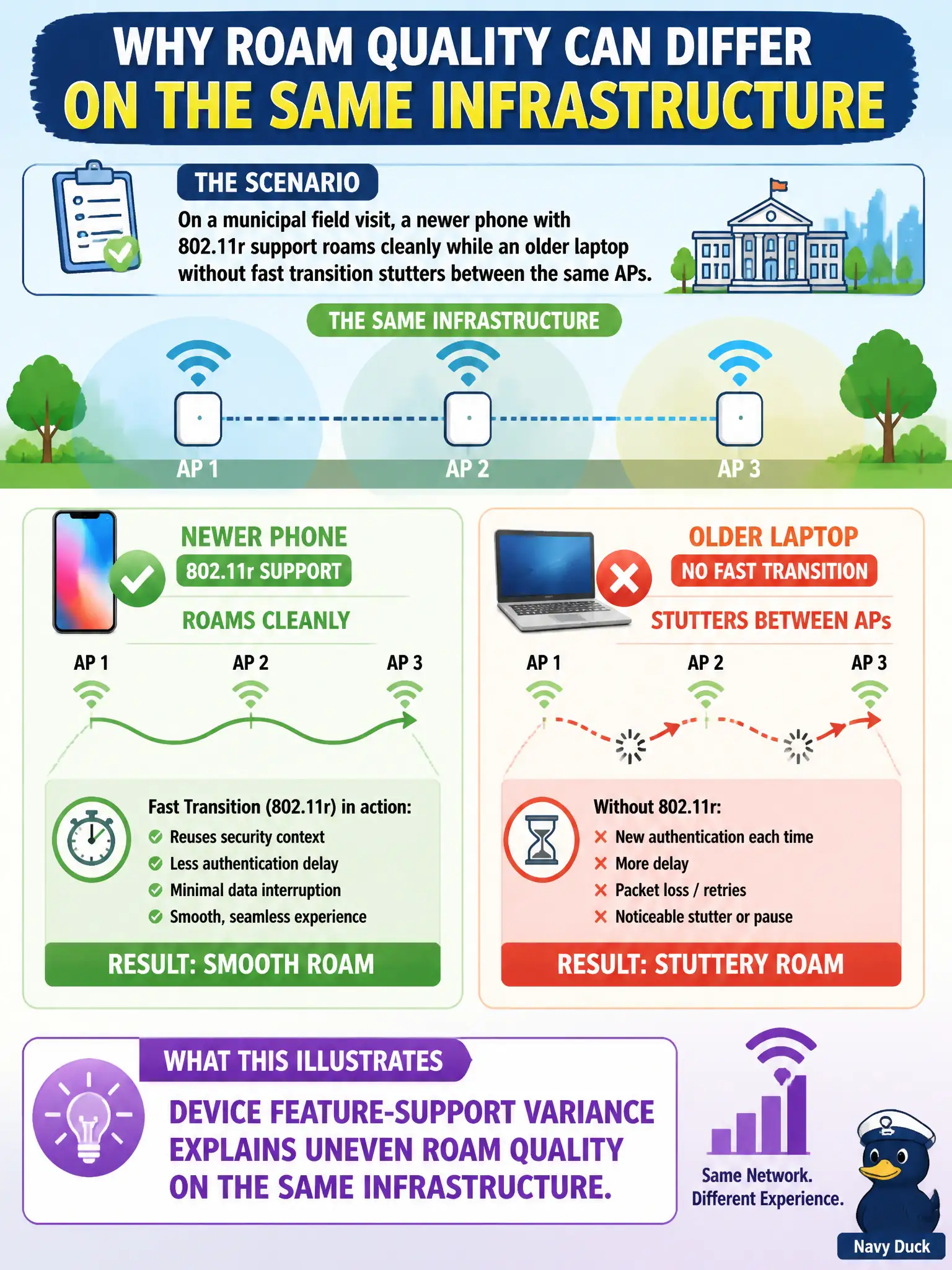
On a municipal field visit, a newer phone with 802.11r support roams cleanly while an older laptop without fast transition stutters between the same APs. What does this illustrate?
Select an answer to reveal the explanation.
Short Explanation
Same hallway, different NICs—phones with fast transition glide while legacy laptops hitch. Feature support variance is why mobility feels uneven. The SSID isn’t handing out different passwords by device type.
Full Explanation
On a municipal field visit where a newer phone with 802.11r support roams cleanly while an older laptop without fast transition stutters between the same APs, device feature-support variance explains uneven roam quality on the same infrastructure. Same SSID and APs do not equal same client capabilities. Technicians set expectations and prioritize upgrades for devices that need smooth mobility.
All devices on one SSID must exhibit identical roam timing regardless of NIC capabilities fails because NICs differ. Older laptops stuttering only because SSIDs broadcast different passphrases to phones versus PCs fails by concept: SSIDs do not issue different PSKs by OS family as described. Fast transition on a phone forcing every laptop on the VLAN to inherit 802.11r automatically fails: features are per-client.
Exam caveat: compare client capabilities before blaming the entire municipal WLAN for uneven roam.
Operational check: verify 802.11r (and related) support on each device; document which field units stutter; upgrade or replace incapable laptops used for mobile work; keep standards-based assists enabled for capable phones. Maintain a simple capability matrix for field devices (802.11r/k/v support yes/no) so uneven roam on the same APs is explained and remediated as client variance, not endless RF redesign.