
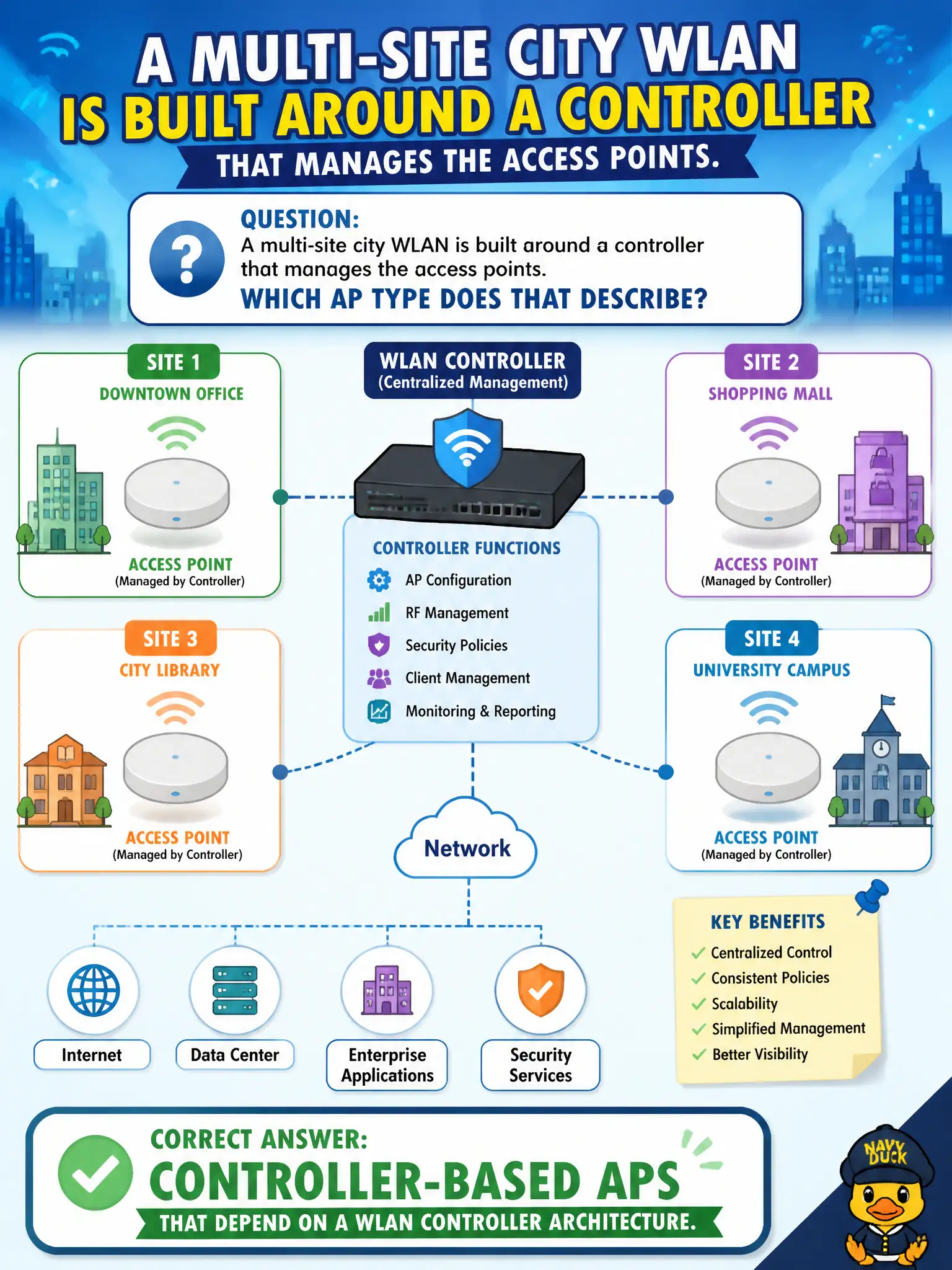
A multi-site city WLAN is built around a controller that manages the access points. Which AP type does that describe?
Select an answer to reveal the explanation.
Short Explanation
Controller-based APs are the workers that take orders from a central boss—the WLAN controller. Multi-site city gear often looks like that. Name the architecture; do not confuse it with a lonely closet AP that runs itself.
Full Explanation
A multi-site city WLAN built around a controller that manages the access points describes controller-based APs that depend on a WLAN controller architecture. In that model, lightweight or controller-dependent APs join the controller for configuration, RF coordination, and centralized policy across municipal buildings. Campuses commonly choose this architecture when many APs must share consistent SSIDs and coordinated radio management from a WLC.
Autonomous fat APs that never contact any central system contradict the controller-managed description in the stem. Outdoor bridge radios that only speak cellular backhaul are a different product class and do not define controller-based campus APs. USB travel routers that employees carry as personal hotspots are consumer client devices, not city controller-managed infrastructure APs.
Exam caveat: language that a controller manages the APs maps to controller-based architecture unless the stem explicitly says cloud or autonomous. Operational check: on a staging VLAN, confirm a new city AP discovers and joins the designated controller, receives the intended SSID set, and shows a joined status in the WLC dashboard before production mounting. Keep annex APs on the correct discovery VLAN and DHCP options so join remains reliable after power or WAN maintenance downtown.