
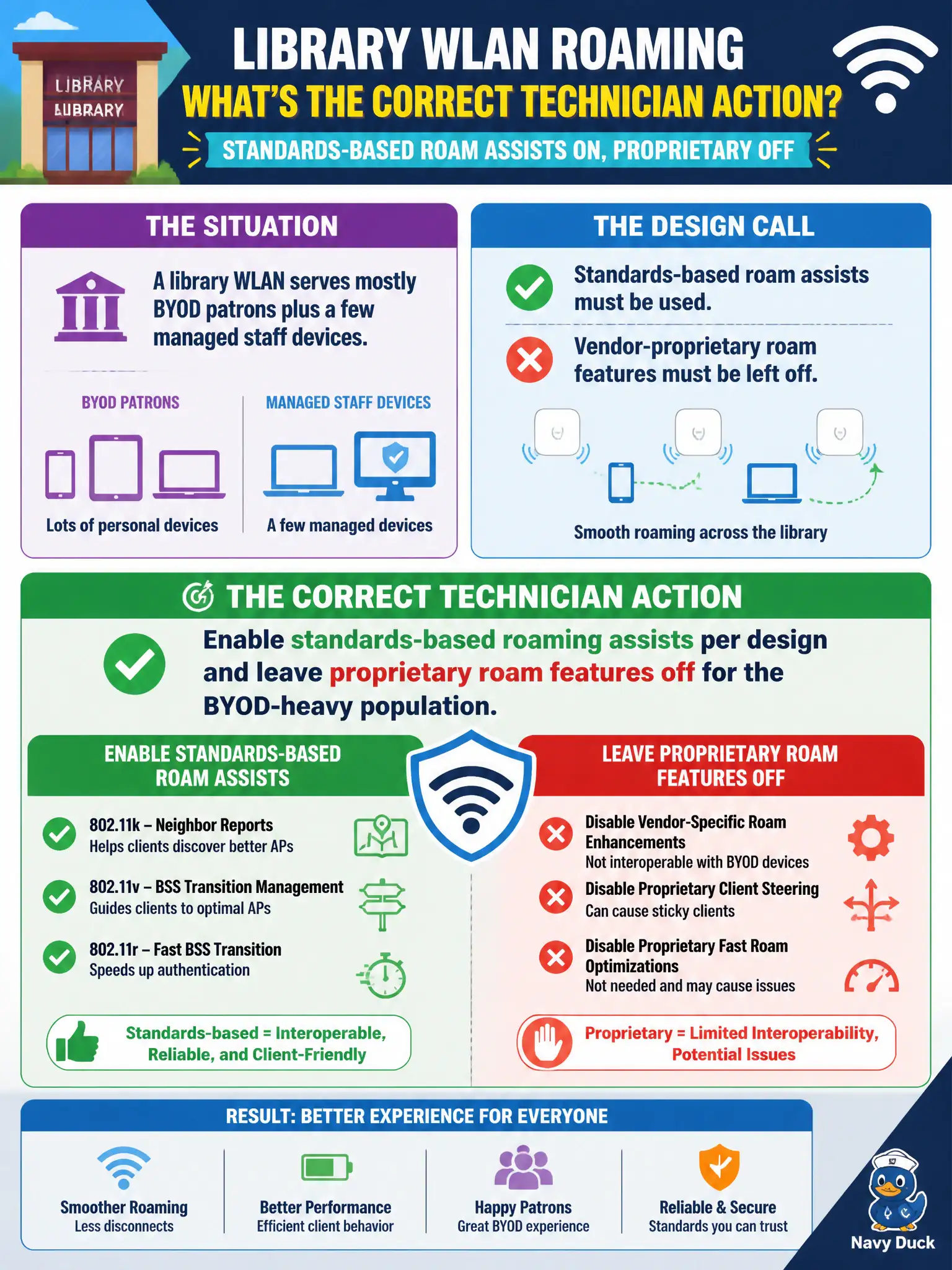
A library WLAN serves mostly BYOD patrons plus a few managed staff devices. Design calls for standards-based roam assists and leaving vendor-proprietary roam features off. What is the correct technician action?
Select an answer to reveal the explanation.
Short Explanation
BYOD crowds drink from the standards fountain, not the proprietary one. Follow the design: standards-based on, proprietary off. Open auth is not a mobility feature substitute.
Full Explanation
A library WLAN serving mostly BYOD patrons plus a few managed staff devices, with design calling for standards-based roam assists and proprietary roam features off, requires the technician to enable standards-based roaming assists per design and leave proprietary roam features off for the BYOD-heavy population. Design compliance matters in public venues. Proprietary helpers that patrons’ phones lack will not magically improve guest roam.
Enabling only proprietary roam features because BYOD phones always include every vendor extension fails because BYOD rarely includes proprietary AP extensions. Disabling all roaming-related features so every walk forces a full fresh association fails mobility quality and ignores the design. Replacing standards-based assists with open authentication to simplify mobility for guests fails security/segmentation goals for a library.
Exam caveat: BYOD-heavy civic WLANs follow standards-based roam designs; proprietary-only is a trap.
Operational check: enable 802.11k/v/r (as specified); disable proprietary roam assists; walk-test patron BYOD and staff devices; confirm design checkboxes match production. Re-check library production against the BYOD roam design after every controller upgrade so proprietary helpers do not get re-enabled by default templates meant for homogeneous corporate phones.