
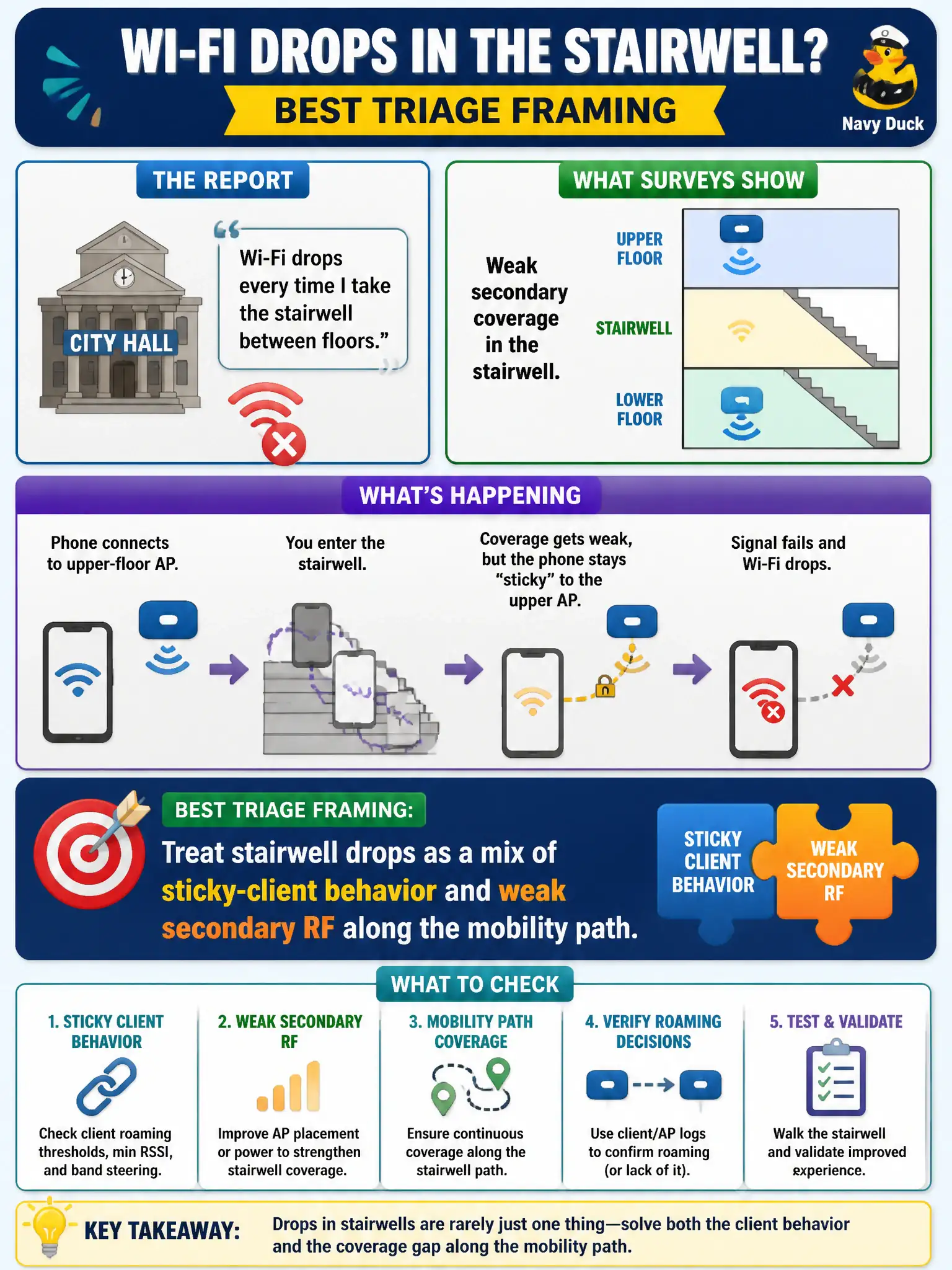
A city-hall employee says Wi-Fi drops every time they take the stairwell between floors. Surveys show weak secondary coverage in the stairwell and the phone often stays stuck on the upper-floor AP until it fails. What triage framing is best?
Select an answer to reveal the explanation.
Short Explanation
Stairwells are classic sticky-plus-coverage traps—phone clings upstairs until the signal dies in the shaft. Triage both stickiness and the weak secondary RF on the path. Don’t invent email-password causes for a roam drop.
Full Explanation
A city-hall employee whose Wi-Fi drops every time they take the stairwell between floors—with surveys showing weak secondary coverage in the stairwell and the phone often stuck on the upper-floor AP until it fails—should be triaged as a mix of sticky-client behavior and weak secondary RF along the mobility path. Stairwells are classic civic mobility gaps. Addressing both stickiness and coverage along the path is more accurate than single-cause dogma.
Assuming stairwells never need RF coverage because clients should use only Ethernet in stairs fails workplace reality for phones. Blaming only the user’s email password because mobility drops are always directory faults fails by concept: mid-stairwell drops with weak secondary RF are not mailbox passwords. Concluding WPA3 alone prevents any stairwell roam regardless of coverage or stickiness fails: WPA3 does not erase RF path requirements.
Exam caveat: mobility complaints in transitional spaces often combine stickiness + weak secondary coverage.
Operational check: survey stairwell SNR/secondary coverage; note sticky BSSID holds; adjust roam aggressiveness and escalate coverage for the stair path per process; retest floor-to-floor walks.