
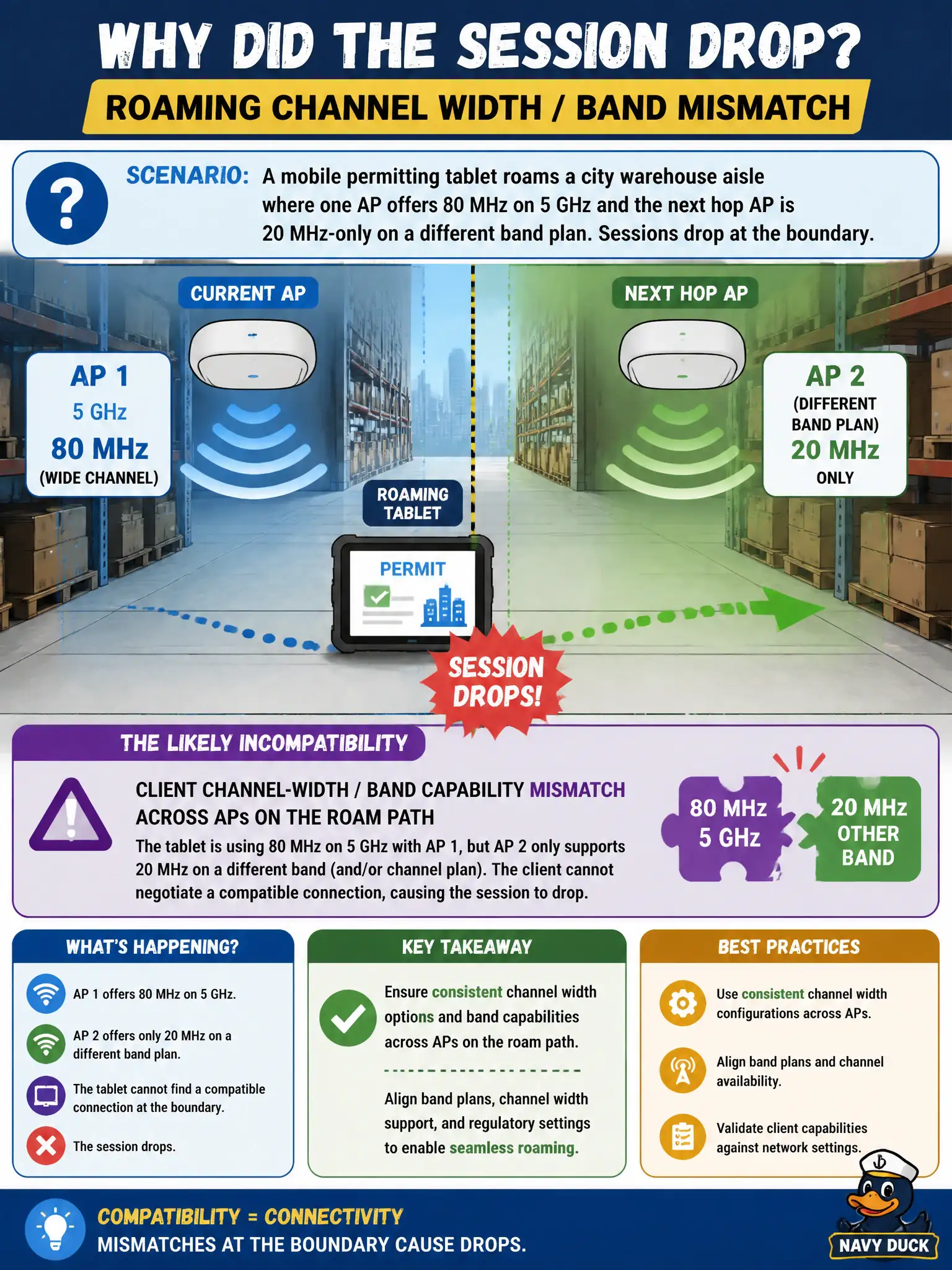
A mobile permitting tablet roams a city warehouse aisle where one AP offers 80 MHz on 5 GHz and the next hop AP is 20 MHz-only on a different band plan. Sessions drop at the boundary. What incompatibility is likely?
Select an answer to reveal the explanation.
Short Explanation
If hop A speaks wide 5 GHz channels and hop B doesn’t, the tablet can stumble at the seam. Capability mismatch along the roam path is a real mobility fault. Keep the path consistent with the design the client can actually use.
Full Explanation
A mobile permitting tablet that roams a city warehouse aisle where one AP offers 80 MHz on 5 GHz and the next hop is 20 MHz-only on a different band plan, with sessions dropping at the boundary, likely hits client channel-width/band capability mismatch across APs on the roam path. Roam paths need compatible PHY offerings the client can follow. Abrupt capability cliffs cause drops even when each AP alone looks fine.
All APs on a roam path always presenting identical channel-width and band capabilities by default fails because misaligned designs do occur—as in this aisle. Passphrase length must double at every AP boundary or the client intentionally drops fails by concept: PSK length does not change per AP hop. Roam-path capability differences only affecting wired Ethernet clients fails: this is a WLAN tablet roam issue.
Exam caveat: inconsistent AP capabilities along a mobility path can cause drops; design consistency matters.
Operational check: align warehouse APs to the design’s band/width plan along the aisle; retest tablet roam without session drops; avoid one-off 80 MHz islands next to 20 MHz-only hops without a plan. Warehouse mobility designs should specify consistent band and channel-width offerings along primary aisle roam paths so permitting tablets do not fall off a capability cliff between hops.