
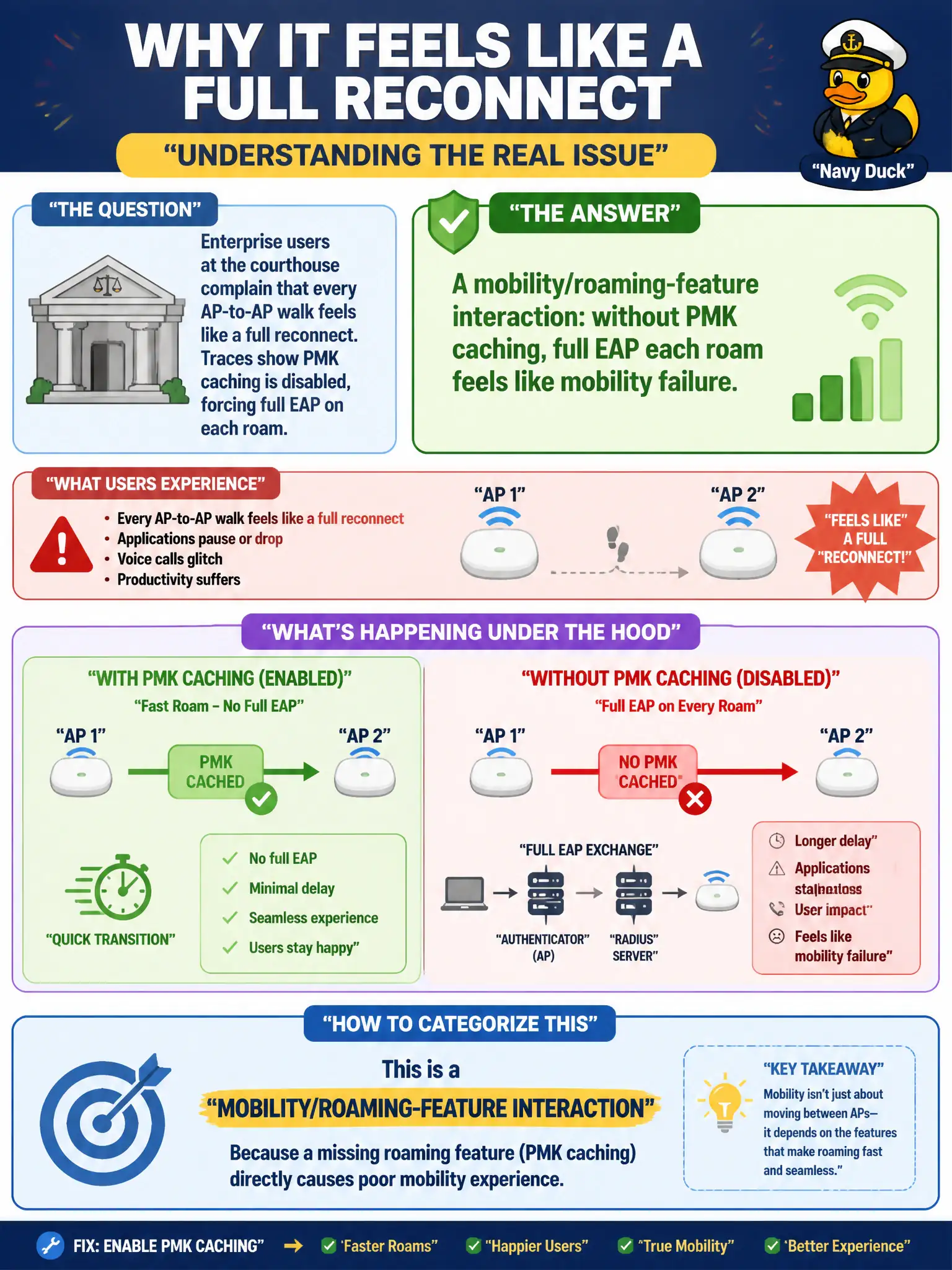
Enterprise users at the courthouse complain that every AP-to-AP walk feels like a full reconnect. Traces show PMK caching is disabled, forcing full EAP on each roam. How should this be categorized?
Select an answer to reveal the explanation.
Short Explanation
Full EAP on every hop is a long handshake—users feel it as a roam failure. PMK caching (when designed/enabled) shortens that pain. This is a roaming-feature problem, not a console-cable mystery.
Full Explanation
Enterprise users at the courthouse who feel every AP-to-AP walk is a full reconnect, with traces showing PMK caching disabled and forcing full EAP on each roam, should be categorized as a mobility/roaming-feature interaction: without PMK caching, full EAP each roam feels like mobility failure. Key caching features exist to shorten re-authentication during roam. Disabling them creates pain that looks like “Wi-Fi drops” to citizens and staff.
Proof that dBm is irrelevant and only DNS TTLs control how fast a client can roam fails by concept: DNS TTLs are not the roam key hierarchy. Expected behavior that cannot be improved by any roaming or key-caching feature fails because enabling PMK caching is specifically intended to improve this. A cabling pinout error on the console port of the wireless controller fails without evidence and mislabels an EAP/roam feature issue.
Exam caveat: full EAP every roam + PMK caching off ⇒ mobility feature configuration problem.
Operational check: enable PMK caching (and related design roam features) on the courthouse Enterprise SSID; retest hallway roam timing; confirm traces show cached/fast reauth rather than full EAP every hop; document the change.