
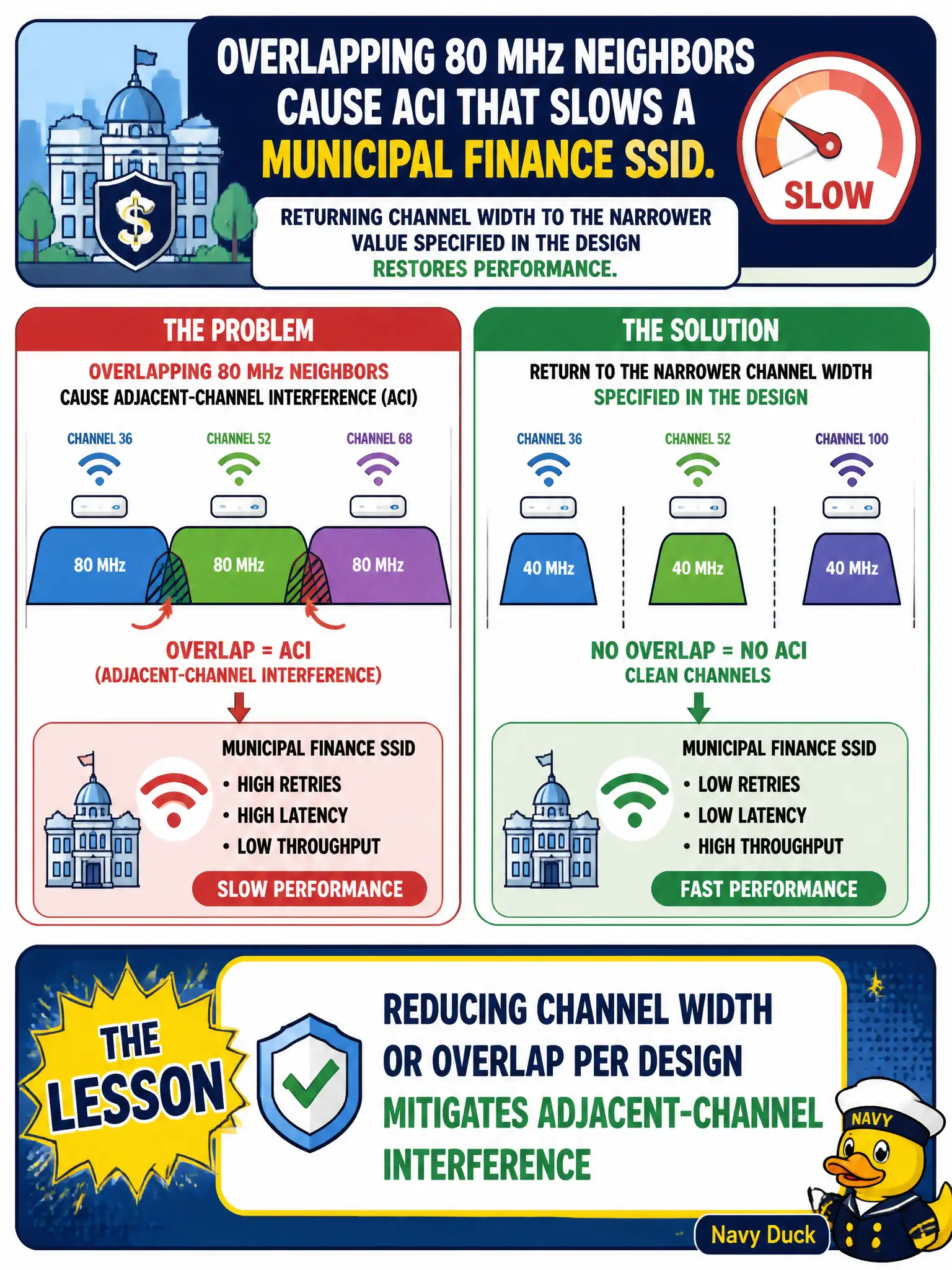
Overlapping 80 MHz neighbors cause ACI that slows a municipal finance SSID. Returning channel width to the narrower value specified in the design restores performance. What lesson applies?
Select an answer to reveal the explanation.
Short Explanation
Wide channels that overlap neighbors are messy watercolor bleed. Painting with a narrower brush—the design width—cleans up the ACI. Follow the design, and the finance SSID breathes again.
Full Explanation
Overlapping 80 MHz neighbors causing ACI that slows a municipal finance SSID, with performance restored after returning channel width to the narrower design value, teaches that reducing channel width or overlap per design mitigates adjacent-channel interference. Width is a controllable interference lever. Following the design doc is the technician action—not widening further.
Only widening to 160 MHz can cancel ACI between neighbors fails because widening usually increases overlap risk. ACI cured exclusively by disabling WMM on both BSSs fails by concept: WMM is QoS, not the primary ACI cure. Design widths being advisory and never affecting interference outcomes fails: the successful restore proved design width mattered.
Exam caveat: narrower/correct design width can be the ACI fix; “wider is always better” is a trap.
Operational check: set finance and neighbor SSID/AP widths to design; verify reduced retries and restored throughput; record the before/after; resist ad-hoc 160 MHz experiments in dense civic floors. Treat design channel widths as mandatory install settings in change control, and require a post-change ACI/utilization check when any finance-floor AP is widened for convenience.