
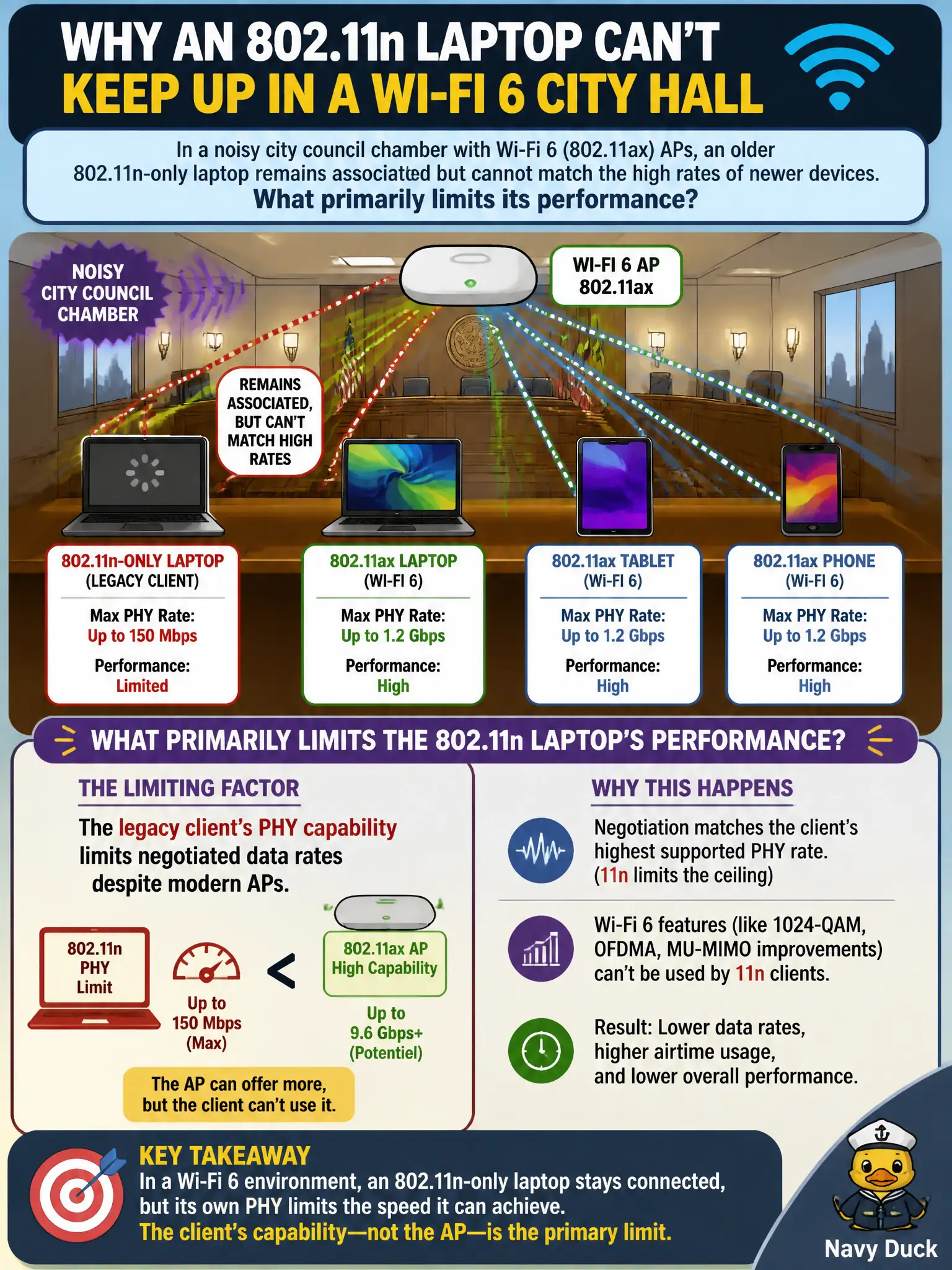
In a noisy city council chamber with Wi-Fi 6 (802.11ax) APs, an older 802.11n-only laptop remains associated but cannot match the high rates of newer devices. What primarily limits its performance?
Select an answer to reveal the explanation.
Short Explanation
A vintage n-only laptop in an ax room is still a vintage engine—the new highway does not add cylinders. Capability caps the rates no matter how fancy the APs are. Expect lower performance from that client or refresh the hardware.
Full Explanation
In a noisy city council chamber with Wi-Fi 6 (802.11ax) APs, an older 802.11n-only laptop that remains associated but cannot match high rates of newer devices is primarily limited by the legacy client’s PHY capability limiting negotiated data rates despite modern APs. APs negotiate down to what the client supports. Noise and modern BSS features cannot invent ax rates on an n-only NIC.
Ax APs refusing association from any n-capable client by default fails because the laptop remains associated; refusal is not the symptom. Council-chamber noise only affecting ax clients, never n clients, fails by concept and contradicts typical shared medium reality. PSK length forcing all n clients to Ethernet only invents a false security-to-PHY rule.
Exam caveat: AP generation ≠ client PHY ceiling. Associated legacy clients still rate-limit themselves.
Operational check: check the laptop’s Wi-Fi standard/MCS capabilities; compare negotiated rates to a Wi-Fi 6 peer at the same seat; upgrade the client hardware if council apps need higher rates; do not blame PSK length for PHY limits. Budget council-chamber client refreshes when ax APs are installed so public meetings are not gated by a few 802.11n-only laptops that cannot use the new PHY capacity.