
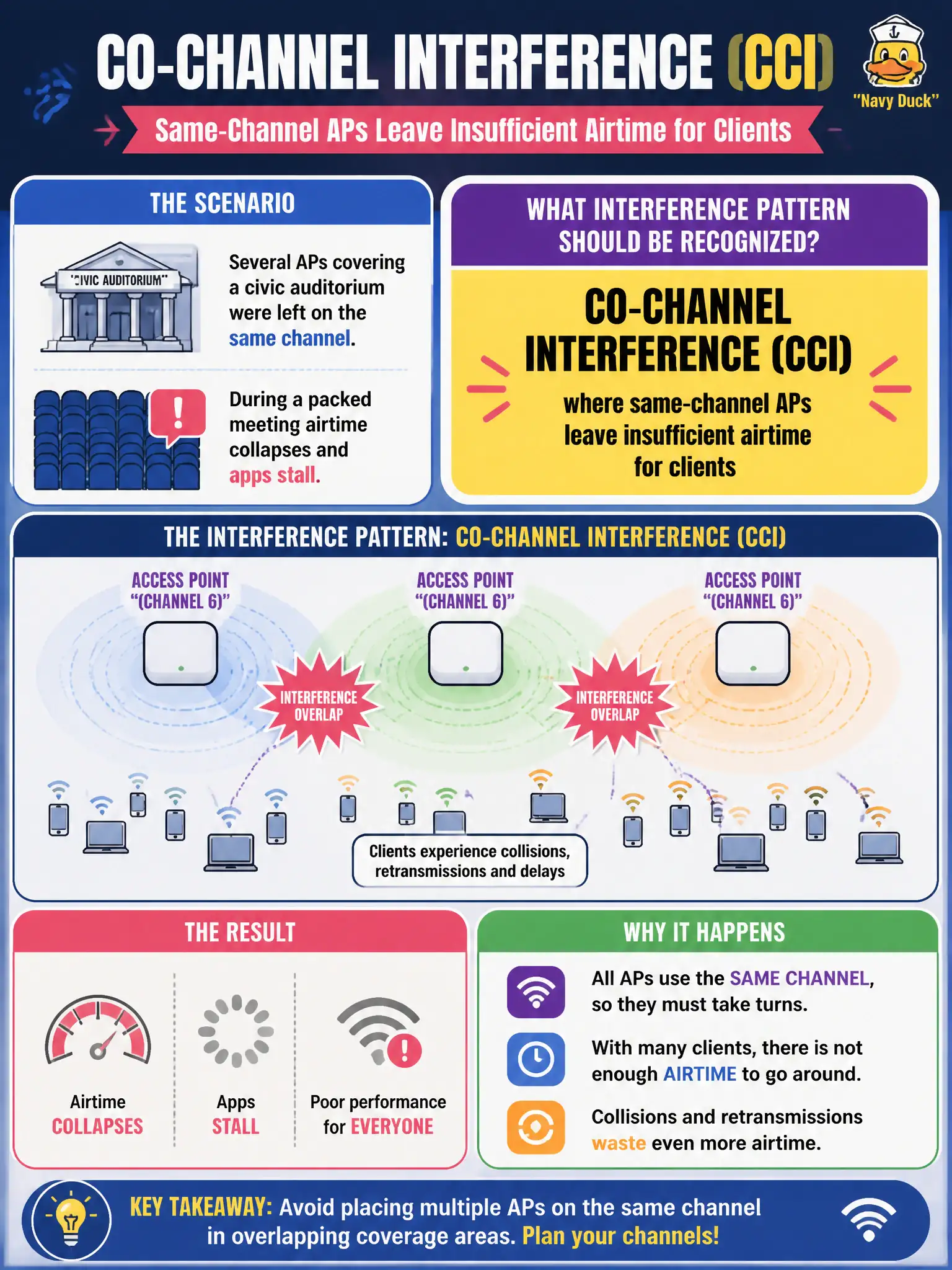
Several APs covering a civic auditorium were left on the same channel, and during a packed meeting airtime collapses and apps stall. What interference pattern should be recognized?
Select an answer to reveal the explanation.
Short Explanation
Many APs on one channel in a packed hall is a single crowded microphone line. Clients and APs keep waiting—classic CCI. Get channels diversified per design so airtime is usable again.
Full Explanation
Several APs covering a civic auditorium left on the same channel, with airtime collapsing and apps stalling during a packed meeting, should be recognized as co-channel interference (CCI) where same-channel APs leave insufficient airtime for clients. Dense client counts amplify CCI pain. Correct recognition leads to channel reuse correction per design, not driver myths.
Beneficial channel bonding that only appears in auditoriums fails as a description of harmful same-channel contention. ACI exclusively, because auditorium APs cannot share a channel by definition, fails by concept: they can share a channel—that is the problem—and that problem is CCI. A driver signing block that mimics multi-AP contention fails without driver evidence and ignores the same-channel configuration.
Exam caveat: multiple APs, one channel, packed venue, airtime collapse ⇒ CCI.
Operational check: inventory auditorium AP channels; assign non-overlapping channels per design; retest during a load event or simulated load; document CCI remediation in the venue runbook. Before large civic meetings, verify auditorium AP channels are unique per the venue plan and run a short airtime/utilization sample with a representative client density if possible.